Was that really a bird I heard singing outside my window in dawn’s twilight, before I was quite awake? Now that we are past halfway between Winter Solstice and the Spring Equinox, we can feel the days lengthening as they melt, one into another. Soon enough, the birds will be awakening me closer to five, inviting me outside to join them. This morning it seemed all too early, a little before seven.
Last Friday, when it was still January, Tony Tomeo’s gift of California plants arrived in the mail. He filled a large Flat Rate USPS box with close to 100 rhizomes and divisions in leaf. I spent much of the day last Saturday in my basement work room potting them up, and finished the job on Monday afternoon. It gave me a nice opportunity to go and visit with the family who runs our local nursery as I picked up a few large pots for the generous Kahili ginger roots, Hedychium gardnerianum, and a few more bags of organic potting soil.
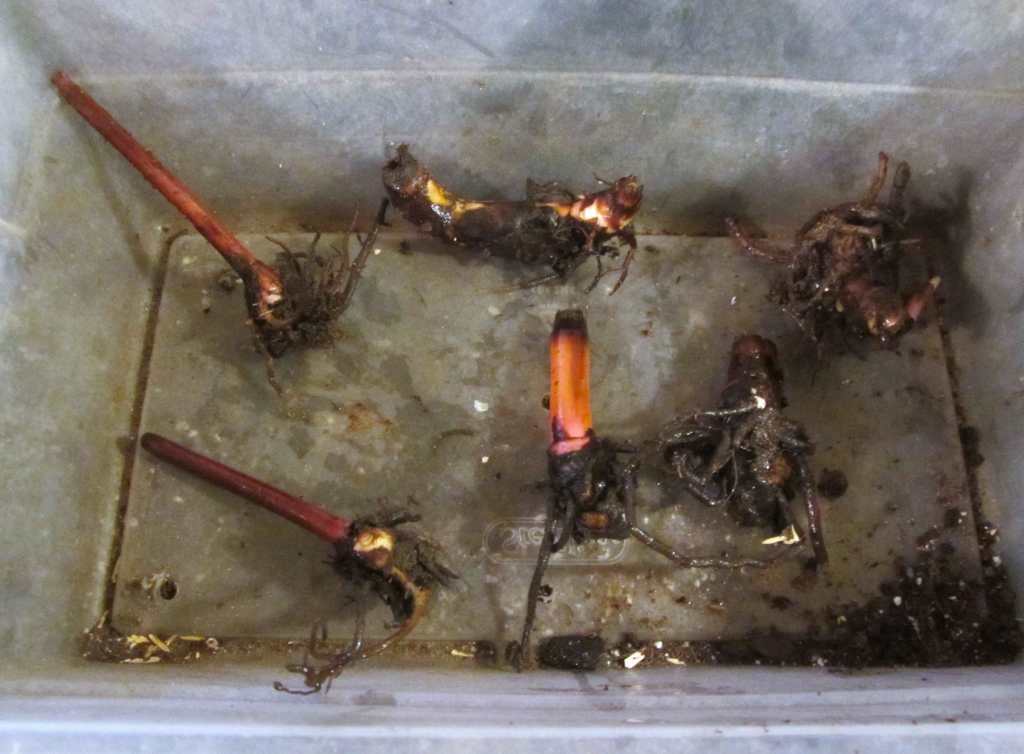
I must apologize to Tony for not getting better photos of the beautiful plants he sent before potting them. I photographed the first bundle (of many) that I opened. These are some of the Canna australia bits that he used to help fill the box to protect the much larger plants underneath. There were around two dozen by the time I had them potted up. He also sent a beautiful ornamental sugar cane, ‘Pele’s Smoke,’ two varieties of Heliconia, including ‘Fire and Ice,’ which should be hardy here, some Siamese culinary ginger, Alpinia galanga, and several varieties of ornamental ginger lily, Hedychium ssp. As I opened bundle after bundle of plants I became totally engrossed in enjoying their beauty, finding appropriately sized pots for them, and getting them potted and watered before they were too shocked from being out from their snug wrappings.
The plants had actually begun to grow new white roots and plump new buds from their rhizomes in transit. They all survived their transcontinental trip, and are all snugged into pots to keep growing roots as they await warmer weather to head outside. What a beautiful gift!
The weather between California and Virginia was cold enough in January that I asked Tony to hold onto the plants until we had a reasonable window for their travel. We finally got our window in the last full week of January, and it was in the mid-50s and sunny here the day they arrived. The days or lengthening now, and more plants are showing signs of approaching spring. But it remains cold enough to enjoy sweaters, socks, and to keep the gas logs burning. And still, no snow for Coastal Virginia.
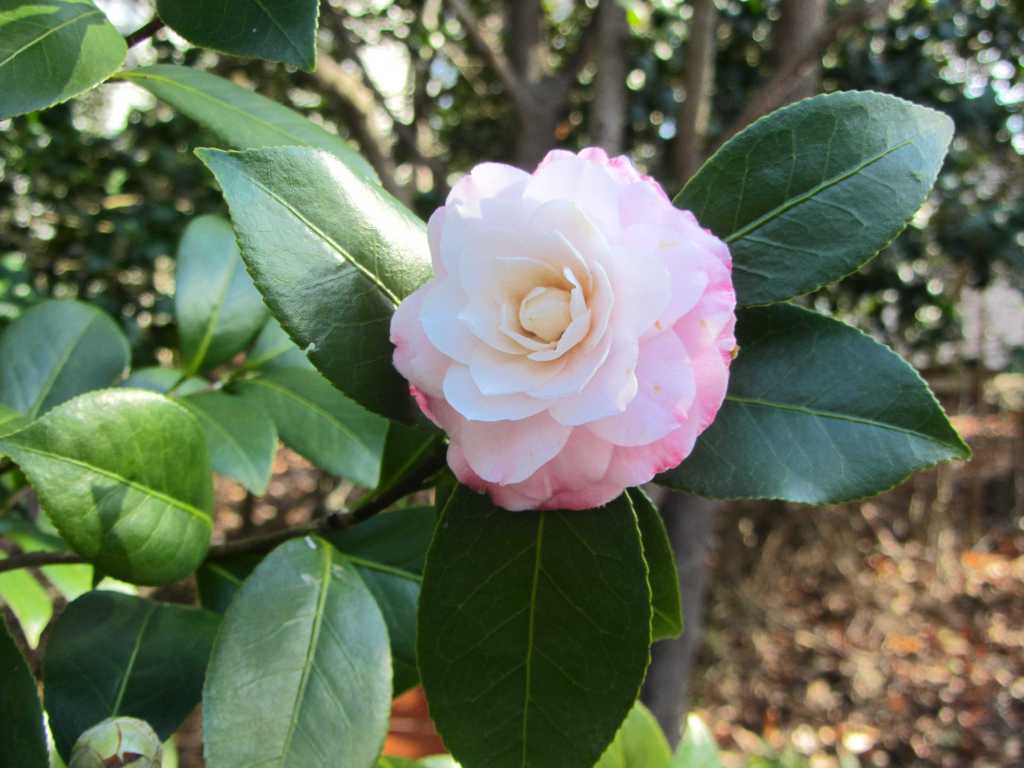
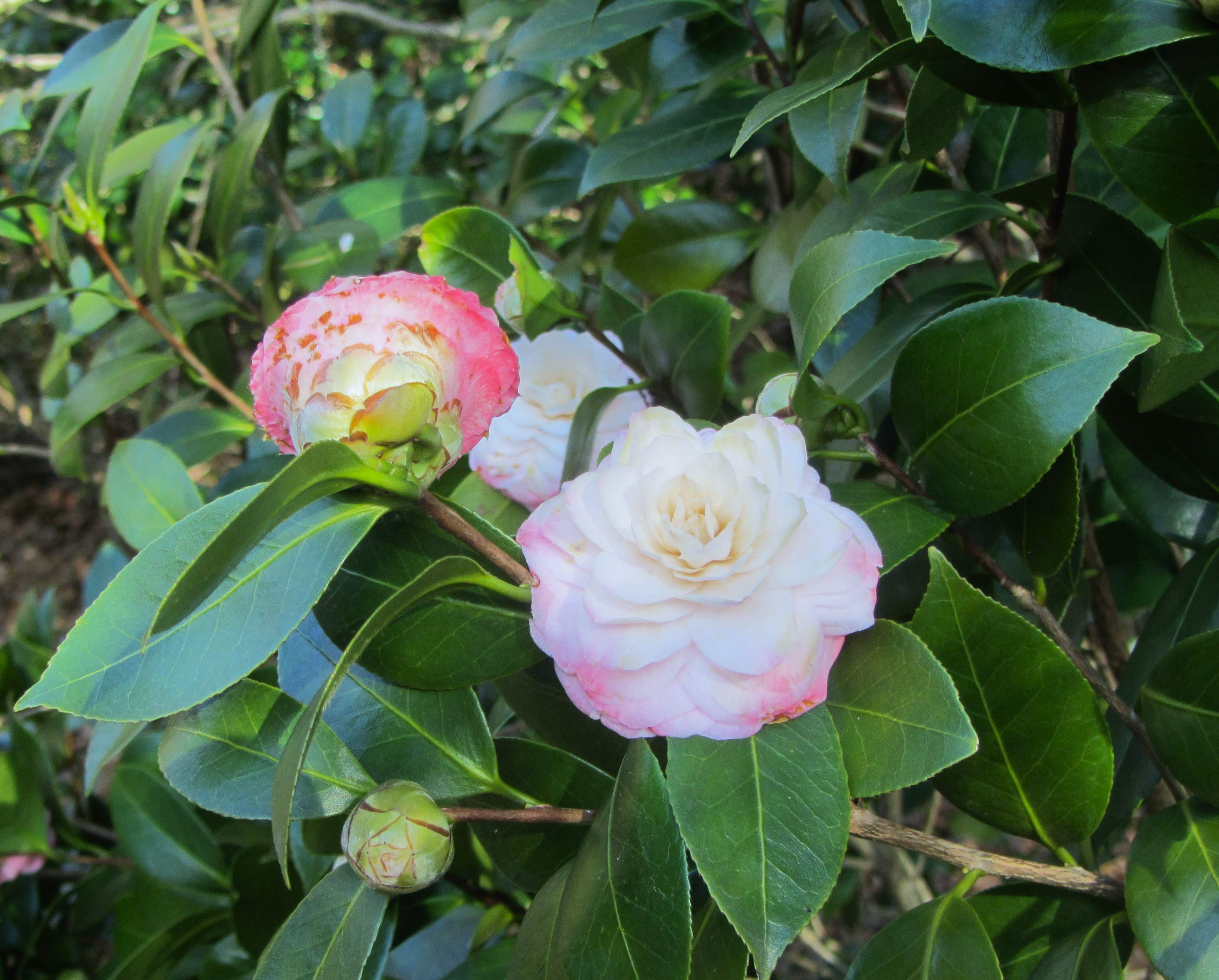
I was delighted to find one of our favorite Camellia japonica shrubs beginning to bloom yesterday as I walked a full circuit around the house and garden. C. ‘Nuccio’s Pearl‘ is one of the most delicate and elegant Camellias, and a few of the early flowers show signs that they were nipped by the cold in bud.
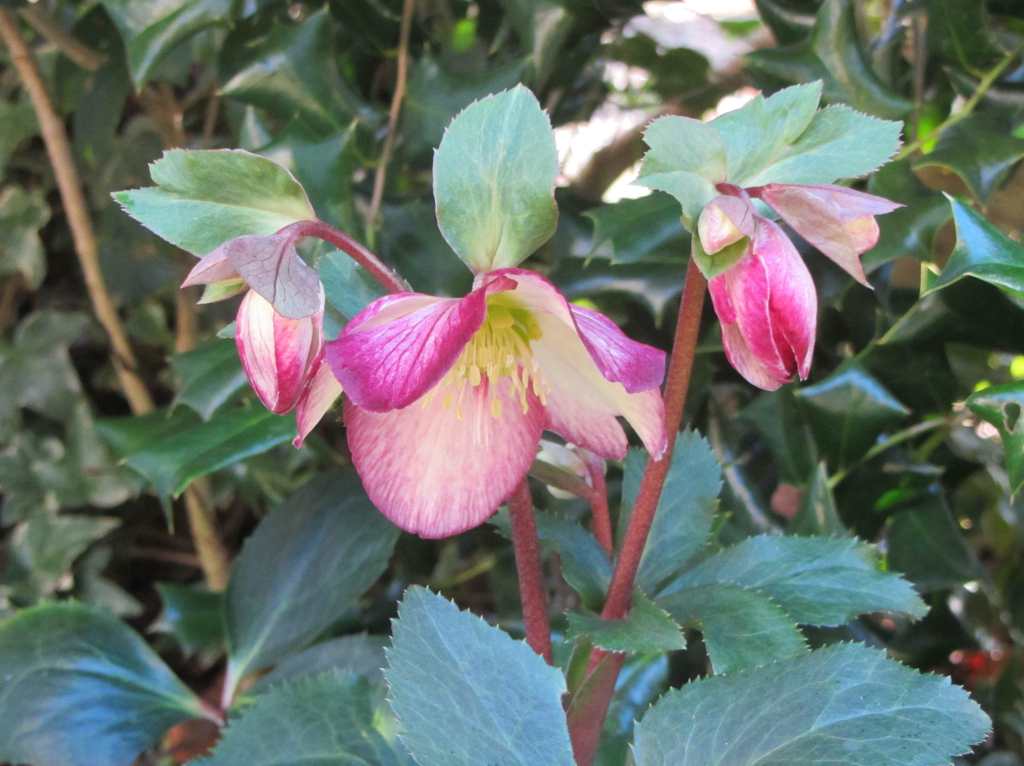
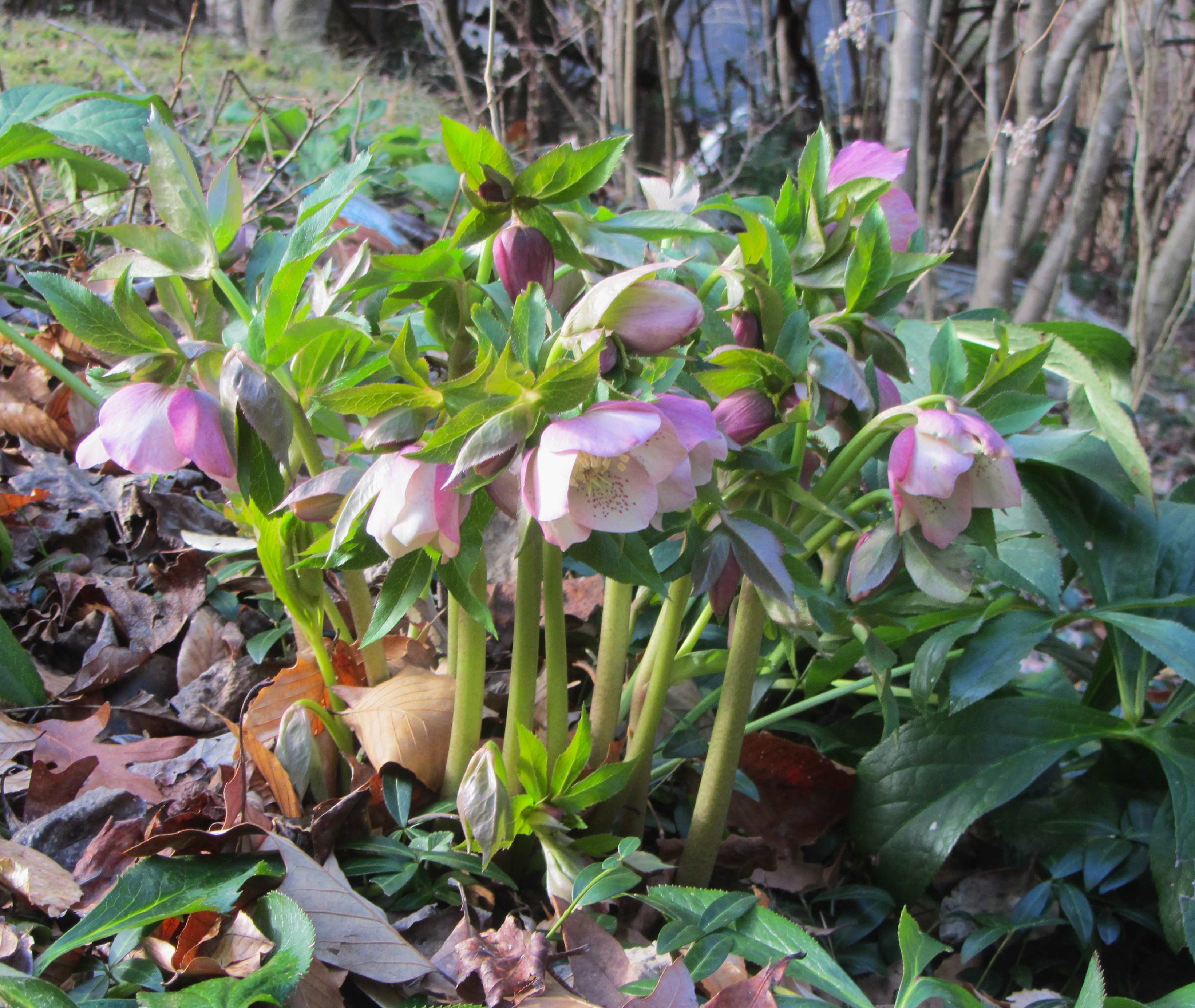
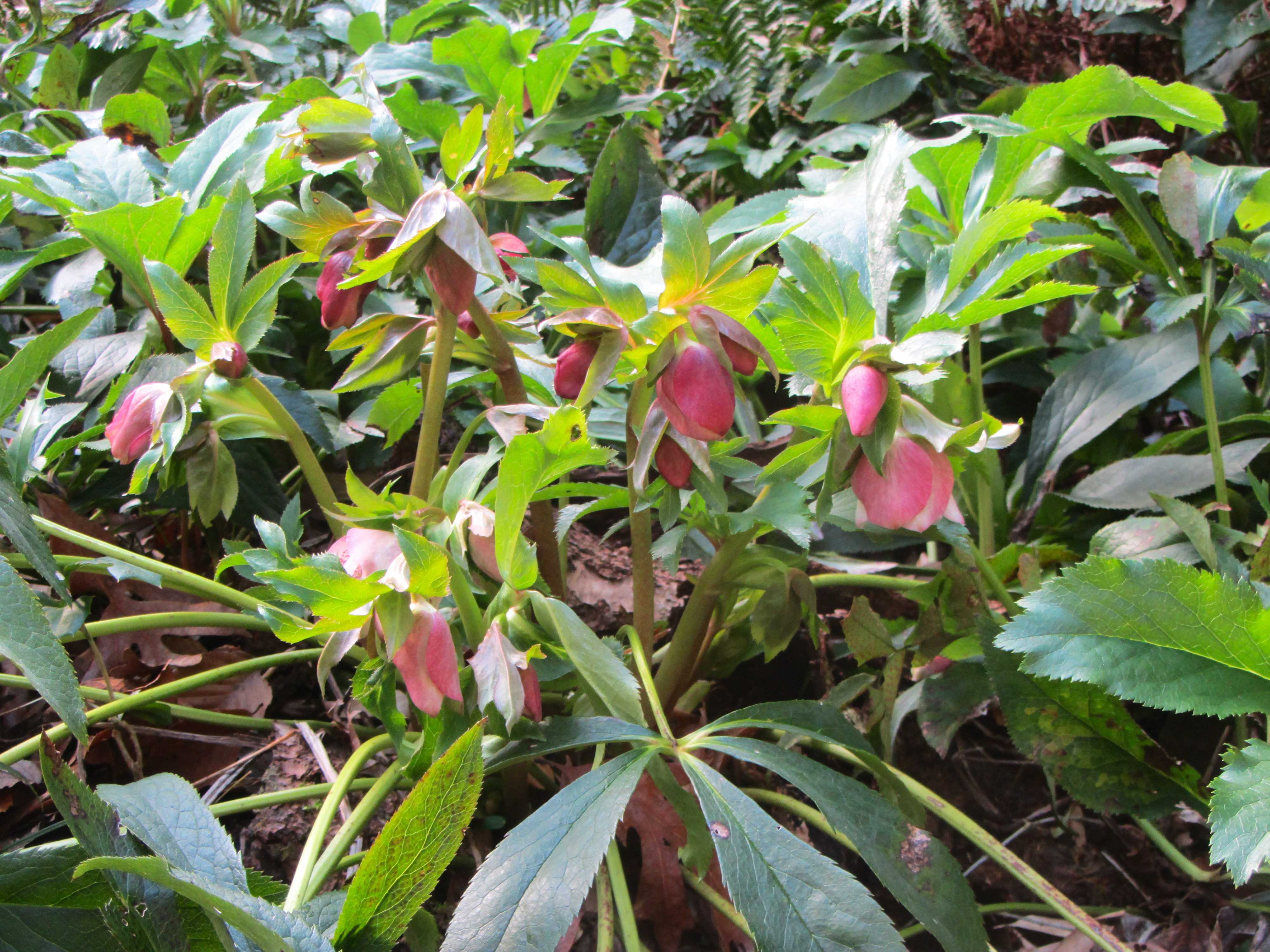
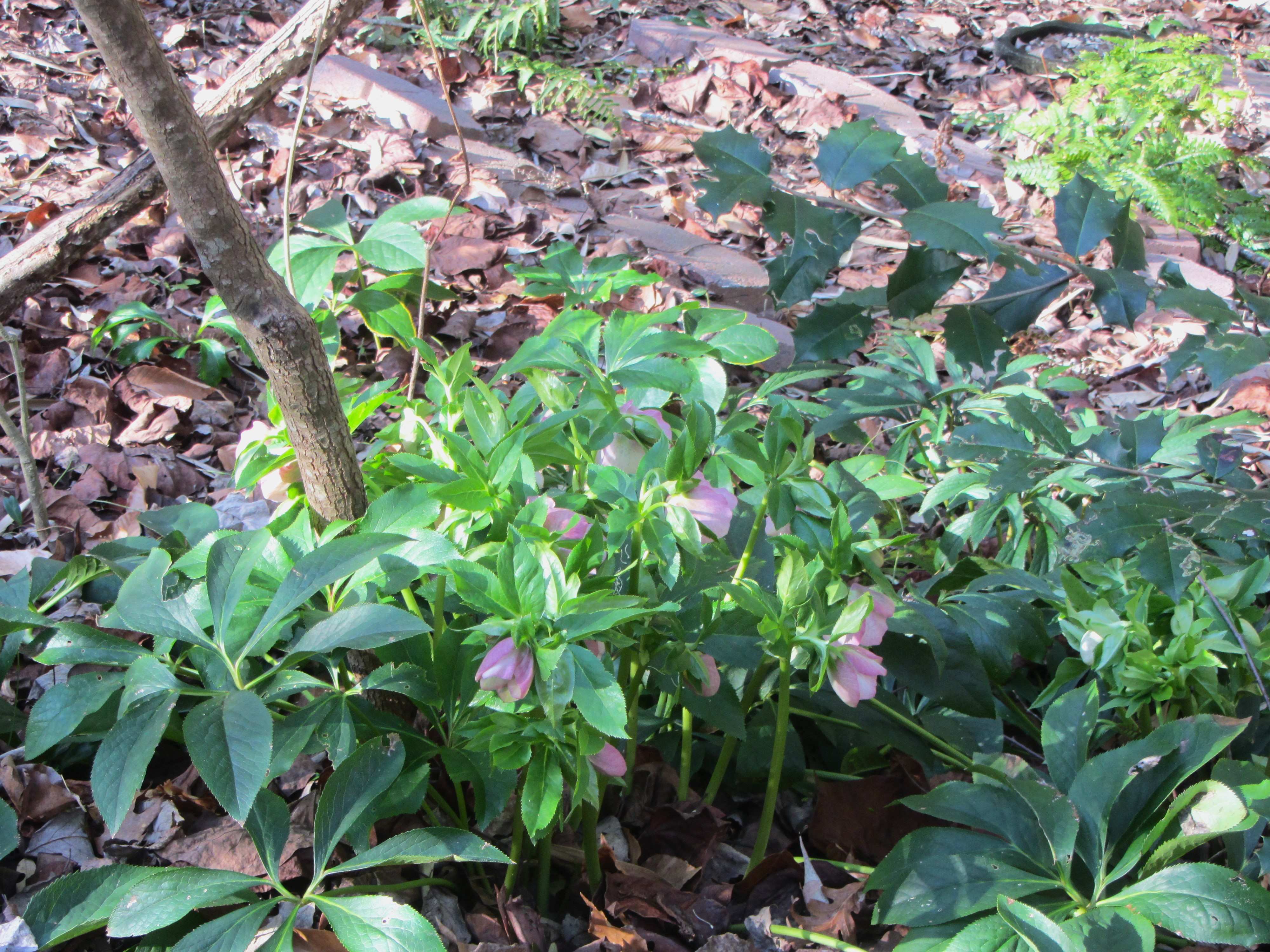
The hellebores are growing very quickly now, with a few new ones showing buds and blooms each week. They are at that point where I need to devote a few hours to tidying them all up by removing their older leaves. I always delay taking those old leaves away because they are still feeding the plant. But removing them shows the new flowers and foliage to much better advantage.
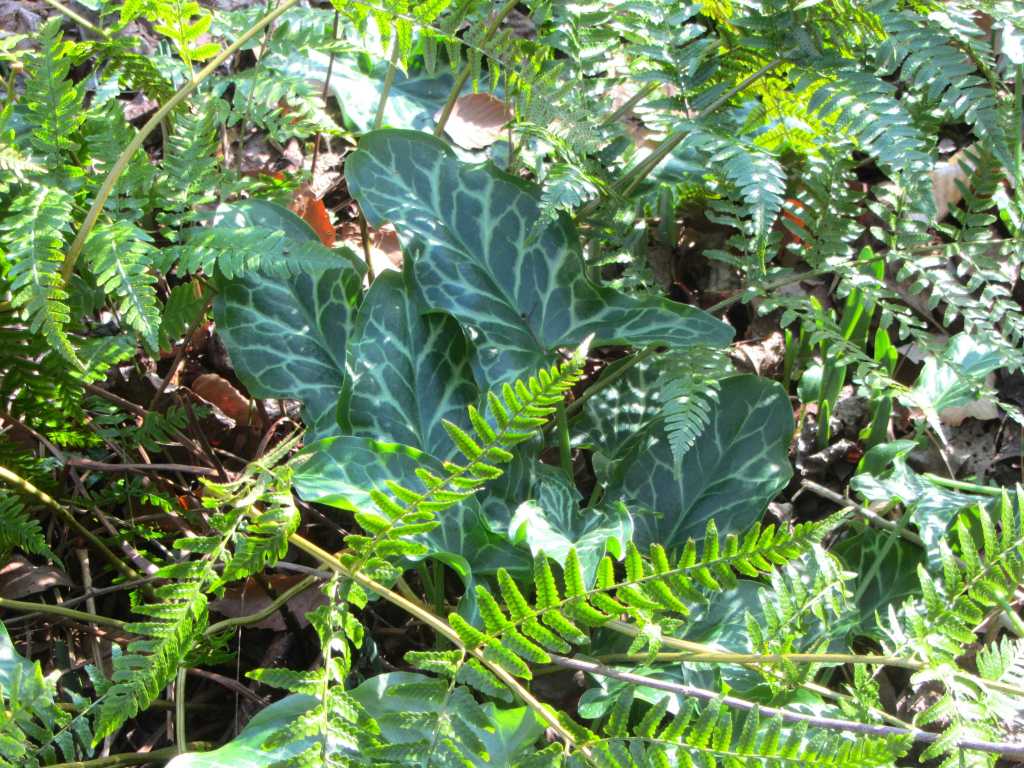
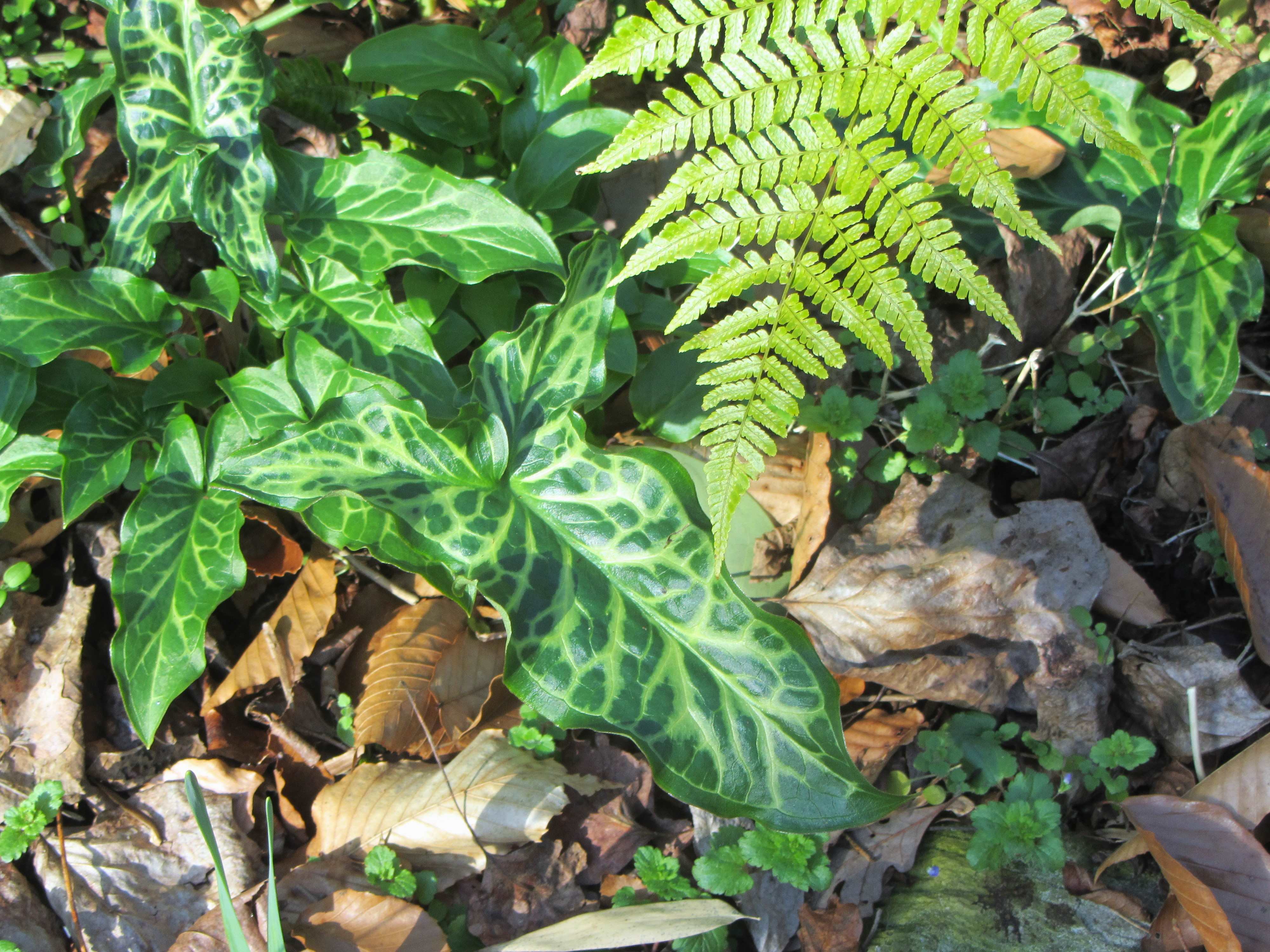
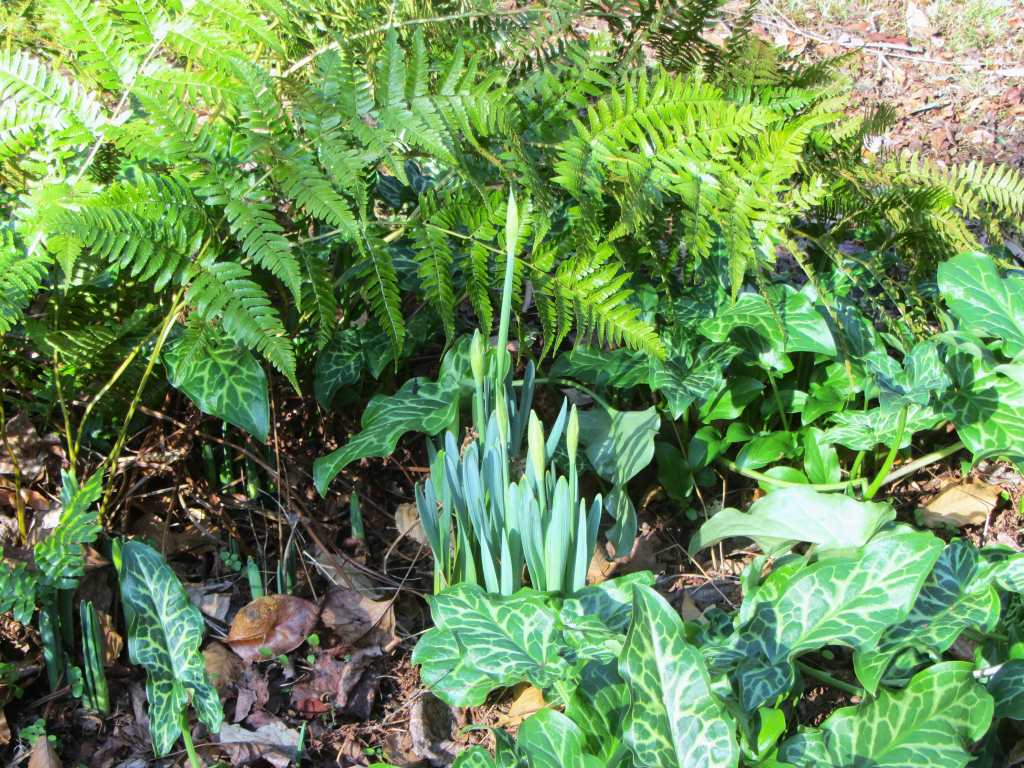
More daffodils emerge each day, too. And I find it very interesting that the Arum emerges slowly, over a long season. Some plants have been in leaf since November at least, and others are just now emerging. Perhaps it has to do with the age of the plant, but I am always delighted to find new clumps emerging. Mine are Arum italicum ‘Marmoratum,’ because I ordered the starts from our local bulb dealer in nearby Gloucester. But I am very tempted by some of the new offerings on the market. I just love that these plants are at their best while most of the garden is dormant through the winter.
This week I also received the newest issue of the Hardy Fern Foundation’s Winter Quarterly. They published my article about raising baby ferns from spores to sporelings. But I was most interested by an article written by Joan Eiger Gottlieb, who raises ferns in the Northeastern United States. She responded to my earlier article about using evergreen ferns to sequester carbon to mitigate climate change, and went into more depth about Earth’s geologic and climatological history in terms of the interplay between climate and the evolution of different types of plants. She elegantly made the point that every plant helps sequester carbon, that evergreen plants do it most efficiently, and that while ferns are relatively small, certainly smaller than trees, they still make a significant contribution. She added an exhaustive list of more than 30 evergreen ferns that she grows in Zones 5-6.
I found her list so interesting because my own list of evergreen ferns that thrive in our area is far more modest. But I have learned, through trial and too many errors, that whether or not a fern thrives in a particular spot depends on the chemistry of the soil, the intensity of the light, the moisture in the air, the range of temperatures, and whether or not it gets regular irrigation. I an grateful to have found a few ferns that perform well through the winter here and also survive the worst of our summer weather. My favorite of them all for both beauty and toughness is still Dryopteris erythrosora, ‘Brilliance.’
We learn so much through trial and error. Some say that the errors teach us best, but I still prefer the successes. Now I have a whole range of new plants to trial this coming season to see which will thrive here in Virginia. Since our weather continues to warm, I feel confident that most of the ‘tropical’ plants that Tony Tomeo shared with me will prosper here. But as he has to protect plants from the gophers, we have voles, rabbits and deer. I will need to keep these starts well protected until I can learn more about them.
With appreciation to Jim Stephens of Garden Ruminations, who
hosts Six on Saturday each week.

 Our Forest Garden
How lucky you are to have received such a lovely gift! This is a generous and kind gift from Tony. Concerning ornamental sugar cane: have you already tried it until now? I want to give it a try, ornemental or not.
LikeLiked by 1 person
Sugar cane doesn’t normally grow in our region, and none of the nurseries offer it. So no, I haven’t tried it. It is a large grass and is said to somewhat resemble Pampas Grass. This one is a pretty one, but also edible. Yes, I feel extremely blessed by Tony’s gift of plants! ❤ ❤ ❤
LikeLiked by 1 person
Even in Los Angeles, I have never seen sugarcane in a nursery. When Brent found this, it was an oddity, likely because it is an ornamental. Those who want to grow sugarcane typically grow it from a cane that they get from a friend or neighbor, or even from a vacant lot.
LikeLiked by 1 person
Are you in France, or someplace where I could send some cuttings to? The sugarcane is only beginning to grow, but there may be a few more of them than I want here, and I really do not want to plant many of them. They stand a bit taller than wide, and do not bloom like pampas grass, but their grassy leaves can cause paper cuts like pampas grass.
LikeLiked by 1 person
That’s very kind of you, but I’m pretty sure the cuttings will be stuck at customs. Yes I am in France. Receiving seeds from the UK or the US or elsewhere remains complicated, with some parcels getting stuck or lost… I’m going to look for a local seller because I saw that they sell them in the south of France, it will be easier. Thanks anyway .
LikeLiked by 2 people
This is a new species for me. I do not know what to expect. I believe that, after it dies to the ground for winter, it regenerates in spring; but I really do not know. I also believe that if it were easy to grow here, it would be more popular here. I have never seen it, and am aware of only a few who grow it. It is more common in the Los Angeles region. When I go to Los Angeles early this spring, I would like to find an agricultural cultivar that is more productive than this ornamental cultivar.
LikeLiked by 2 people
What a lovely package to receive.
LikeLiked by 1 person
Lovely Camellia. Enjoy your fabulous garden gift! 🌿
LikeLiked by 1 person
Thank you, Sarah ❤ ❤ ❤
LikeLiked by 1 person
Beautiful photographs! Spring is on the way and there are so many gardening tasks to complete.
LikeLiked by 1 person
Thanks so much. Spring is on the way, but I’m still not ready to sharpen those pruners and get busy outside! It won’t be much longer, though ❤ ❤ ❤
LikeLike
The Hardy Fern Foundation was not an organisation I had heard of and is another rabbit hole full of good information. The first article I looked at about was about fossilised ferns in Glasgow! There is just so much interesting “stuff” on the internet, one lifetime isn’t enough to take it in.
On a different note, I was reflecting on whether when Camellias were introduced to ‘the West’, anyone had seen anything like them before. The bicolors, the perfectly symetrical formal doubles like ‘Nuccios Pearl’. I suppose striped tulips were earlier and might have prepared them a bit.
LikeLiked by 1 person
Hi Jim,
The HFF is an international organization. They offer multiple Zoom seminars each year, and those are taped and available later to members. A particularly good one in recent months was exploring the ferns of the Canary Islands. It seems that several active members are also members of the equivalent organization for fern lovers in Great Britain. The content on the website, in the Quarterlies, and in the online presentations is always interesting and different. I recently read about the centuries long history of Camellias in China, Japan, and other nearby areas that preceded their introduction in Europe. It leads one to wonder how sophisticated Asian gardeners were to select and hybridize flowering plants well before European scientists understood hybridization. From what I’ve read about the history of gardening in Europe, the Camellias and their perfect little flowers was something totally new at the time. So many plants were pouring into Europe from all over the world from the time of the Crusades, on- but nothing like the Camellia shrubs. And of course, as you know, the Europeans, and later Americans/Colonists, were after the tea species, not the ornamental species in those early years. The striped tulip in those days were something of a mystery, and so highly prized for their colors and patterns. I’m not certain that even rose culture had developed rose cultivars to the point of sophistication in flower form and color, that was found in the flowers of imported Camellias. I love how long of a season we have now with the various Camellias in our yard. Hope you have a great week!
LikeLike
Lovely pictures and what an exciting parcel to receive
LikeLiked by 1 person
Yes, it was! I love this time of year when the winter flowers begin to open, promising that spring is on the way! ❤ ❤ ❤
LikeLiked by 1 person
100 rhizomes?! Goodness, I had no idea. I was more concerned that there were not much of each type. Because I acquired most of them only recently, they had not grown enough to spare more bits, and that kahili ginger had been eaten by gophers. None of them have gotten frosted yet here, and I doubt that they will. I will cut them back regardless. They could start growing at any time.
LikeLiked by 1 person
They are all beautiful, Tony, and I appreciate them. I will have enough to share, as I already shared with a neighbor, and make a lot of folks happy with your gift from the West Coast. I can’t wait to see what they do here in Virginia, and there will be more photos as they begin to grow out.
LikeLiked by 1 person
I want to see what galangal does. I have never grown it before. I only brought it back from Los Angeles because it was there when I was grabbing unfamiliar goodies. I am unimpressed by pictures of the bloom, but I want to try the rhizome as an alternative to common ginger. So far, my favorite ginger is the white butterfly ginger that you sent, but that does not mean that I can not try others.
LikeLiked by 1 person
I haven’t met a ginger that I didn’t like! The white butterfly is hardy here, and my impression has been that many Hedychium and culinary ginger, and related plants like Tumeric, are more tropical. But local plant dealers sell a wider variety. I am willing to give them a try. If in pots, I can bring them inside when it gets too cold, as I do for other tropicals that I grow. But I’m very curious to see how well they do! I like the leaf of galangal- very elegant. Sometimes the foliage is better than the flowers, and that is OK too.
LikeLiked by 1 person
Technically, Canna are tropical also; but because they live in the Andes, and are experienced with frost, they can live in Oklahoma and the Pacific Northwest without shelter from frost. They simply die back after frost, and regenerate in the spring. The only unpleasantry that I encounter with this sort of tropical is that, because they do not understand what seasons are, they try to grow immediately after frost, so that they can get damaged again. In the 1980s, while still in school, I was told that kahili ginger would not live here. I later found that it can actually be a bit too vigorous here.
LikeLiked by 1 person
That is probably one of many things we were told ‘in school’ that life proved to be untrue! The unpleasantness I experience with both Cannas and Hedychium is that if I leave them standing until a hard frost, they become very unpleasant to handle. I cut my Cannas this year, but didn’t get to all of the gingers. I noticed the unsightly ginger remains yesterday in areas where bulbs are trying to emerge, and I plan to clean them up on our next warmish day. The other thing, of course, is that as the climate shifts we have the opportunity to grow more plants that normally wouldn’t survive the former colder weather. We still haven’t had any snow accumulate this winter, and only relatively light frosts. I left a Colocasia in a container in a sheltered location near the house just to see whether it will come back in spring. Its foliage lasted deep into December and I hope it regenerates when the weather warms. If not, its siblings are in my basement. Enjoy the day!
LikeLiked by 1 person
My perennials are doing the opposite. Most of the Canna here (in a cool spot) frosted, but those in the landscapes did not. I do not like to cut them back while they are still green, but I also do not want the new growth coming up and mixing with the old growth. The gingers still have not frosted! So far, only the kahili ginger is growing, and it is not so crowded that it will be difficult to cut out the old canes. The galangal actually looks quite pretty, since the foliage looks like it did last summer.
LikeLiked by 1 person