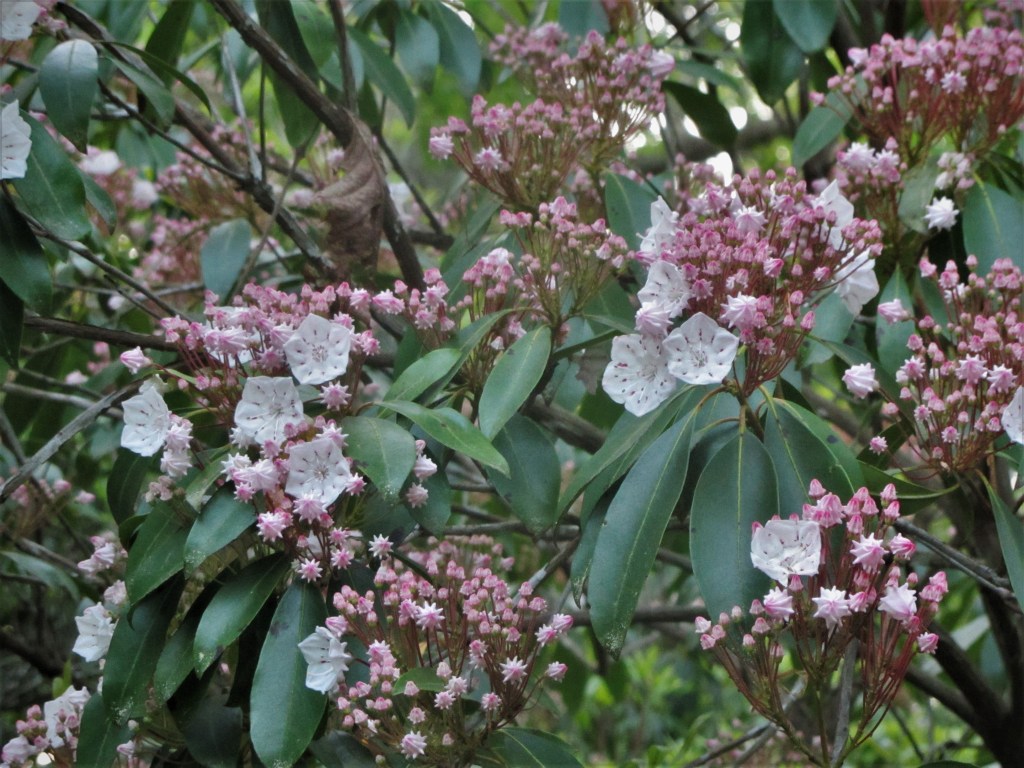
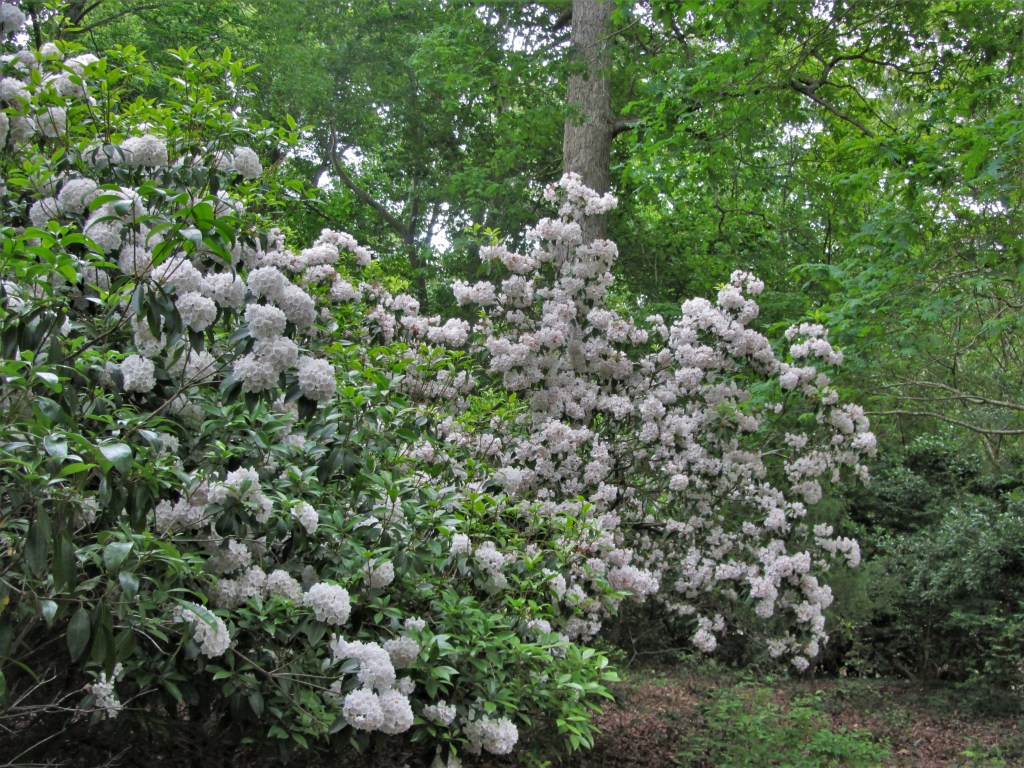
I love finding mountain laurel growing in large, lovely masses in the wild. Its creamy pink flowers glow softly in the forest. Wild mountain laurel, Kalmia latifolia, sometimes covers the undeveloped banks of creeks and rivers in Eastern Virginia. It grows as an understory shrub in our oak and pine forests.
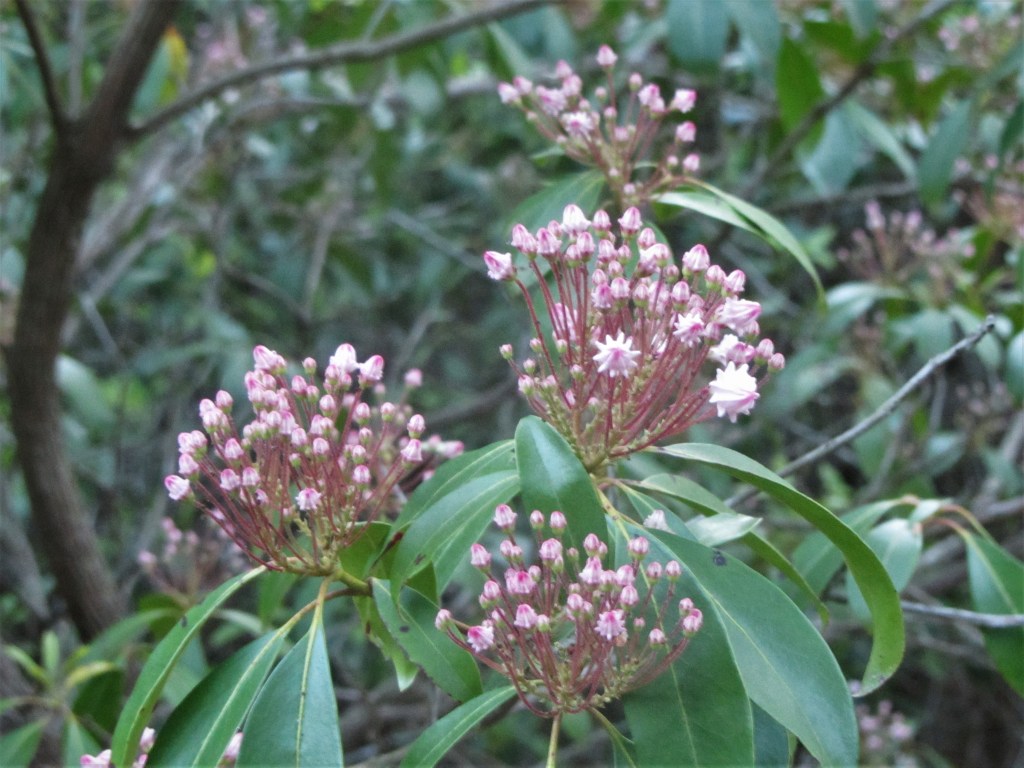
These evergreen shrubs, almost small trees, simply blend into the fabric of the woods through much of the year before bursting into bloom, suddenly elegant and beautiful, in late April and early May. The native species mountain laurel has flowers of white or pink. Some cultivars in the nursery trade have been selected for darker flowers of red or maroon. Ours probably pre-dates our neighborhood, from when this forested land was still undeveloped.
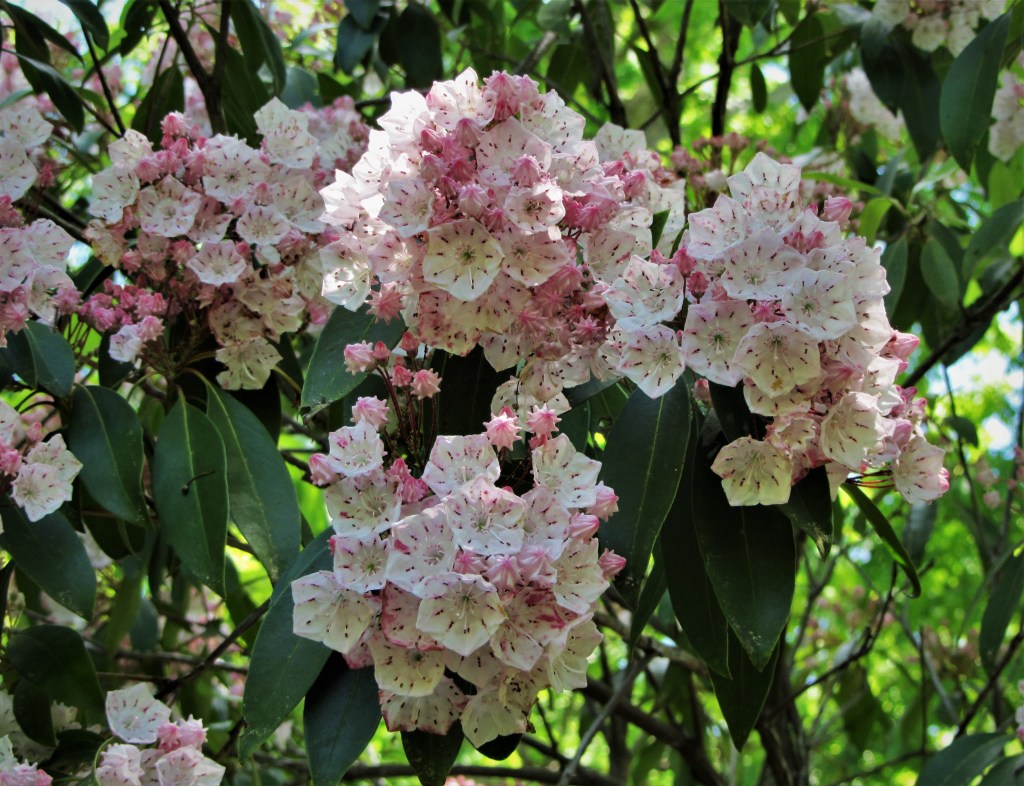
Early American botanists first recorded mountain laurel, then called “Spoonwood,” in 1624. Carl Linnaeus named the shrub for Peter Kalm, a Swede, who explored eastern North America in search of new and useful plants in 1747-51. Mountain laurel, one of the most ornamental native plants growing along the east coast of North America, was collected by Kalm to export to gardeners in Europe.
Mountain laurel grows from Maine to Florida in Zones 5-9. It even grows east along the Gulf Coast from western Florida to eastern Louisiana. But it isn’t generally found near the coast south of Virginia. It prefers the coolness of the mountains, and its southern range moves ever further west, at elevation, following the Blue Ridge and Appalachian Mountains.
Mountain laurel, part of the Ericacea family of plants, is related more closely to blueberries than to bay laurel, which is native to Europe. It prefers moist, acidic soil and requires at least partial shade. Although the shrubs flower more abundantly in bright shade than deep, Kalmia don’t like growing in full sun where summers grow hot. These plants are best mulched, and fertilized, with shredded leaves, pine straw or pine bark mulch.
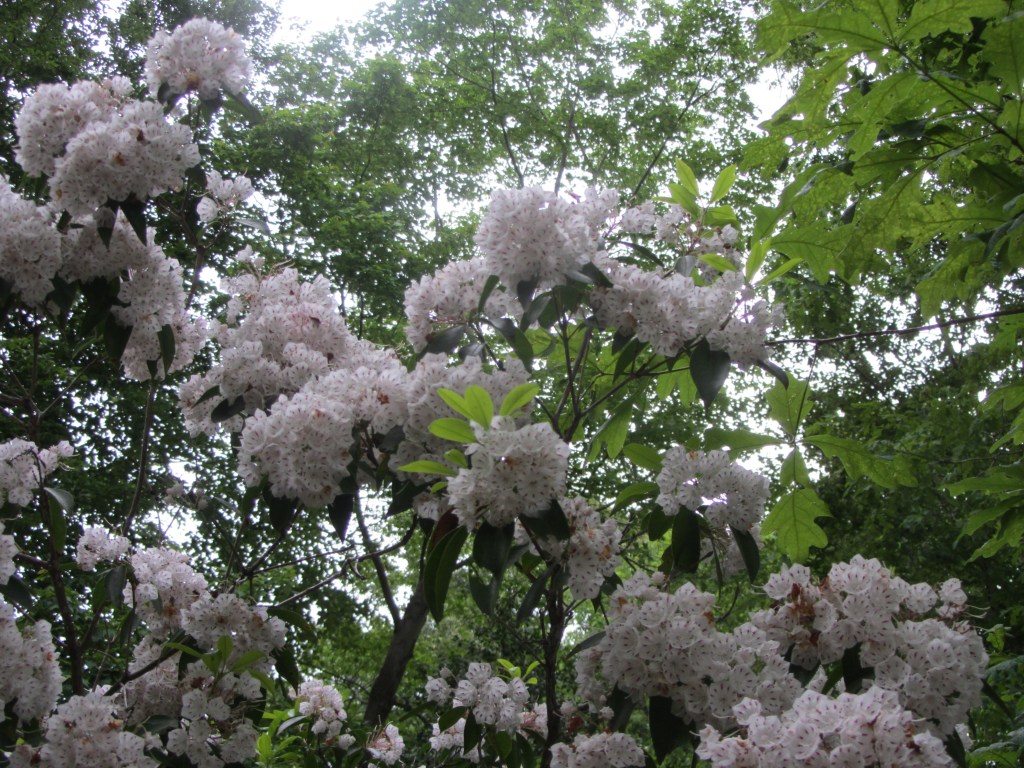
All parts of the mountain laurel shrub are poisonous, from root to nectar. They have survived in our garden over the years because the deer rarely graze them. Even honey made from Kalmia flowers in bitter and toxic for human consumption, although it will sustain a hive of bees. Native bees, and other pollinators, gather nectar and pollen from mountain laurel when it blooms each spring.
These shrubs don’t need pruning. They are best left to grow in their own twisted, idiosyncratic way. Over time they form a thicket. Their open structure near the ground makes intriguing little places in the garden for birds and small animals to seek shelter. Underplant these shrubs with evergreen Christmas ferns as an evergreen, carbon sequestering ground cover layer.
Kalmia wood is very hard and brittle, much like the wood of Rhododendrons, close relatives also in the Ericaceae family. Although they can grow to more than 30′, over many years in optimal conditions, most Kalmia won’t grow more than 15′ tall in one’s garden. The largest specimens usually grow in the Appalachian Mountains on steep embankments.
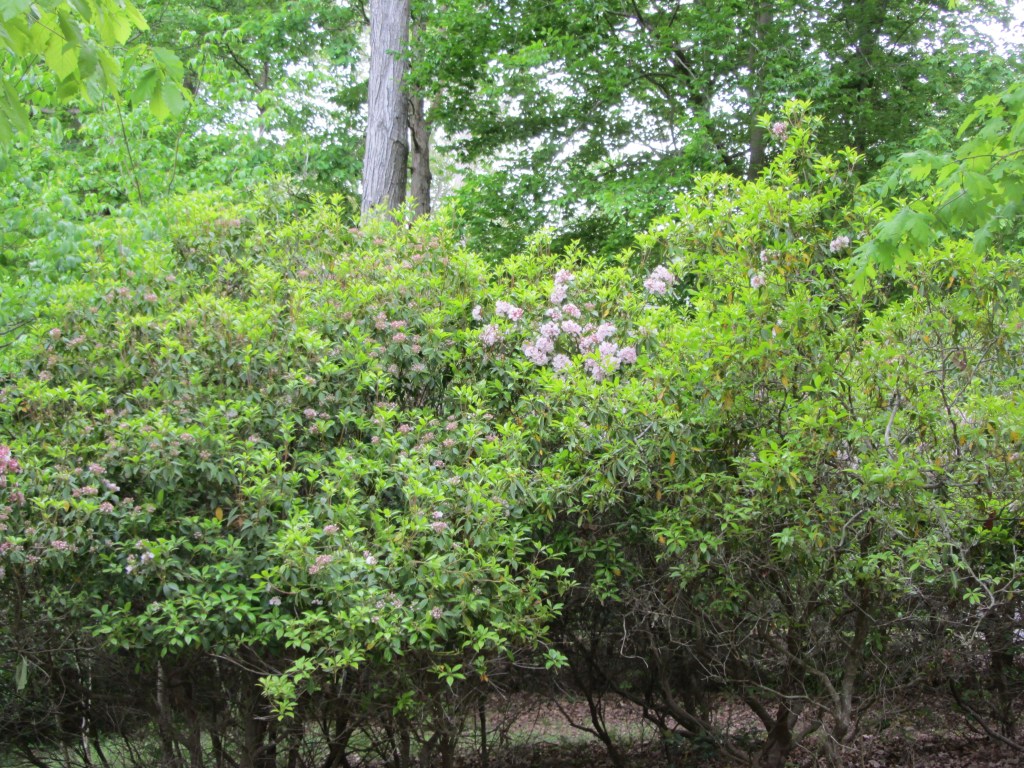
Mountain laurel can be started from cuttings taken from young plants in early fall, but plants should never be dug from the wild. Dust-like seeds should be sown fresh. Commercial production is from tissue culture and shrubs can be ordered from several online nurseries. Sometimes they can be purchased at nurseries in regions where they will grow. Plant mountain laurel a little “high” like an azalea, as planting too deeply may kill the shrub.
Mountain Laurel will grow successfully if you can site them in the moist, shady, acidic forest environment they prefer. Kalmia may be grown alongside dogwood trees, native blueberries, azaleas, native hollies, and of course, pines, oaks, beech, and other native hardwood trees. Their roots like to remain cool and moist, so it is important to keep the shrubs mulched. Water the first few seasons as the shrubs are established, and then only in times of drought.
A little careful planning and initial care will reward you with many years of beauty as Mountain Laurel grows into its potential. It is beautiful throughout the seasons, but especially when it is covered in flowers each May.
For More Information:
Mountain Laurel at NCSU Extension
Plants I Love That Deer Ignore
 Our Forest Garden
Ah, we started to grow this, but discontinued it because we could not sell much of it. People here either do not know what it is, or do not care.
LikeLiked by 1 person
Ah… a plant that hasn’t (yet) migrated to CA from the east. It can be drought tolerant once established, but probably wouldn’t be happy in your climate without a lot of irrigation during the dry season.
LikeLiked by 1 person
Well, it ‘sort of’ migrated here, but never became popular. Ours performed reasonably well with irrigation.
LikeLike
What a surprise! All these years I assumed deer were nibbling at my lovely mountain laurel. It bloomed nicely the one spring I doused it with deer repellent.
LikeLiked by 1 person
Nate, deer often surprise us with eating what the aren’t ‘supposed’ to eat. Even poisonous plants, like Caladiums and mountain laurel may get nibbled, especially by young deer. If deer repellent gave you flowers, the I hope you have continued to use it. I lose a few leaves on low branches from time to time in the winter months when the deer are really hungry, but my shrubs have survived and bloomed for decades here. Good luck!
LikeLike