These past weeks have been traumatic ones for so many folks across the United States, as well as around the world, as historic storms batter once peaceful and beautiful communities. We see the destruction on the news almost daily as people’s homes and communities lay in splinters after the passing of a storm.
As more and more of us feel the effects of chaotic weather patterns and climate change on our own communities and families, we know that waiting for governments and corporations to ‘solve’ the problem is no longer enough. Perhaps we seek out ways that we can make a personal, positive difference in this very personal circumstance. Whether we worry about heat or storms, flooding or high winds, we understand that communities around the planet are also experiencing rapid and life altering changes because of the weather.
Carbon dioxide, one of the major ‘greenhouse’ gasses that absorbs and traps heat in our atmosphere, has been increasing at alarming, unprecedented rates year to year for the past few decades. According to measurements carried out at the Hawaiian Mauna Loa observatory, at an altitude of 3400m, the ‘parts per million’ of carbon dioxide in our atmosphere has steadily increased over the period of record keeping since 1958. They measured 420.41 ppm of CO2 in the air in February of 2023. Here is a chart of recent observations at the Mauna Loa observatory. This is up from 414.72 ppm in 2021, according to an analysis from NOAA’s Global Monitoring Lab. And that reading showed an increase of 2.58 ppm over readings in 2020.
Scientists have determined that natural carbon ‘sinks,’ like forests and plant life in oceans and lakes, removed approximately half of the carbon emitted each year between 2011 and 2020. The amount of carbon in the atmosphere increases each year because as we continue to emit carbon in a variety of ways, we still haven’t been able to capture and sequester enough to keep our planet’s atmosphere in balance. And every year more acres of forest, prairie, and other natural vegetation are cleared for development or monoculture farming. We continue to emit more carbon than we sequester each year, and the concentration of carbon in our atmosphere continues to increase.
All of us who enjoy gardening are a part of the solution to this climate challenge. We know that plants absorb and sequester enormous amounts of carbon dioxide, which they use for their own respiration and carbohydrate production. Carbon is deposited in wood, leaves and roots as cellulose. The more we plant and cultivate our gardens, the more carbon we help clear out of the atmosphere in our own areas.
The Nature Conservancy’s director of forest carbon science, Bronson Griscom, has long believed that nature itself is a significant factor in the solution to climate change. According to Griscom, “We tend to think of nature as a victim, but there’s been less attention to the phenomenal resilience and power of nature to heal. The ability of nature to solve problems just doesn’t get enough attention.”
For a while now, the best advice to anyone wanting to make a positive difference on this front, and perhaps offset some of their own carbon emissions, has been to ”Go plant a tree.” Planting and caring for trees to mitigate carbon isn’t bad advice, so far as it goes. Even if we aren’t in a position to plant a new tree every year, we can contribute to charitable organizations involved in reforestation. Groups like Arbor Day and The Nature Conservancy emphasize forest restoration after logging and natural disasters.
But I run across stories from time to time describing the effectiveness of smaller efforts with simple plants like succulents in dry climates and algae in waterways and laboratories. All plants absorb and sequester carbon, not just trees. Though a single tree might be able to absorb and sequester hundreds of pounds of carbon each year, smaller plants like shrubs, succulents, perennials and ferns play their part, too.
For those of us who don’t have room to plant another tree, or perhaps don’t have room in a small yard to plant any tree, we can still have a positive impact by planting other, smaller, evergreen plants. Evergreen plants continue to absorb and sequester carbon throughout the year, even while deciduous trees take a rest in the winter.
The native Christmas fern, Polystichum acrostichoides, is an excellent choice for small scale restoration and carbon sequestration in residential areas across much of the United States, and there are other great native evergreen ferns along the West Coast. If you take a drive through the Virginia woods on a winter day, you may notice tufts of Christmas fern glowing in the winter sunlight.
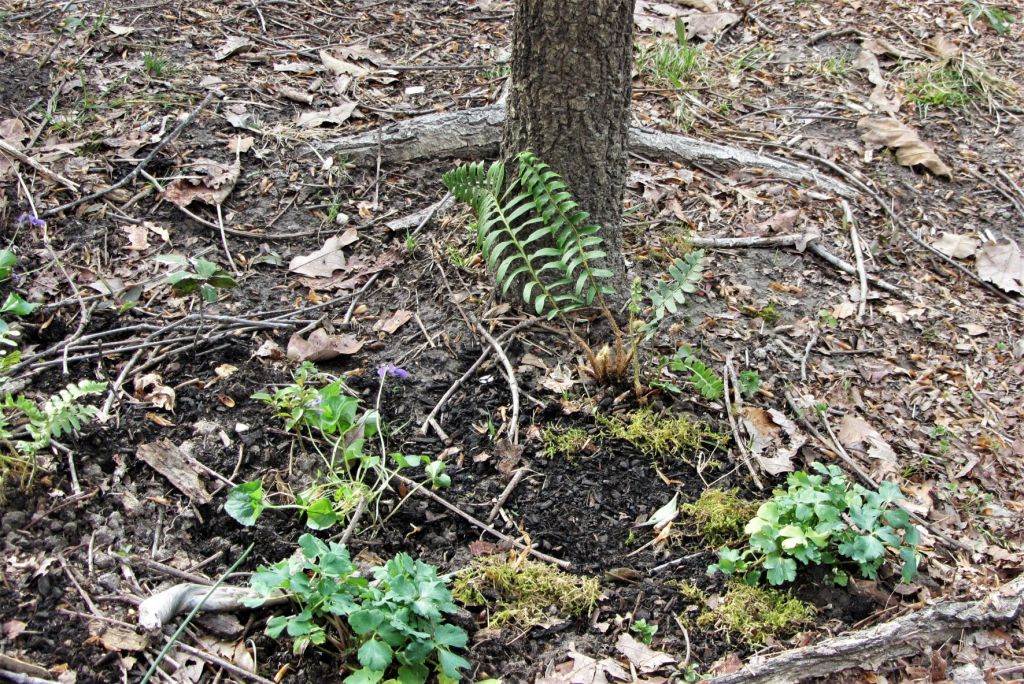
Christmas fern grows in deep shade to partial sun and is highly drought tolerant once established. Each plant grows as a vase-shaped clump, 1’-3’ tall. It grows from a rhizome, which expands the clump over time. But it doesn’t run and send up new clumps nearby as several other ferns may do.
After admiring native, naturalized Christmas ferns growing along the Colonial Parkway this past winter, I decided to add a significant planting of them to the ground layer of our own wooded garden. I’ve had this project in the back of my mind since the holidays and spent a while trying to source bare root Christmas ferns in January, without any luck. I finally talked with our local garden center friends and learned that they could order ferns in 2” plugs, so long as I was willing to buy the entire flat.
This family run garden center offers amazing deals on small perennial plants each spring that always puts me in the mood to plant and to try something new. This week I’ve made a focused effort to break out my gear and get busy planting some of these newly adopted perennials into the ground. The weather has been fine enough for me to begin the annual process of remodeling containers, shifting plants into larger pots as needed, and generally adding some color with bright geraniums, too.
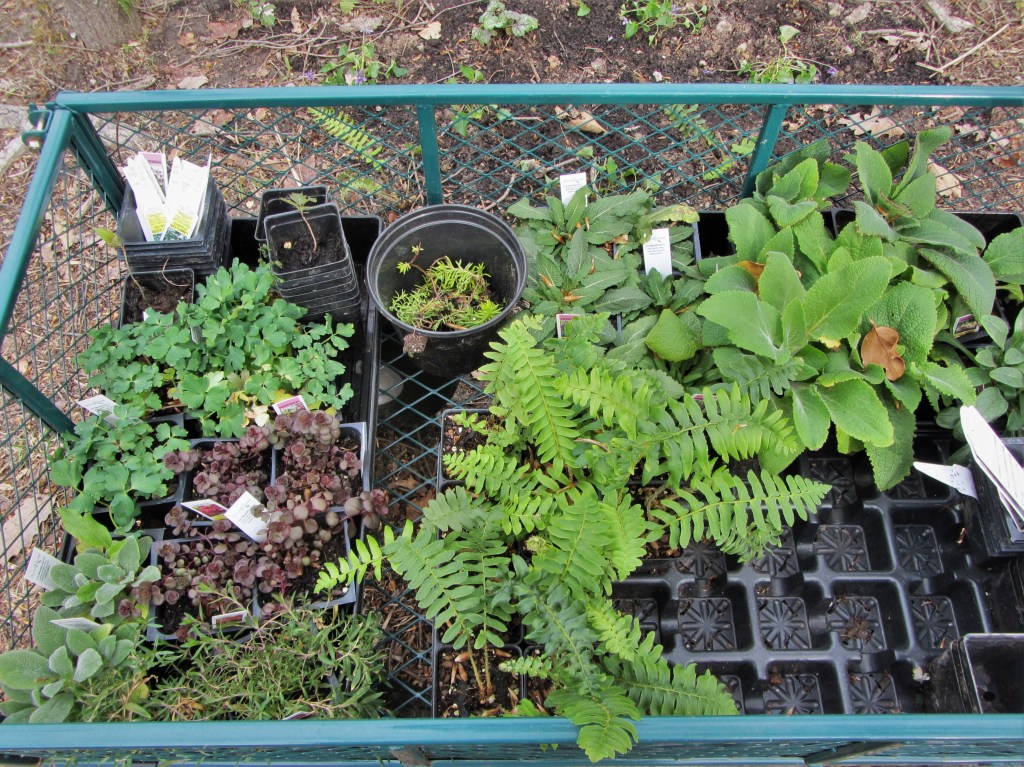
I’ve finally begun planting the Christmas ferns and a few other perennials In the wooded parts of the garden. We also had a beautiful pot overgrown with native wild violets that I divided and replanted among the ferns. Planting the ferns and other perennials involved digging out goldenrod shoots and cutting away invasive vines. We’ve had perfect weather several days this week for working outside, and I’ve tried to make the most of it.
The Christmas fern grows on a variety of soil types, from thin gravelly soil on the sides of mountains to rich, swampy soils here near the coast. Best of all, Christmas fern requires no fertilizer or other chemical inputs to thrive. It will only need watering during a summer drought. Planting these ferns is ‘sustainable gardening’ at its best.
Any evergreen fern will perform the same function of cleaning carbon, and other pollutants from the air, and covering the ground. Large, evergreen ferns also provide shelter to small birds and other animals. I’ve been building up my collection these past few years, trying new varieties, and dedicating more and more of our shady garden to various ferns. They all have a role to play. This year, Ive decided to choose a native fern already common and naturalized in our area to enhance our woodland garden, while also making a positive environmental impact by planting lots of them. There are 32 plug ferns to a flat, and I just ordered a second flat to plant in April.
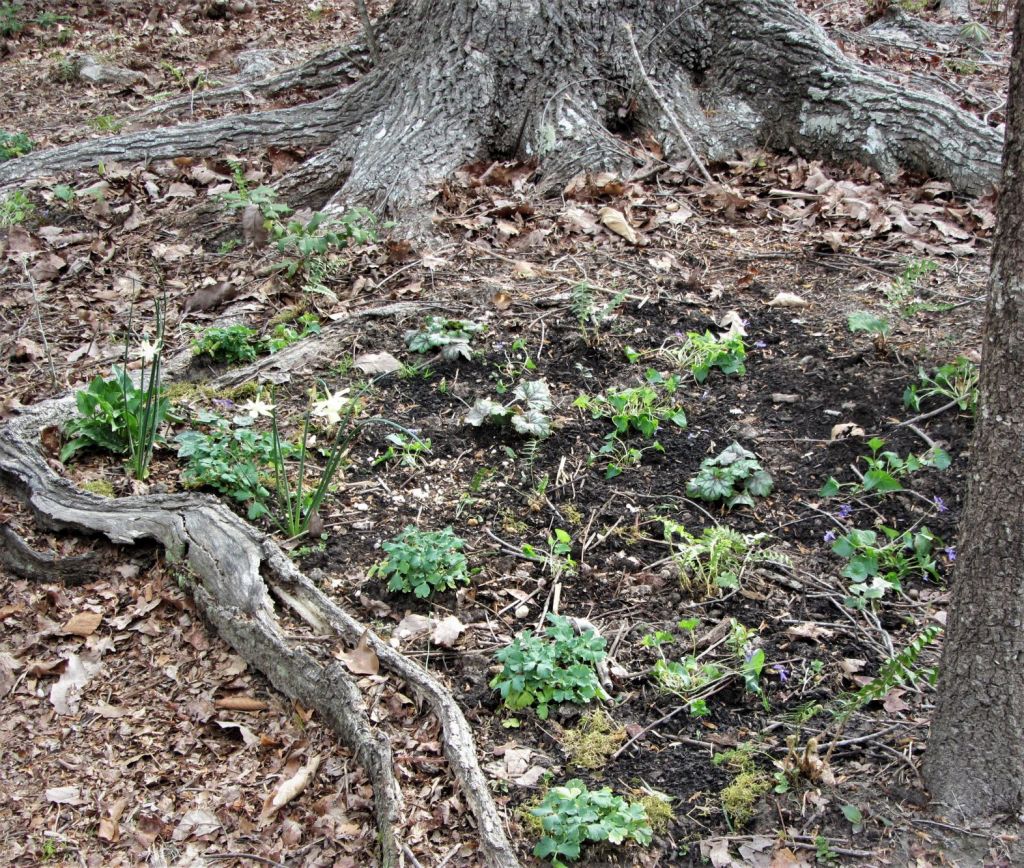
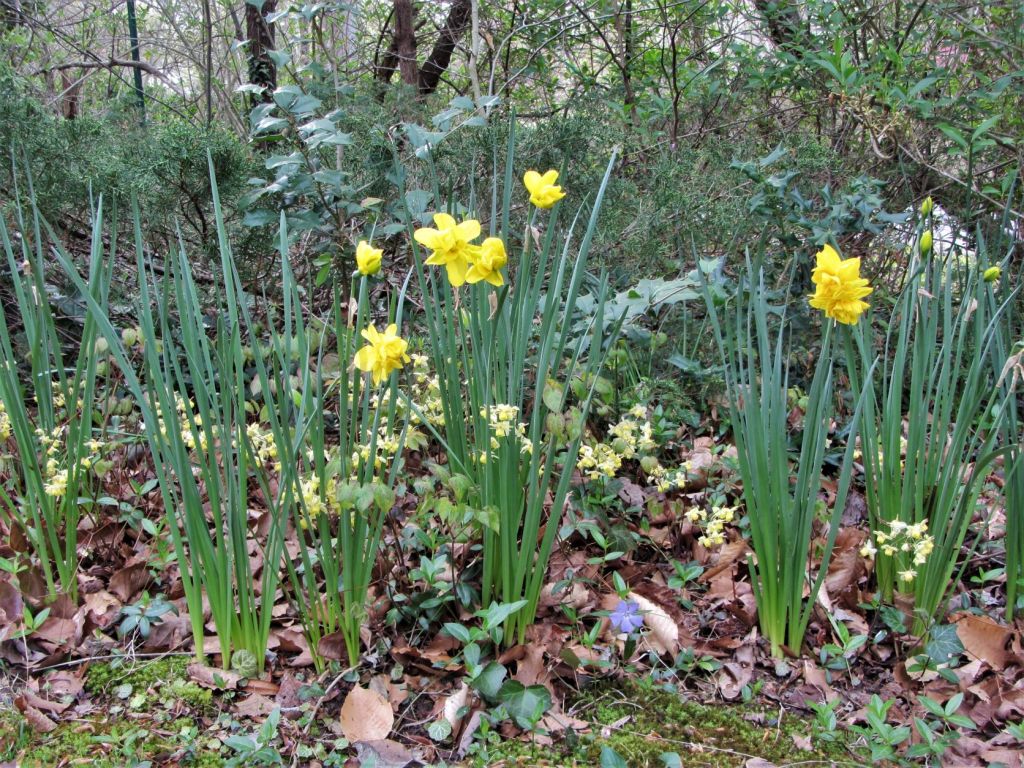
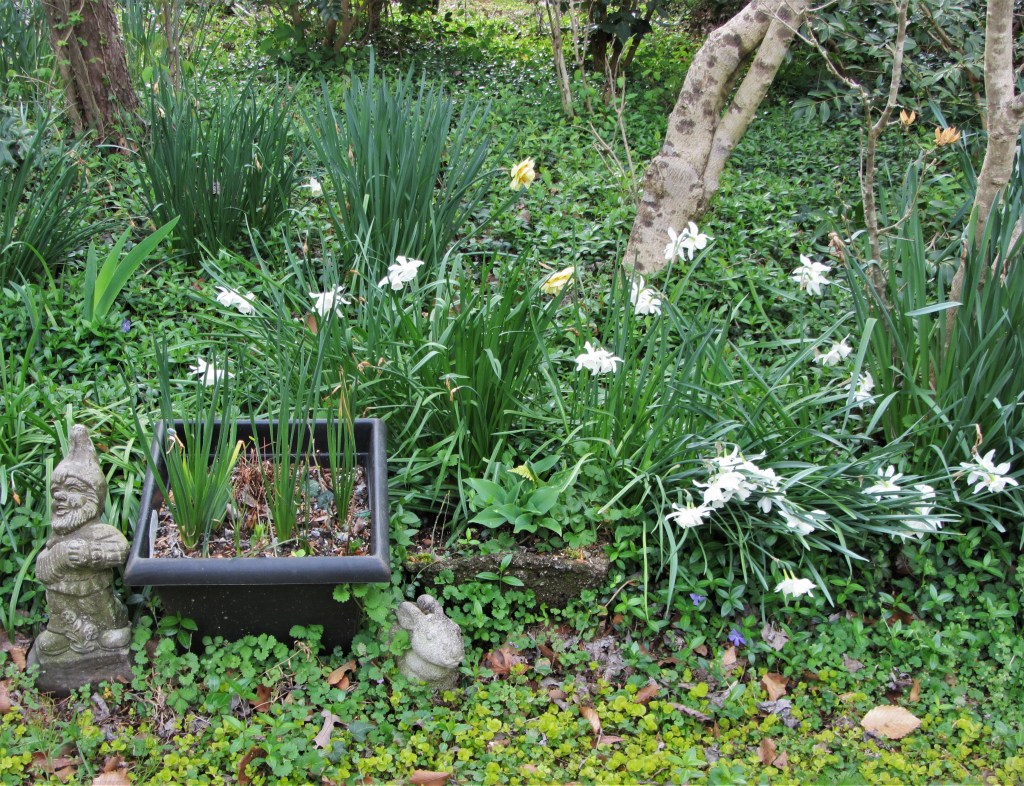
The garden changes so much day to day. On warm days we can watch the leaves emerge and grow hour to hour. And then the wind will shift and we’ll have a night or two in the 40s with wind. March is definitely a time of transition. Our ‘late season’ daffies are already in bloom, even though today is only April 1. Even with a few cold spells, we are running 2 to 3 weeks ahead of our normal spring development where the plants are concerned. I won’t pretend that we haven’t been enjoying this very early taste of spring.
The weather has been strange for a while now. Every continent and country has had its own epic storms and drought. When presented with a challenge like a warming climate and the dramatic weather patterns resulting from it, we need to bring all of our creative thinking and dedicated effort to the table. None of us can wait for someone else to ‘solve the problem.’
We can all begin now, where we are, with whatever resources we have, to make our own personal best effort to help meet the challenges of our times. If that means planting a single plant in a pot by our own back door, that is a first step in the direction of creating positive change.
With appreciation to Jim Stephens of Garden Ruminations, who hosts Six on Saturday each week.

You might enjoy my new series of posts, Plants I Love That Deer Ignore.
Visit Illuminations Each Day for a daily garden photo and a quotation
 Our Forest Garden
Lovely and thoughtful post. I could not agree more that we all need to do more to help ourselves. Imagine what happens when crops fail on a large scale and worse, when there is not enough clean water for daily needs.I recently made the jump to add solar panels and hope to bolster that by improving insulation. It is too early to tell how much energy I can expect to generate in the average year, but every day of full sun generates about 20 KWH, so in a good month, I will make more than I use. On a bad day (a foot of snow on the panels, sun shining beautifully) I make nothing. As you say, every bit helps. I jumped on it because there are several incentives available, and my loan payment is lower than my electric bill is. So it is not a financial advantage, but an environmental one that could build into a more resilient electrical grid if more people can do it, My excess flows to the grid where others can use it. We thought about battery storage, but in the end, the batteries are quite expensive and there are safety considerations. Rain barrels are an even easier add for homeowners. I use rainwater almost exclusively outdoors, and indoors too, as our water is very hard and makes decorative planters ugly, I save about 50 liters of rainwater in old wine bottles for winter use. Also, now that we are out of drought, I water my baby trees with the sump outflow. Your post made me even more glad that I convinced my husband that a row of arbor vitae was so much better than a fence could ever be (assuming you are not trying to corral pets or children, but rather screen things).
LikeLiked by 1 person
Well, I trust you and your family have come through this latest round of storms OK. Thank you for taking time to share your experience with solar panels and rainwater systems. I see a day when we all move to solar panels for most applications. In France, they are experimenting with installing solar panels as a ‘roof’ over public parking lots. What a novel and great idea! Are you familiar with the ‘Earth Ship’ homes that a very inventive architect designed and built out in the desert- maybe New Mexico? I am totally intrigued by those because absolutely everything is recycled and off-grid. But, not a great place to try to garden out of doors! Every small shift towards sustainability and conservation helps. We live in abundance. Only, we don’t always understand how to make the best use of the resources we have- like sunlight and rainwater! Take care, ❤ ❤ ❤
LikeLike
I love reading your points on saving the planet, I have lots of Sycamore seedlings growing on my garden, although most are in inappropriate places I shall pot some up to plant elsewhere.
LikeLiked by 1 person
That sounds like a great plan. There are probably neighbors who would love to have a beautiful Sycamore tree seedling! I picked up a fruit ball in the winter, but it stayed in a baggie in my purse too long and I never sowed the seeds. Sycamores are so striking, especially in winter, and do so many great things for wildlife and the environment! I hope all is good with you, ❤ ❤ ❤
LikeLiked by 1 person
A well-written, thoughtful and informative post! Thanks for spreading the message. 🙂
LikeLiked by 1 person
Thank you, Eliza ❤ ❤ ❤
LikeLike
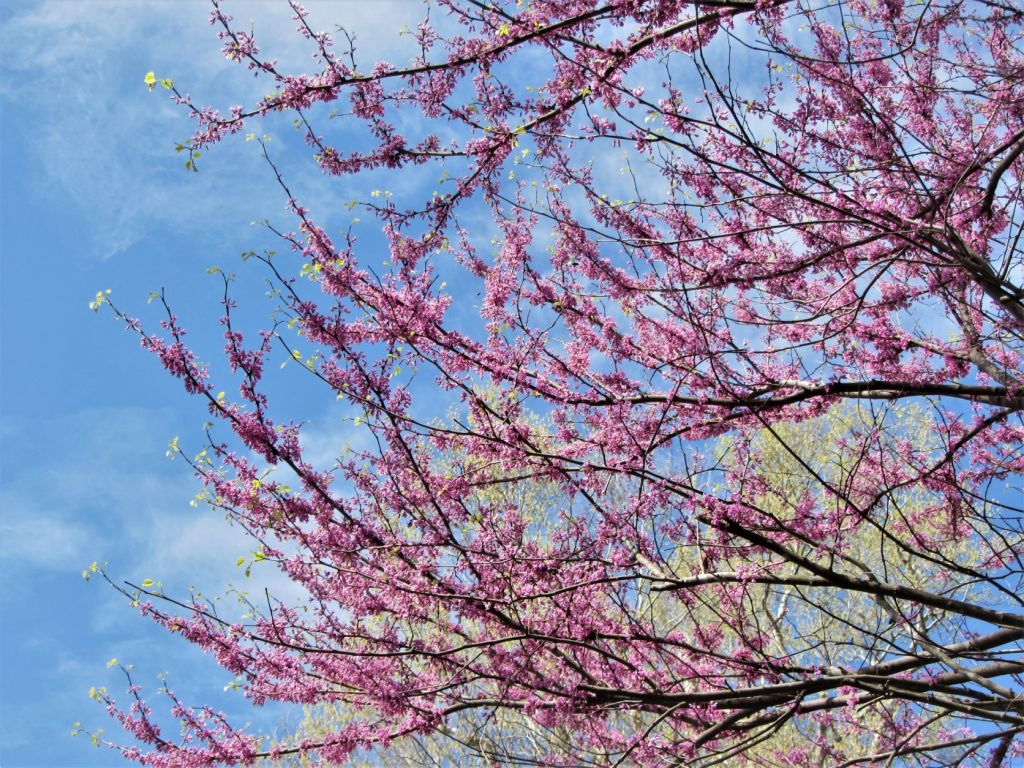
Eastern redbud is rad! I brought seed back from Oklahoma, and have one small tree growing outside right now. I still do not know if it is a distinct variety of the species. Some insist that Oklahoma redbud is a distinct species. I sort of doubt it though.
LikeLiked by 1 person
Has yours bloomed yet? It is such an amazing thing when the bright flowers emerge directly from the wood!
LikeLiked by 1 person
No; it was shaded. Western redbud is even weirder because the color is brighter and seemingly artificial. They are rare in landscapes though because they are shrubby and do not last for long.
LikeLiked by 1 person