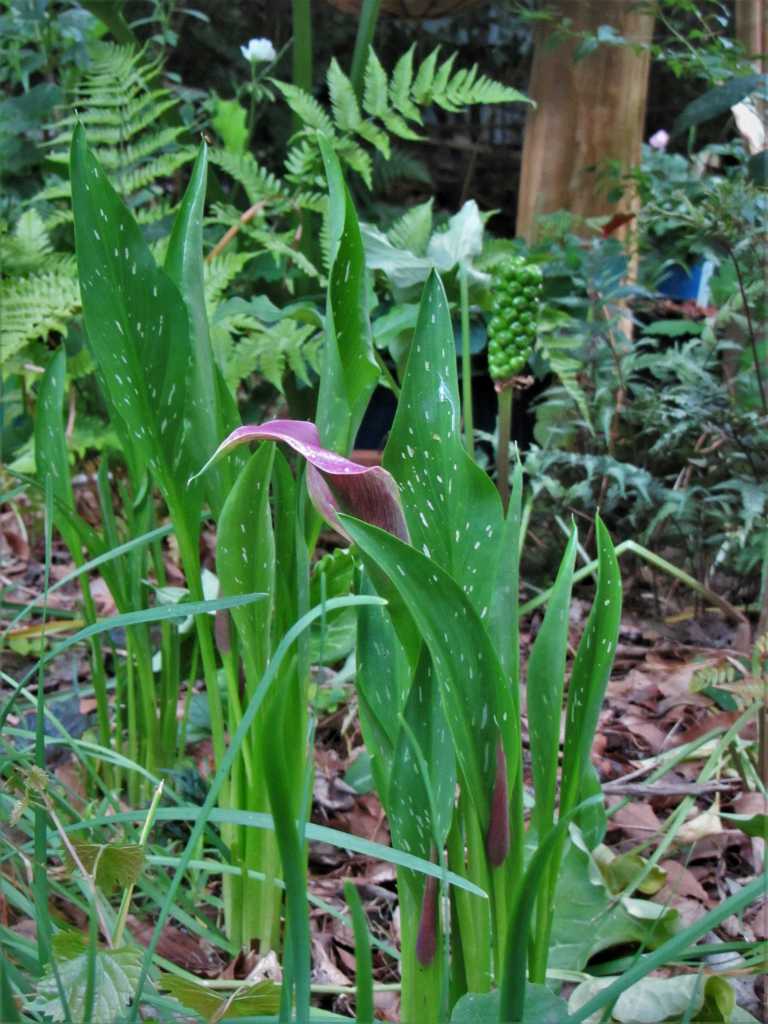
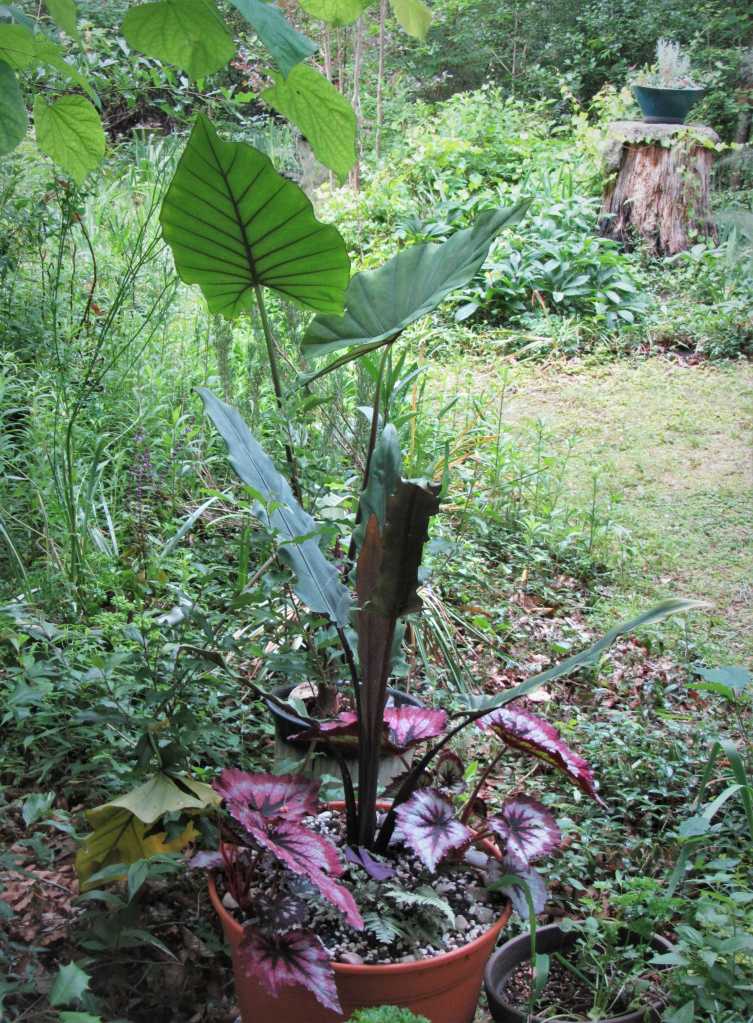
I’ve been trying to remember where I planted the Amarine belladiva lilies I ordered last winter and picked up from the Bulb Shop in Gloucester in early April. The Begonias, Alocasia, Gaura, and calla lilies are all accounted for. The callas have even begun to bloom this week. I probably planted the Amarine bulbs first, and then the callas and Gaura ‘Passionate Rainbow,’ a hybrid Gaura with variegated leaves. The Alocasia ‘Stingray’ and Begonia ‘Fire Woman,’ both young plants and not bulbs, had to wait for the weather to settle from early April until mid-May before it had warmed up enough to move them outdoors.
Everything that needs heat has had to wait this year. It was probably hotter here some days in March and April than it has been over the last month. That is a blessing for us, of course, but doesn’t do much to stimulate the plants to grow.
I planted the calla lily bulbs in the front of a favorite bed at the end of our driveway. The daffodils were still in bloom at the time, but I cleared a narrow space to plant them neatly in a row in front of the daffies, with white Dianthus in between. I didn’t give them another thought, until I noticed their first sprouts emerging a few weeks ago. It didn’t take long to remember, ‘Oh! The new callas are growing there!” That bed is still a bit of a mess as the daffodil leaves finish up. Some are green, others lay wilted and brown. I cleaned up all that were ready to pull early in the week, but the whole bed needs more neatening up and then a layer of fresh mulch.
This year’s gardening efforts have had me all over the place doing as much cleaning up and clearing as planting. Every spurt of effort yields pleasing rewards, but there is much left to do. Why do we see what needs doing more clearly than what we have already accomplished?
And then there were the many hours spent, hose in hand, trying to make up for the rain that wasn’t falling. It has been so dry this year, until this week at least, that I spent some time researching and writing two articles about drought tolerant plants and drought tolerant gardening strategies. I learned some very interesting things through the research, came across some terrific resources, and am inspired to try some new techniques.
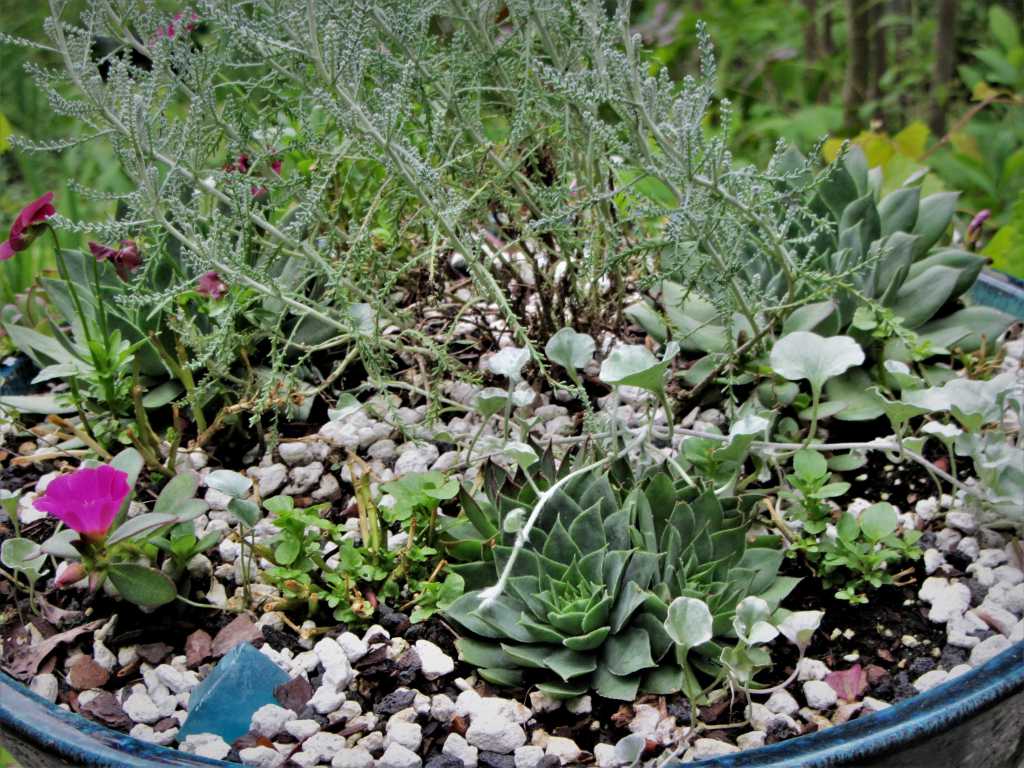
I had already refreshed one of my favorite containers with very drought tolerant plants in hopes it will look good all season without constant attention. It sits in probably the most challenging spot for a container in this garden. Succulents and Mediterranean plants are reliably tough. The Dichondra vine is a North American native, and has become one of my favorite plants for summer containers.
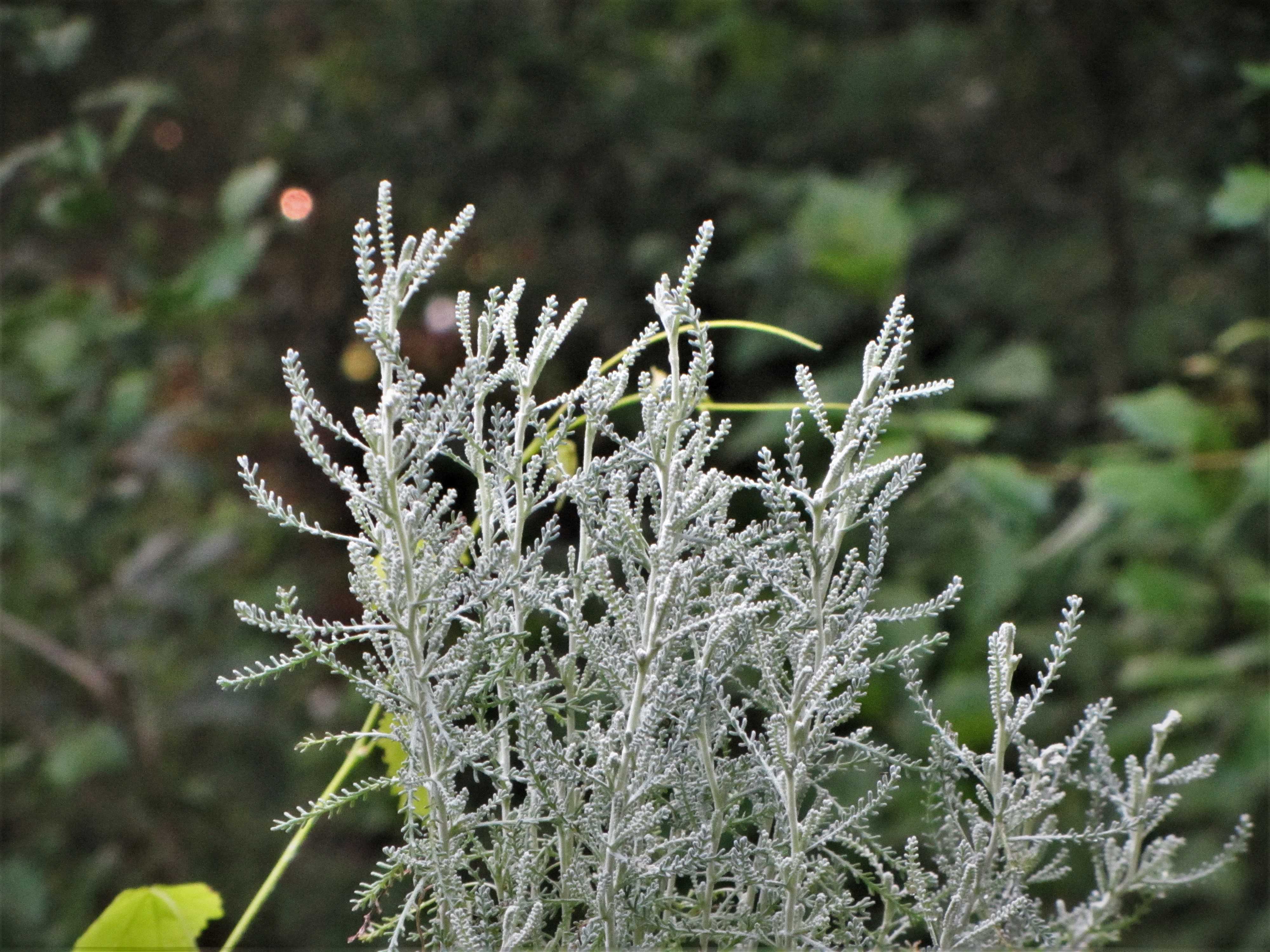
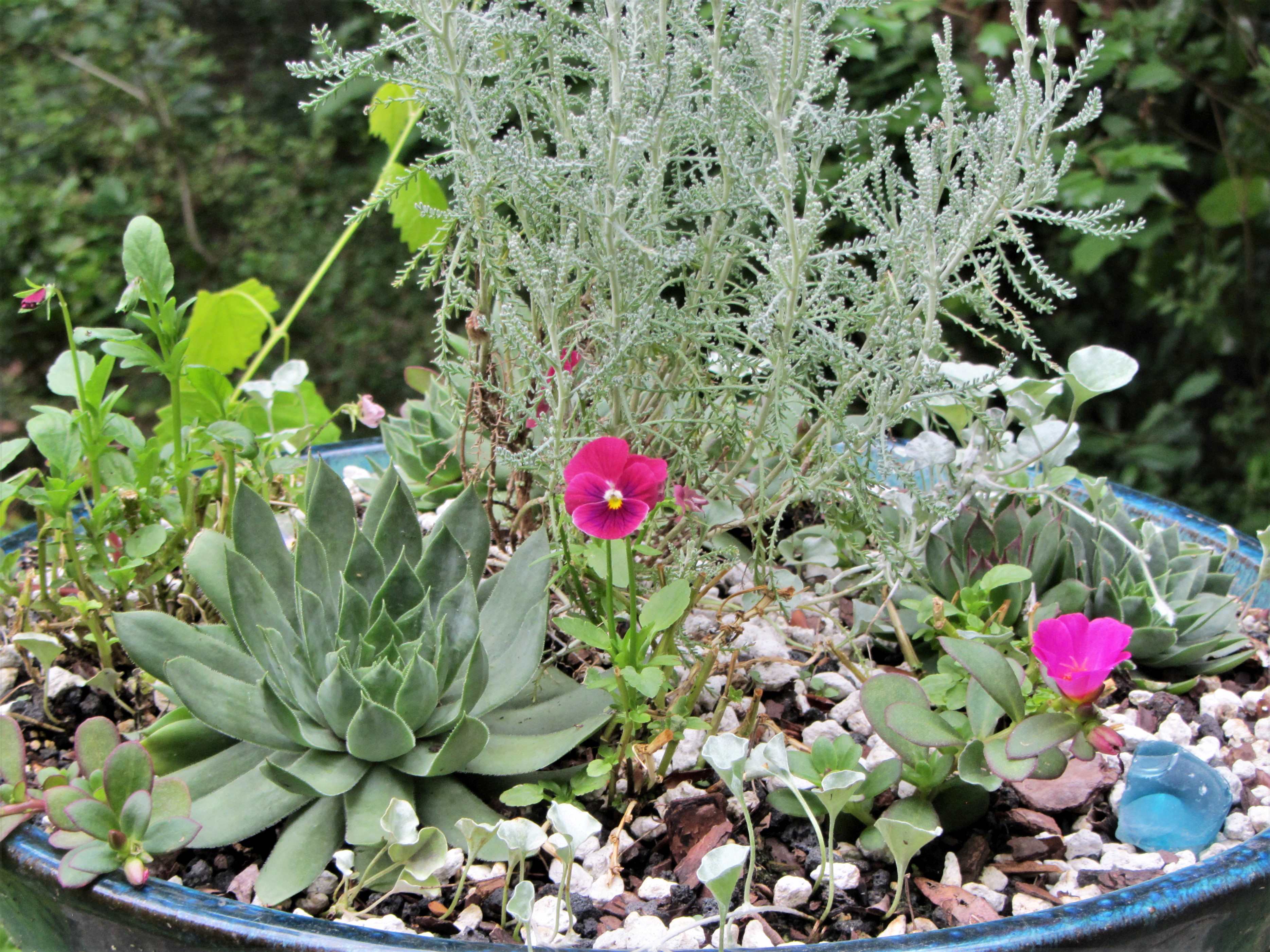
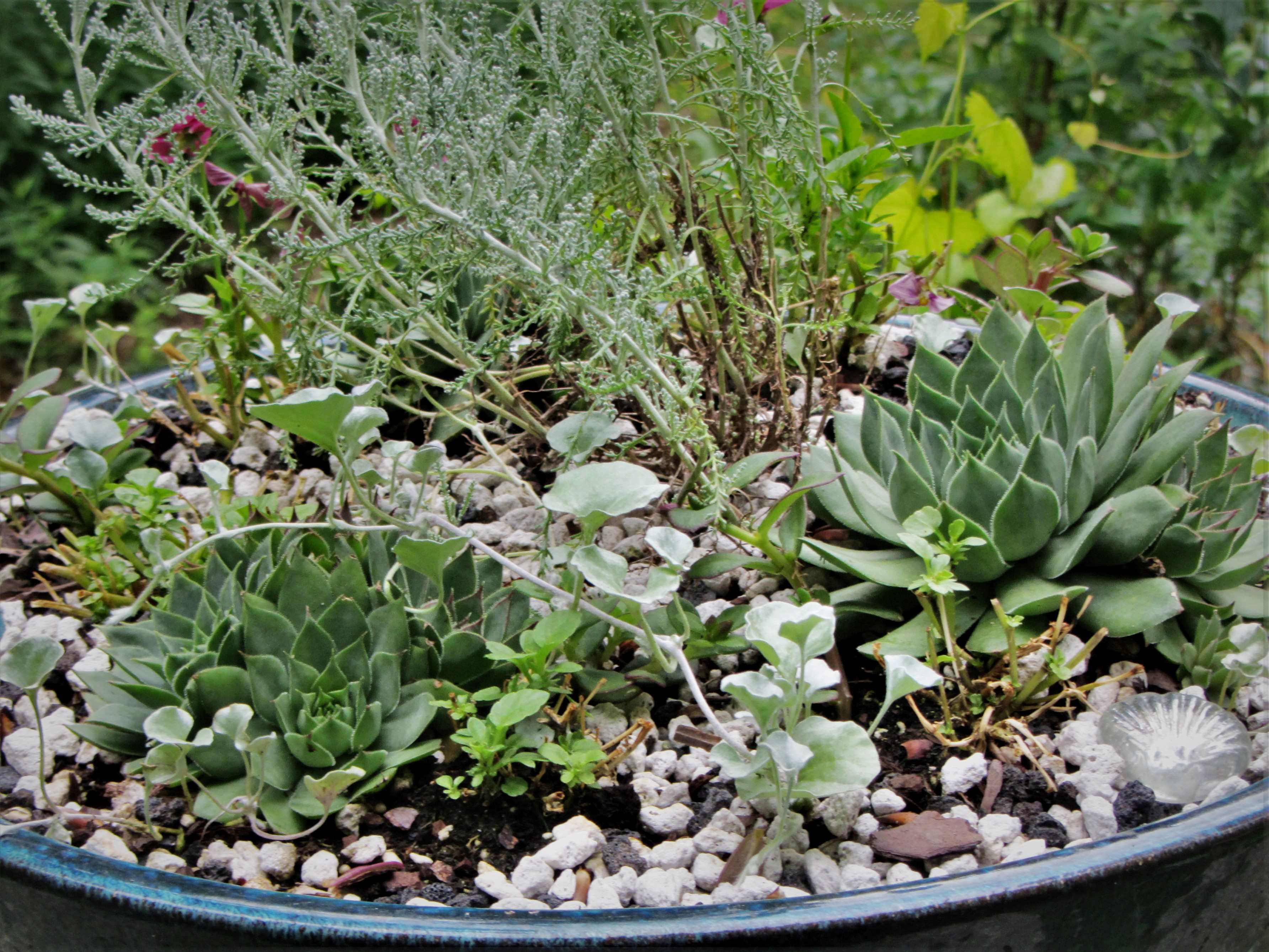
Finally, we’ve had some good rain this week. And we’ve also had smoke from the Canadian wildfires, which actually helped to keep me inside at the computer writing. The smoke was worst on Wednesday, much better Thursday, and we could barely see it on Friday. But other than a bit of watering and grooming containers and chasing deer, I’ve not gotten much done in the garden since Tuesday.
I wrote about native Gaura, Dichondra, and Crinum lily as a good, drought tolerant plants, which made me wonder where on Earth I had planted my Amarine bulbs this spring. I’m sure you know the feeling of sitting there tapping your chin, trying to remember, and coming up dry. I didn’t have much time to waste in worry, confident that if the voles didn’t get them, they’d show themselves eventually.
I’ve been much more concerned about some other plants too slow to throw out new growth this spring. I’ve been potting, re-potting, trying to decide what is still alive in some cases, and what to throw away. That offers the opportunity to start over with a fresh plant in the pot. It has been musical pots here. I’ve been mixing up cans of fish and seaweed emulsion to water the containers, and sprinkling Espoma and Osmocote around in hopes of stimulating some lush new growth.
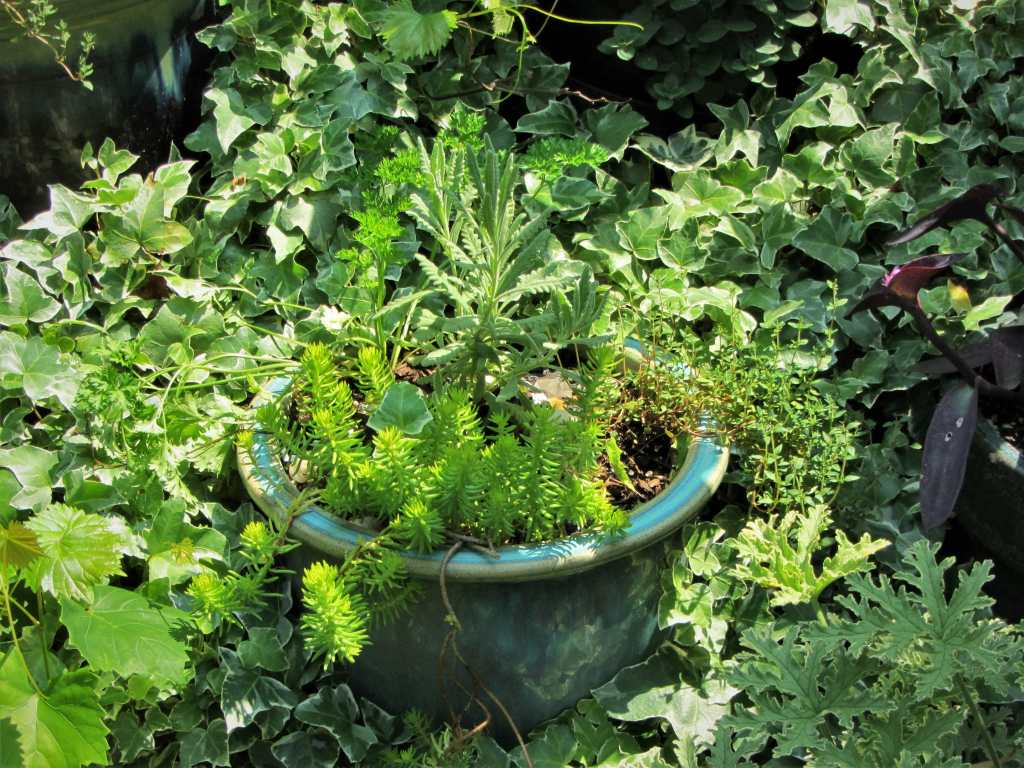
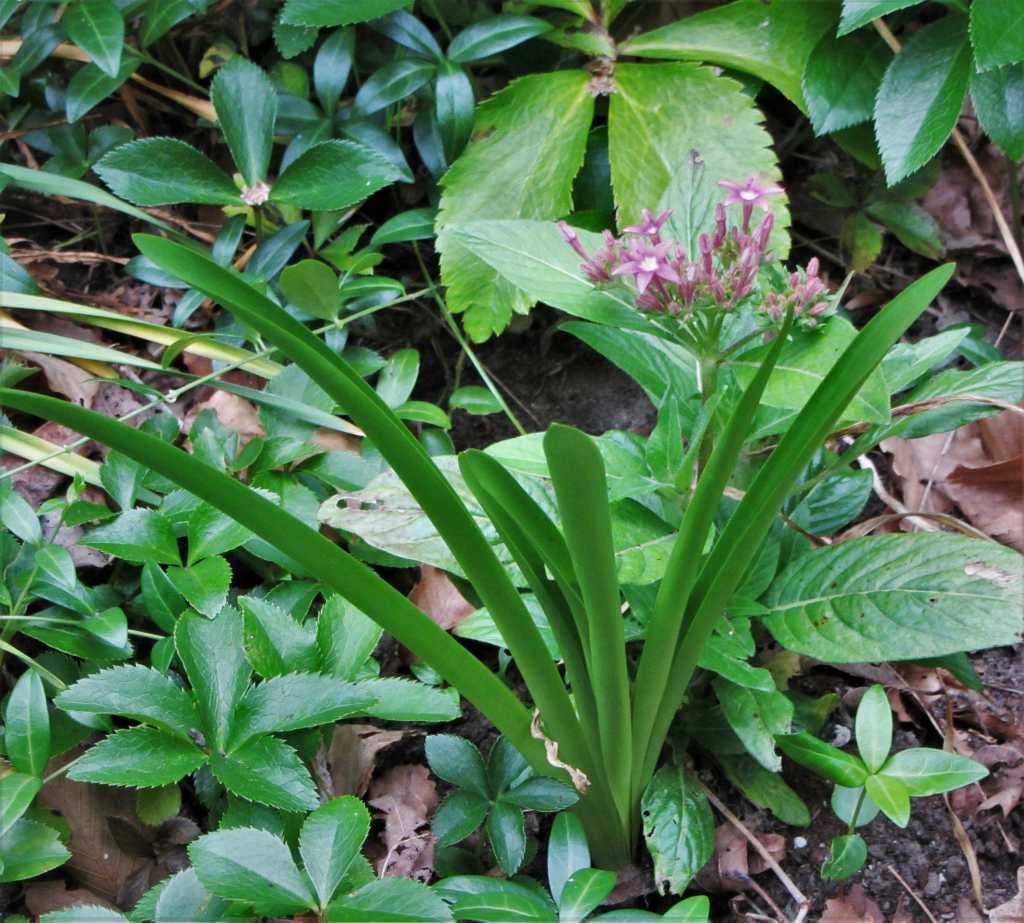
Even though I’ve taken a few hundred photos in the past few days, I still didn’t quite have the photos I wanted for SoS this week. I went out with the camera one more time to try again on Friday evening. And there was the little Penta I’d planted weeks ago finally in bloom. Its little pink flowers, nestled at the base of a towering fennel plant caught my eye. But as I studied it more closely, pulling a weed or two to get a more pleasing shot, I noticed the tall thin leaves emerging right beside the Penta. And of course, it was the Amarine finally showing itself. I rarely put markers by things I plant, and so I planted the Penta almost on top of the bulb. At least they should look good growing together.
I think I bought five bulbs this spring, and so far, I’ve located two. Perhaps the rain this week finally stimulated them to grow. I’ve located some, but not all of the Lily of the Nile divisions that Tony Tomeo generously shared with me last summer. The ones I planted into a bed have leaves, but I’m still waiting to see the smaller divisions that I put into containers so I wouldn’t lose track of them.
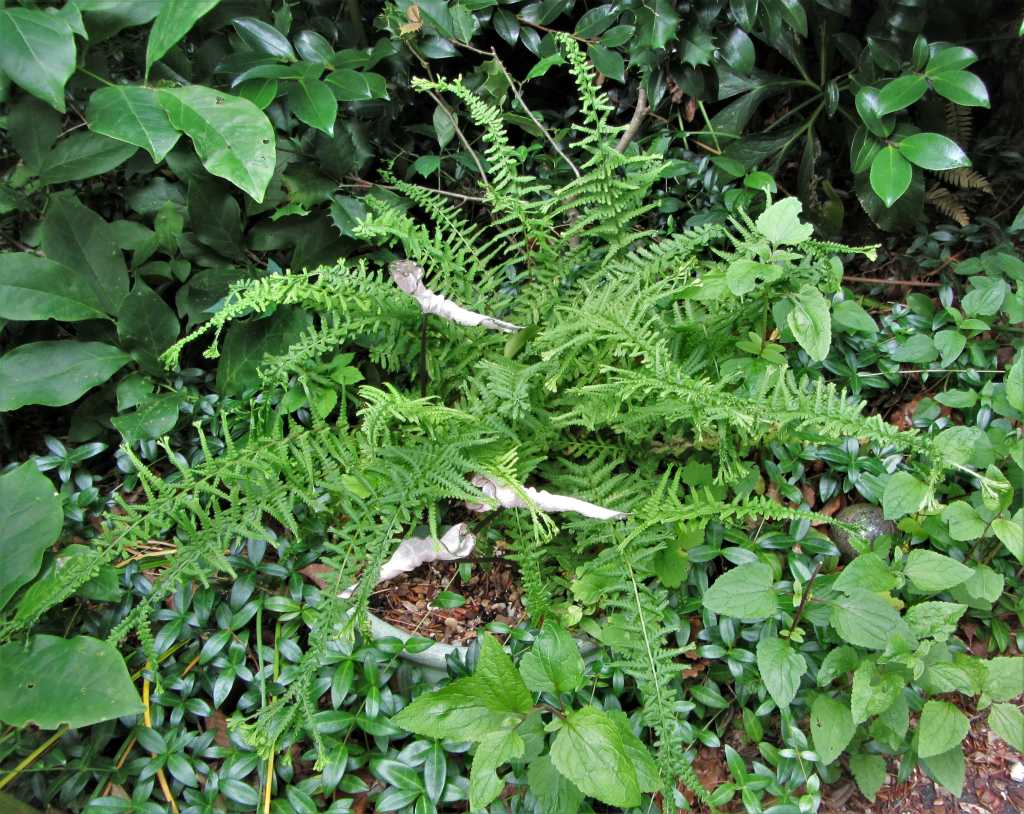
Still waiting. Still waiting on Caladiums, still waiting on Colocasias, and still waiting on some seeds, too. Some Alliums are up and in bud, but they’ve remained in bud, not in bloom, for a couple of weeks now.
We’re on a slow roll into summer here. I’m not complaining. The mophead Hydrangeas look better than they have looked in several years, because they haven’t gotten baked. A previous gardener planted them decades ago when they were in more shade. This year they are full of flowers and there are no crispy edges on the leaves. All the ferns and trees I planted earlier this spring have had time to grow some new roots. The Portulaca cuttings I struck in late May are rooting and beginning to bloom.
So long as the wildfire smoke blows out to sea, we are doing OK. Lately the weather news has sometimes been as alarming as the evening news, between all of the destructive happenings around the world. So, a calm, damp and overcast day is counted as a blessing. It is nice when the sun peeks through for a few hours, long enough to walk around and admire the garden as it continues to awaken and grow. Some say that plants respond to being admired. Some say you can talk to them. Whether or not that is true, a little appreciation is always a wonderful thing.
With appreciation to Jim Stephens of Garden Ruminations, who hosts Six on Saturday each week.

You might enjoy my new series of posts, Plants I Love That Deer Ignore.
Visit Illuminations for a daily photo and
 Our Forest Garden
White butterfly ginger may finally be able to bloom! They had it rough for so long, but finally, nothing seems to be bothering them! Meanwhile, I accidentally procured a bit of red butterfly ginger. It came with a bunch of Clivia miniata that I brought back from Los Angeles. I did not know what it was until my colleague who gave me the Clivia miniata mentioned that his red butterfly ginger did not come up this year.
LikeLiked by 1 person
A bonus for you! The white butterfly ginger is up, but taking its time here. We rarely see it bloom before late August- sometimes September. It definitely is a late-season show-stopper. I’ll look forward to photos of your red ginger when it blooms.
LikeLiked by 1 person
It still has a way to go, so will not likely bloom until later in summer. I am impressed by the vigorous growth though. It is developing hefty pseudostems for the first time since it arrived. It grew somewhat well last year, but only vegetatively as it recovered from getting trampled and then getting damaged by a gopher.
LikeLiked by 1 person
They are tough! My established patched is still only 2′-3′ tall. They wait for the long, hot days of summer to really bulk up and prepare for bloom.
LikeLiked by 1 person
After the most wintry winter in a very long time and perhaps recorded history (with both historically extreme rain and historically extreme frost within the same winter!), spring and summer so far have been historically cool and mild. It is SO weird and actually frustrating. I enjoy the nice weather, but so many perennials grow slower than the slugs and snails can eat them. I put the white butterfly ginger into the white garden, where gophers found it twice. It developed into a nice colony, but because of the interruptions of growth, had not been mature enough to bloom until this season. I kept some in a can here at the yard as a spare, and it seems ready to bloom also. The red butterfly ginger is canned nearby. It looks similar but with slightly darker foliar color.
LikeLiked by 1 person
Tony, you just described our experience almost to a ‘T’. You probably had more rain over the winter- more precip in CA overall as our winter was unusually dry. But we had historic cold. And yes, it is SO weird and frustrating to see how everything has responded. I cut a leaf off a Canna this morning that was ‘rolled up’ and I expected to find webs/eggs/larvae inside of it. But when I unrolled it, there were about 4 little slugs. And this leaf was more than 2′ off of the ground!
We never see blooms on the ginger lily until after mid-August, but since your winter is milder overall, it may bloom on a different schedule for you.
A friend left 3 little potted BGL divisions with me over the winter. Because she told me she was coming back for them (she moved) I didn’t plant them and left them canned all winter, in a sheltered spot. There’s not a sign of life from any of the 3 pots and I’m wondering whether they froze in December. I spent several hours this morning watering because we didn’t get the rain forecast Sunday or yesterday. It is alarmingly dry out there and the new starts I planted earlier this spring are really struggling. Yes- we are loving the cooler weather and fewer flying insects here so late into the season, but it is hard on the plants.
LikeLiked by 1 person
Is BGL blue ginger lily? I thought that mine did not survive, but they are just very slow to get started. They really need warmth.
LikeLiked by 1 person
Yes, they really love warmth! BLG is Butterfly Ginger Lily- apologies for the confusion. Is there a blue Hedychium?? I’d love to grow that one! I have a fresh piece of culinary ginger sprouting, and it is about ready to pot up.
LikeLiked by 1 person
No, blue ginger is actually more closely related to spiderwort or wandering jew. Dichorisandra thyrsiflora. I just got some cuttings last year, but just prior to the second worst frost in recorded history. They surprisingly survived. The color is great, but it lacks fragrance.
LikeLiked by 1 person
Thanks, Tony- that is the genus name I found when I searched online for ‘blue ginger,’ but didn’t want to assume it is what you meant. So glad that they survived for you. A ‘wandering Jew’ style of spiderwort comes up here in places where it just looks weedy. Flowers are a lovely blue but small and sporadic. In recent years I just yank it out like stiltgrass. Maybe I should dedicate a patch to it and give it a chance….? I’ve learned that several ‘weedy’ volunteers I yanked when we first moved here are native wildflowers, and I’ve learned to like and use several of them, like blue mist flower. I’m still not in love with many of them, however- I admire how you embrace the native vegetation of your area.
LikeLiked by 1 person
Yes, I just noticed that in your Six on Saturday post. Blue ginger flowers look like that, but are compressed together on dense floral spikes, like ginger. It looks sort of like grape hyacinth on a stem.
LikeLiked by 1 person
Oh, that sounds very pretty. I will watch for the opportunity to get a start and try it.
LikeLiked by 1 person
Brent just telephoned a moment ago, and mentioned that his blue ginger is more than six feet tall! Of course, it is stretched by the shade, so is very scrawny. It will bloom with only a few floral spikes. Growth starts earlier there. I do not expect mine to bloom this year, but they could do so for autumn.
LikeLiked by 1 person
Is it fair to assume that Brent enjoys bragging a bit?? It is always entertaining to watch how plants perform year to year. Everything is off to such a slow start here…. or is it that I’m just impatient and have conveniently forgotten how slow plants took off in previous Junes?
LikeLiked by 1 person
I do not know because I am not familiar with the climate there. I know that our season is very late this year.
Brent enjoys bragging; but of course, he is a landscape designer. I am merely a nurseryman. He naturally takes credit for what I grow.
LikeLiked by 1 person
And he’d be up a creek (without paddle or sail) without you. Landscape designers depend on the quality and variety of plant material they can access for any success they enjoy. I am deeply appreciative for the nurseries I depend on to source plants, and I’d guess that Brent appreciates you more than he will ever let on!
LikeLiked by 1 person
Brent does not use my material. He creates landscapes for the Los Angeles region. Although I grew citrus trees in the early 1990s, not much of what I have grown performs well in Southern California, particularly rhododendrons and azaleas. Rhododendrons are very rare there. I only bring Brent a few odds and ends for his home garden, and retrieve a few odds and ends for my home garden. I would like to grow street trees for him like I did years ago, but transporting them to Southern California is expensive.
LikeLiked by 1 person
Perhaps nature will surprise you and the bulbs will appear. The wild fires to sound bad.
LikeLiked by 1 person
The wildfires have been terrible for Canadians, and the smoke has been drifting southwards across the East Coast of the US for much of this week. The weather patterns bringing the smoke south are finally shifting and so things have cleared out here very nicely. I was able to work outside again for a few hours this morning. The fires continue, however, with so much destruction. We’ve been warned to prepare for the smoke to return periodically all summer. Yes- a concerning situation and dangerous for many people.
LikeLike
The photo with the begonia and the alocasia is quite representative of the style of garden that I like! The mix is very well done. I’m always hesitant to plant my alocasia in the ground. So it stays in its pot. Yours is also potted: all year round?
LikeLiked by 1 person
Thank you, Fred. That tall, thin-leaved Alocasia was sold- unnamed- at a local grocery store this spring. It is a heat lover and I still put it out a bit too early, but it is surviving. There is only 1 reliably hardy Colocasia, and no Alocasia, that I’ve found to grow here. C. ‘Pink China’ naturalizes here, and most years I give away several that have strayed into my partner’s green area he likes to mow. I’ve tried growing a few other varieties in the ground, and they are fine until winter comes. None of the other varieties survive winter here. All of the Alocasias are too tender to leave outside, but they do fine, potted, in the garage or basement with minimal water and attention. It is easier to simply keep them in containers so I can move them around as needed. I really love Begonias- all types of Begonias. They do particularly well paired with Aroids for some reason.
LikeLiked by 1 person
My 2 colocasias ( Jack’s Giant and Blue Hawaï) are lifted up every winter and overwintered indoors. My alocasia (cucullata) remains in a pot on the terrace.
LikeLiked by 1 person
I forgot in that earlier response that I have managed to overwinter Alocasia in very large pots on our stone terrace, right up against the house. They suffered last winter, but yes, in past years they have managed. Isn’t C. ‘Blue Hawaii’ something special? One of my all-time favorites. I maybe should overwinter here, but doesn’t. I’ve not tried C. ‘Jack’s Giant,’ but admire it when others make the space to grow it. You are quite ambitious to dig those every fall! You might enjoy seeing this close up: https://illuminationeachday.wordpress.com/2023/06/10/june-10-2023/
LikeLiked by 1 person
Very nice ! Thanks for sharing.
LikeLiked by 1 person
The cool temps are great for working in the garden, but the lovers of warmth like tomatoes and squash are doing nothing, alas. I expect it will change.
But let’s hope they get a soaking rain in Canada, the smoke has been really bad everywhere south and east. My sympathies esp. to those who have lost their homes to fire.
LikeLiked by 1 person
Yes- we haven’t gotten any news here on damage to structures/towns/infrastructure in Canada, but I’ve been thinking of everyone dealing with this and wondering how so many fires were all set so early in the season. And I’ve been wondering about you, Eliza, and what the smoke has been like in your area. You are so much closer to the source than are we. I hope that everyone in your family is doing OK. My basil is largely just sitting there still- I used a little today at lunch and maybe the bit of pruning will stimulate it to grow. We do have 80s forecast every day this coming week. But yes, folks raising summer vegetables haven’t had the usual June heat to bring on that first crop of tomatoes and squash- I’m assuming- we can’t grow veggies here because of the critters ❤ ❤ ❤
LikeLike