Disturbance: N. An interruption to a peaceful and settled condition; a disruption of healthy functioning.
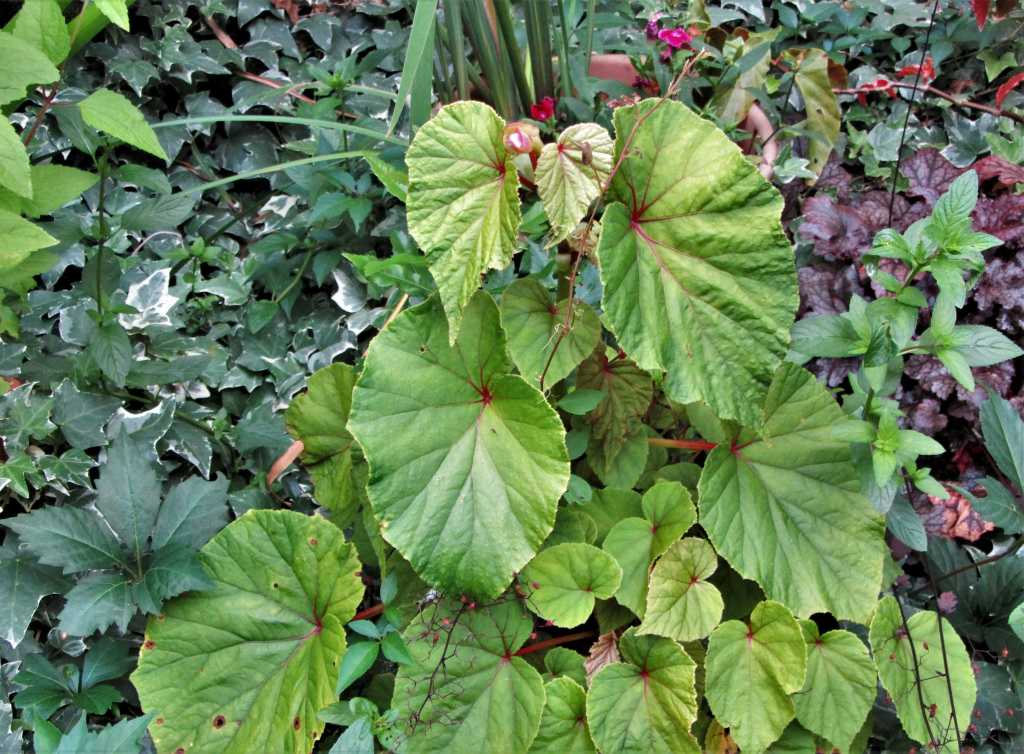
Perhaps gardening is, by definition, disturbance to the existing ecosystem of the land around our homes and on our allotments. We, the humble gardeners, serve as the apex predators, the megafauna in our own domain. That rather casts things into a different light, does it not?
For all of the years I’ve been grousing about the deer grazing our Hydrangeas and other shrubs, I didn’t fully understand that plants and animals live in symbiosis. The plants need pruning and thinning and the garden responds favorably, over time, to disruption.
Guy Shrubsole’s book about The Lost Rainforests.… remaining in the United Kingdom led me to Isabella Tree and Charlie Burrell’s book, The Book of Wilding- A Practical Guide to Rewilding Big and Small. Tree and Burrell have been ‘rewilding’ their Knepp Estate, inherited from Burrell’s family, since around 2002. Their land contains some of the remaining rainforest, and they have been learning by experience the most effective ways to restore the natural ecosystem on their land. Shrubsole writes about his visit to Knepp Estate, and their use of ponies, pigs and cows to help restore the natural vegetation. It sounds counter-intuitive, doesn’t it?
This book is helping me to look beyond the immediate damage herbivores cause by their grazing to see the bigger picture of how they help to shape the environment over time. Since our land is too small to bring in ponies or pigs, I’m left with the hungry deer, voles, turtles and bunnies, who rather like sheep, will do tremendous damage to woody and herbaceous plants. But given the opportunity and a favorable environment, the plants will produce abundant new growth to replace what was eaten, or pruned away. Or at least that is the theory…


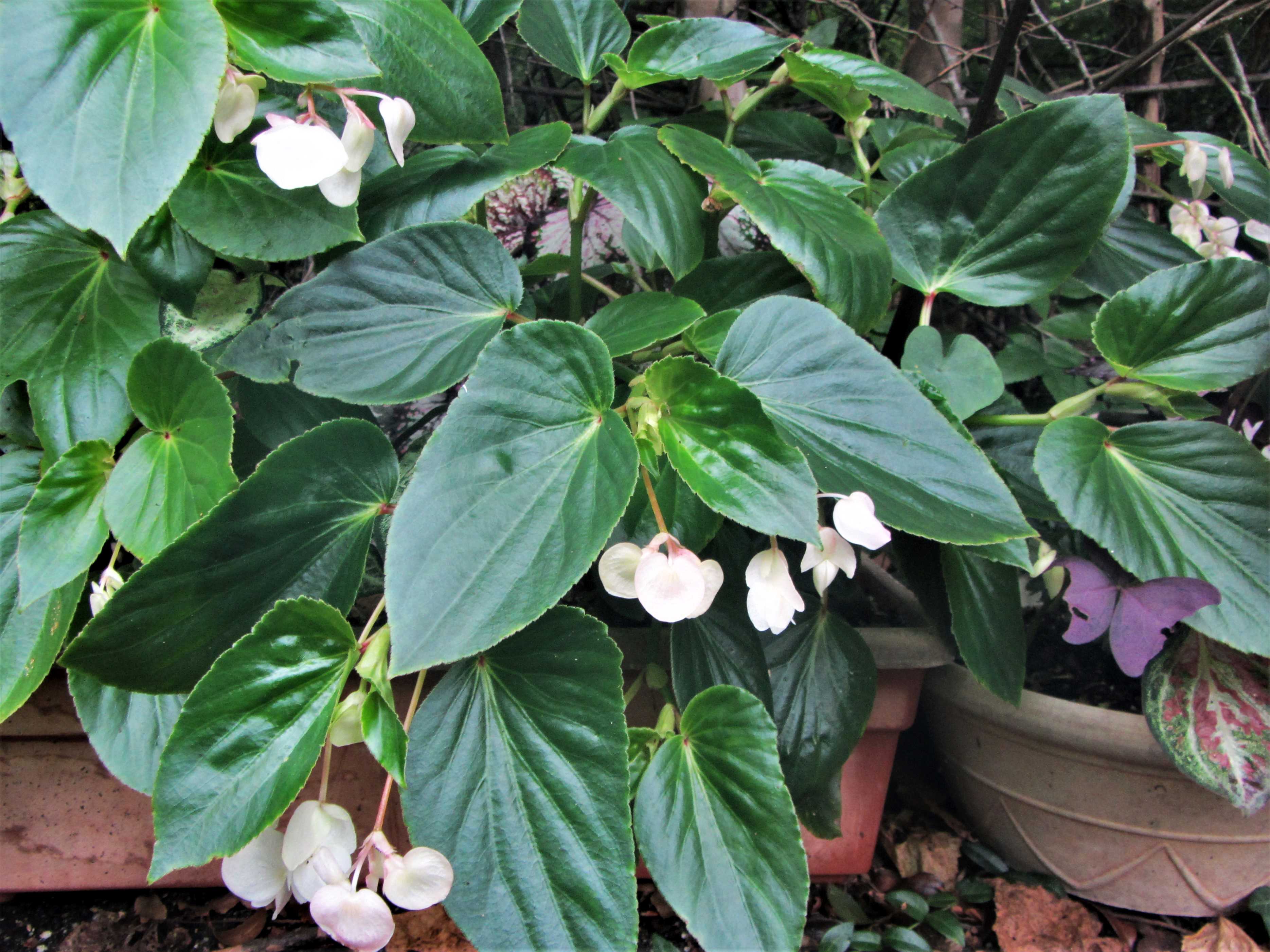
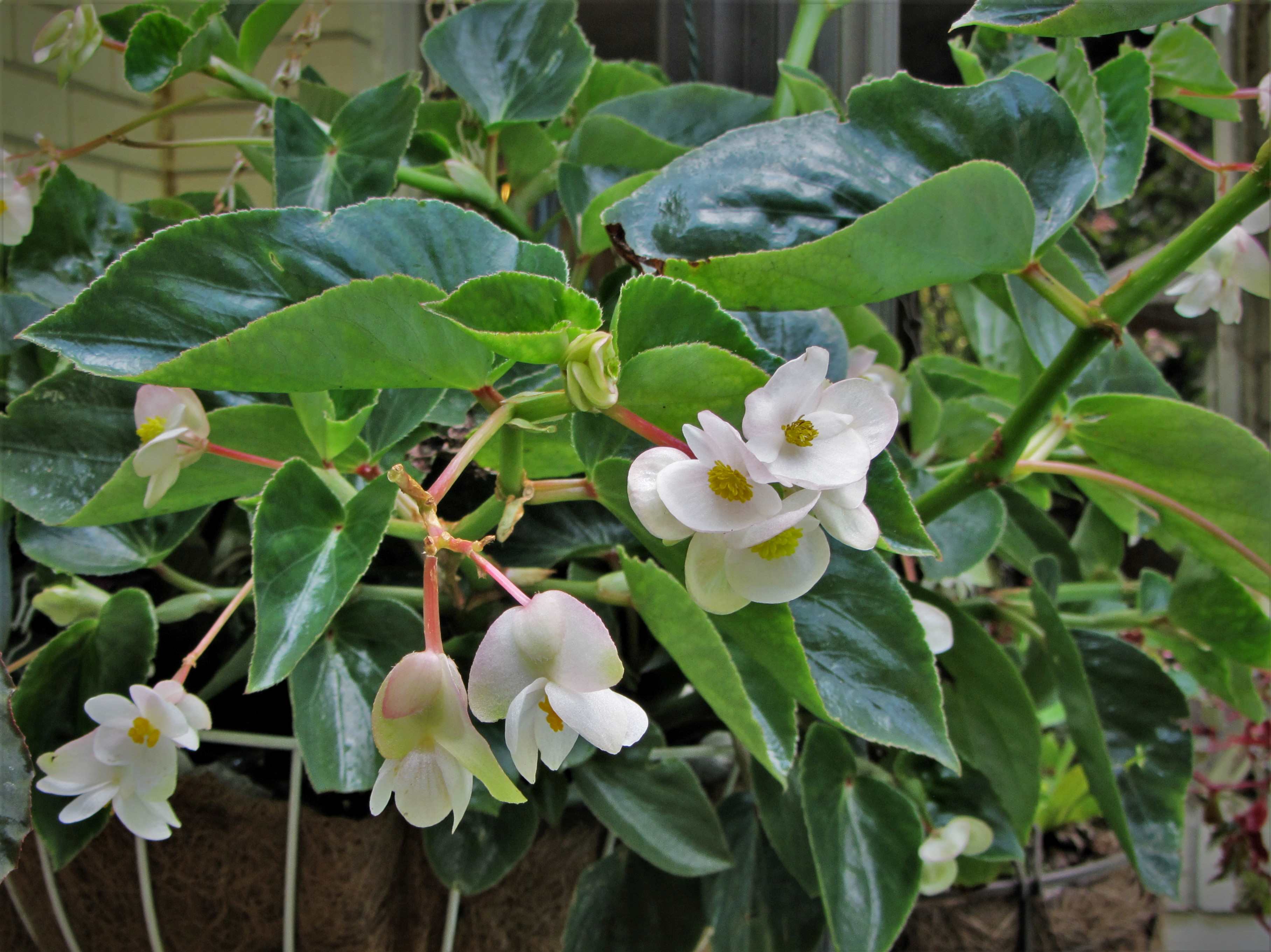
It was wicked hot here, yesterday. I came out to water a bit just before sunset, and found a favorite pot of white flowering dragonwing Begonia over on its side, more than half of its branches eaten away. It had been whole and upright on Friday morning.
This particular pot was grazed previously, along with another planting of the same Begonia. In both cases, the plants recovered quickly with abundant growth. They remain smaller than the same Begonia grown safely out of reach in a hanging basket, but they have survived. I moved the overturned pot to a safer location on the patio, watered it, and will likely move it to a more protected spot.
The series of photos shows the Begonia before and after grazing. The third photo is the other planting that was grazed a few weeks ago, and the fourth is a close up of the bloom in a hanging basket. For the record, the Hydrangea cutting growing in the larger planter beside the Begonia was grazed hard at the same time yesterday.
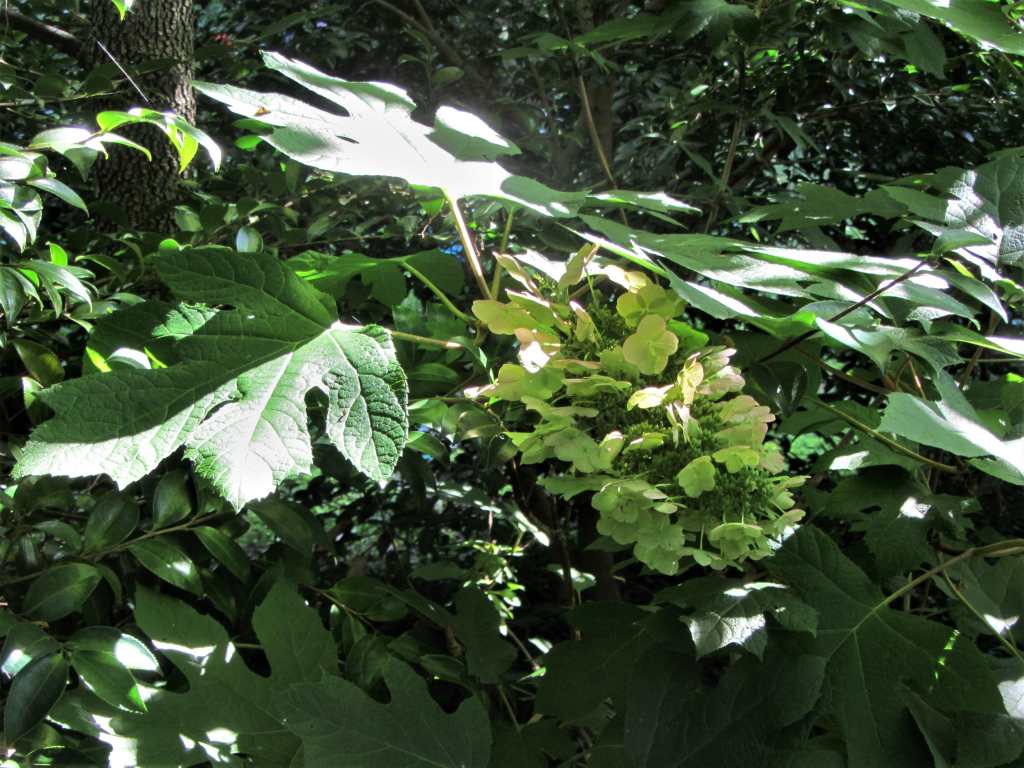
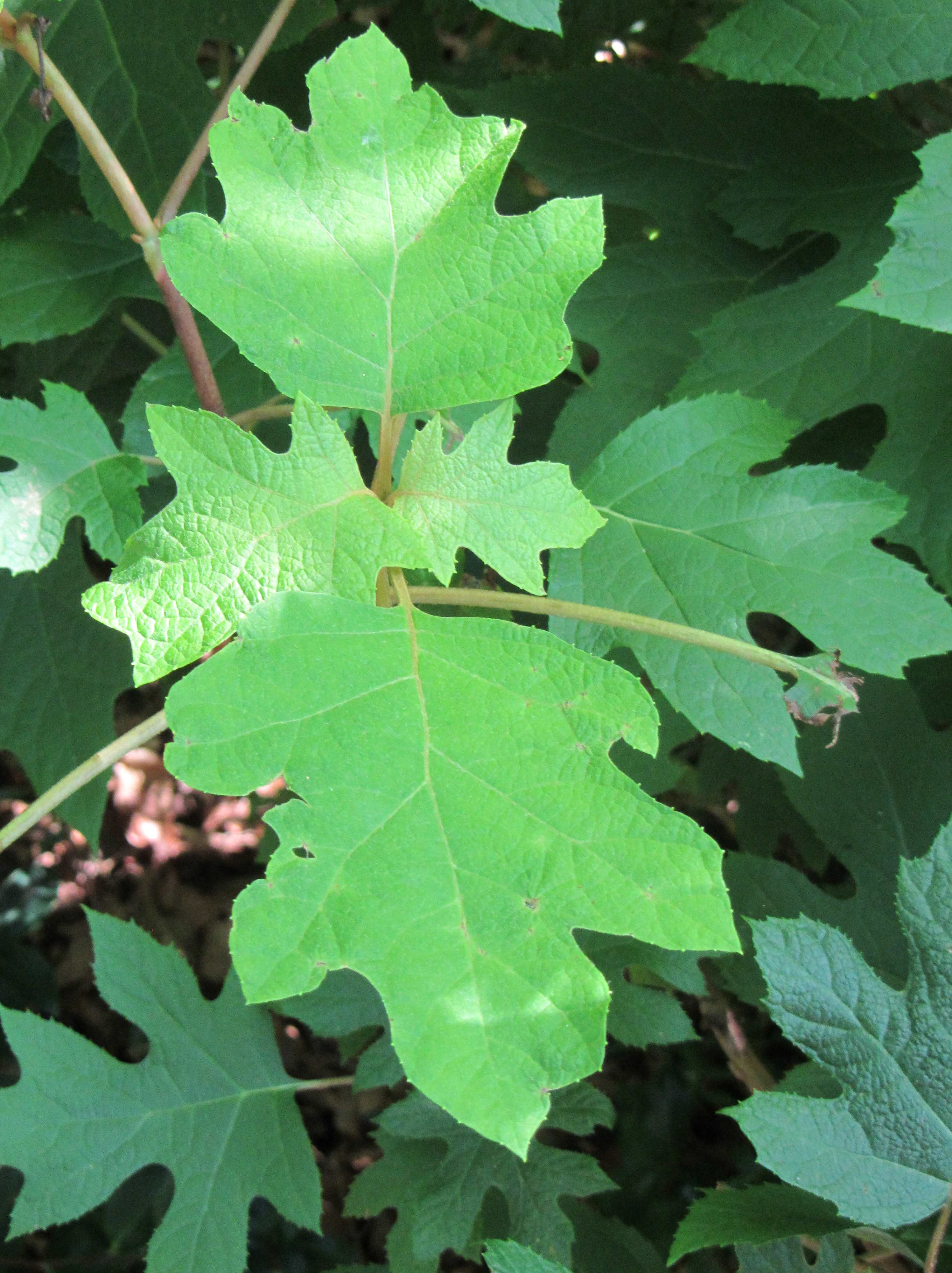

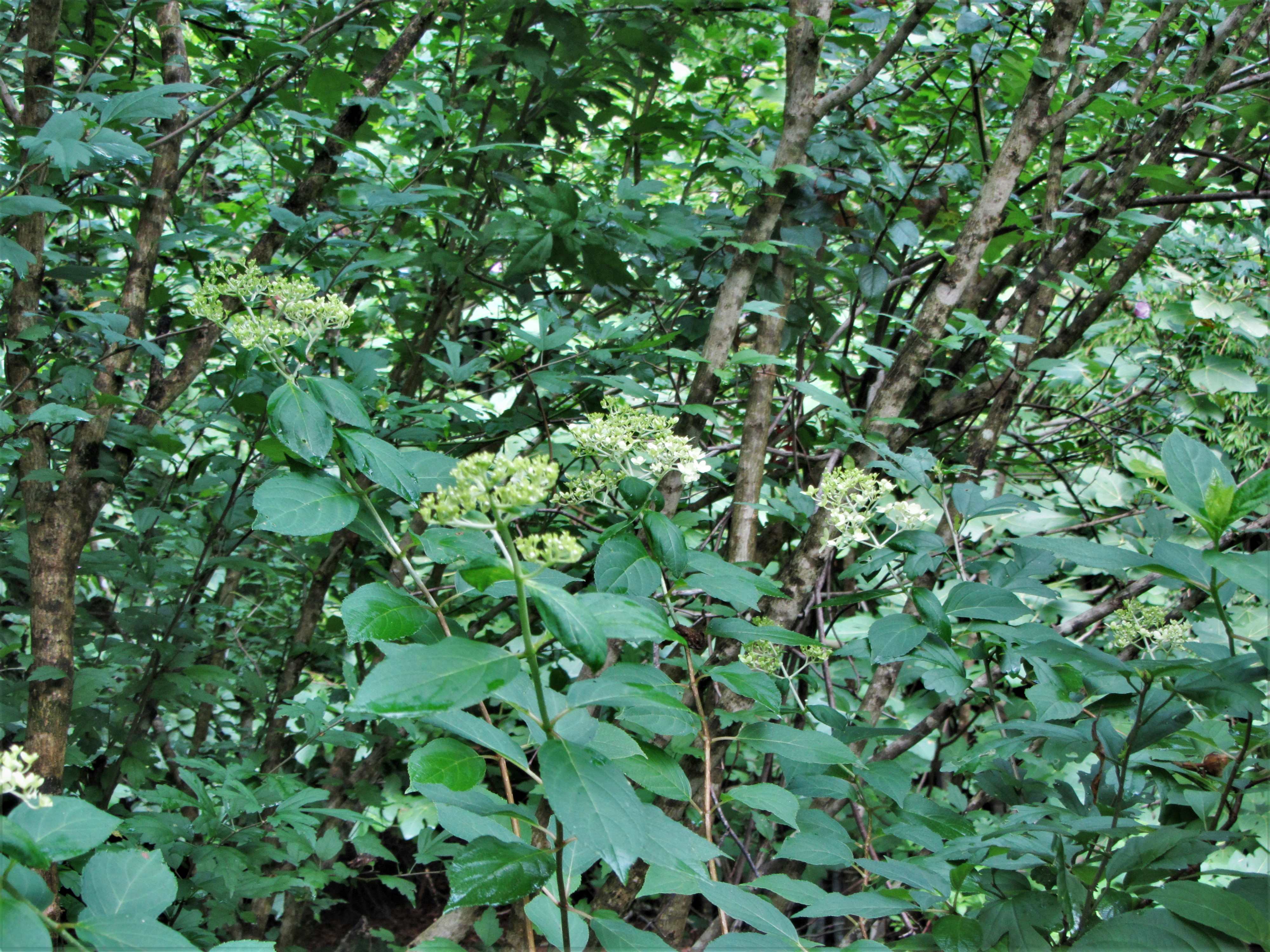
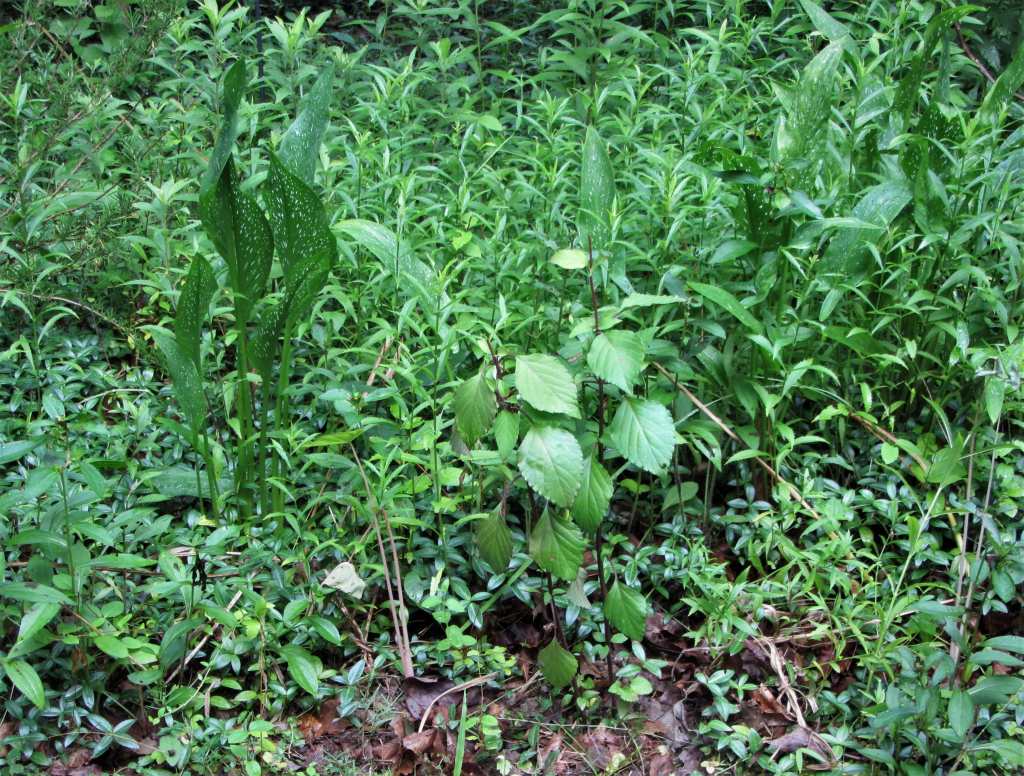
Our Hydrangeas are hit hard by the deer every year. Yet stubbornly, I keep growing them and keep looking for new ways to protect them. This series of photos shows a bloom of native oakleaf Hydrangea quercifolia beginning to turn pink. It is high enough to be above the reach of deer. The next photo shows new foliage growing to replace what was recently grazed on that shrub, and the next photos show other native Hydrangeas blooming as they recover from grazing earlier this year. The last photo is showing the first ever blossoms on a H. paniculata that I planted bare root several years ago. I plan to prune it hard this coming winter, expecting to get even more flowers next summer.
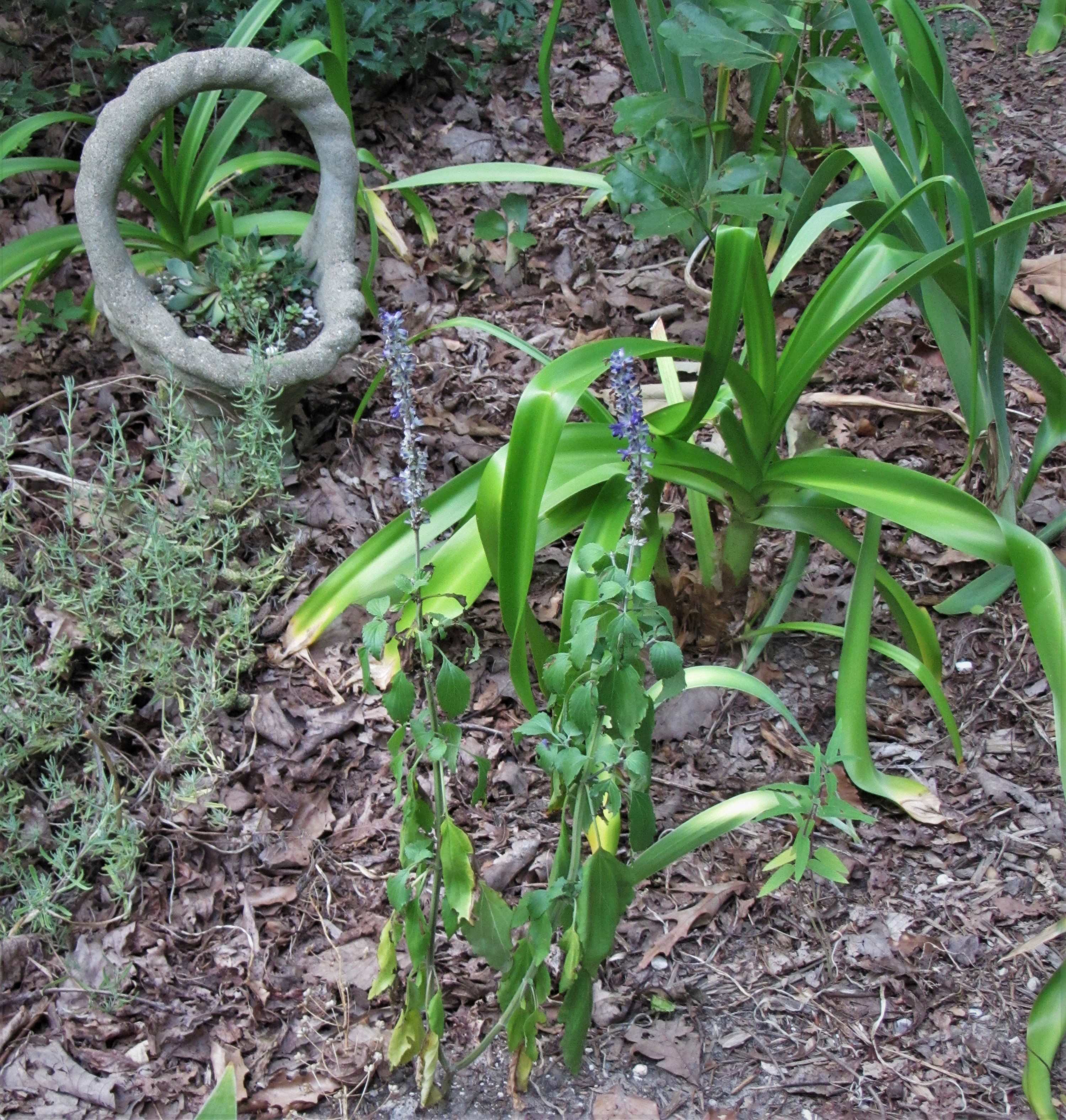
Sometimes, the disruption comes from my own carelessness. Last Saturday, I finished planting out a group of hybrid Salvias that have wonderful large, pink flowers. This will be the third or fourth summer I’ve grown this tender Salvia with great results. I picked up the last few pots from the garden center earlier this month so the plants were very root-bound.
Fast-forward to Tuesday morning, when I was tidying up with the string trimmer, and a slip of the wrist rendered the newly planted Salvia sheared as well as a sheep could have done it. I collected the stems and got them into water right away to root. Now, I’m waiting to see whether this sheared Salvia blooms better than the several others planted without severe ‘pruning.’ Time will tell…
The second Salvia in this group is ‘Mystic Spires,’ one of my absolute favorite drought-tolerant Salvias. It is a hybrid of the ever-faithful S. farinacea ‘Victoria Blue,’ and a magnet for pollinators. This is another newly planted ‘late season’ addition struggling with our heat. I know it rained Thursday night and Friday morning, yet the plant was this wilted by Friday evening. I’ve since pruned off its flowers and deeply watered it. It requires care until its roots establish, and then it will be very tough.
The weather is a frequent disturbance that brings change to our garden. I am trying to move beyond classifying ‘change’ as good or bad, and rather just remain neutral and cheerful in the face of what comes. The other books I’m reading this week are updated, edited versions of the writings of Epictetus (The Manual) and Marcus Aurelius (The Meditations) compiled by Sam Torode. Taking a stoic view helps reduce the drama of responding to ‘disruption’ and ‘change.’ Reading these four books together enriches the experience and wisdom of each of them.
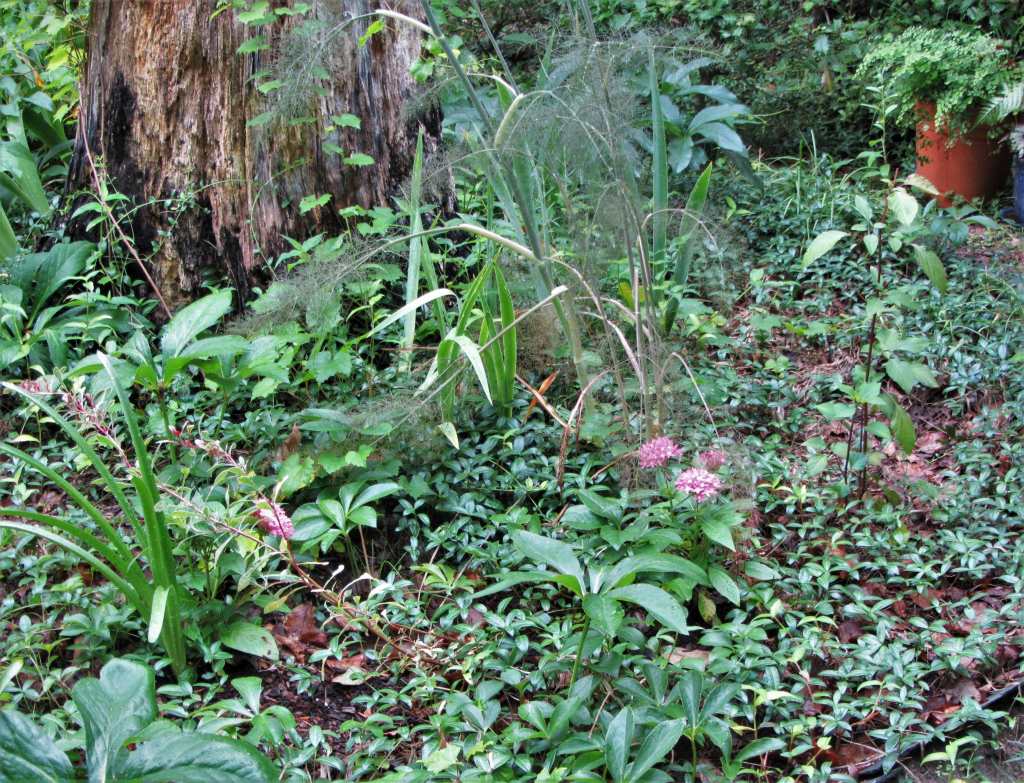

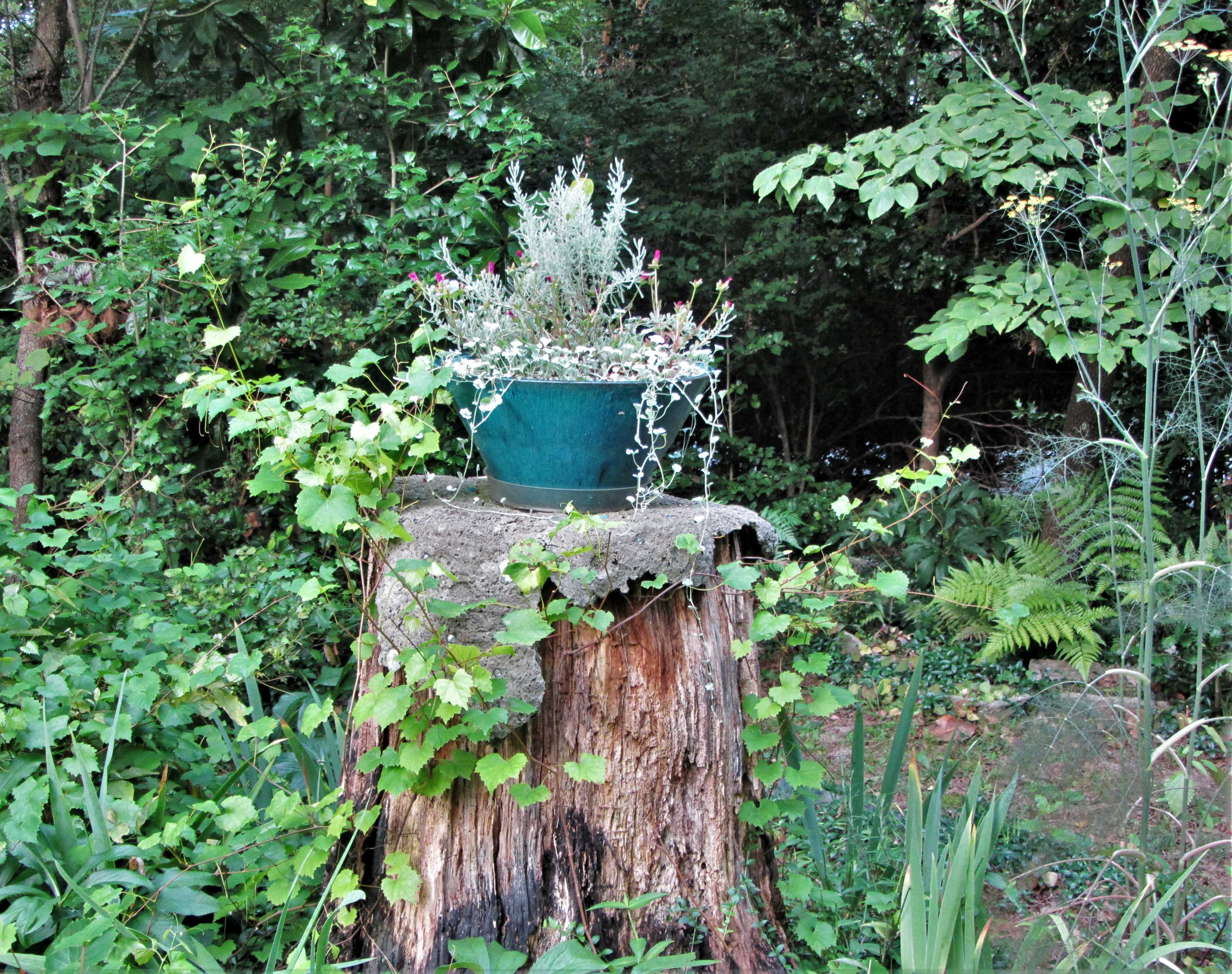
Ten summers ago, a severe thunderstorm, that probably had a small tornado with it, destroyed several of the trees in our front garden and changed it forever. Full shade became full sun in the space of perhaps three minutes. One of the oaks was twisted off about 20+ feet above ground, and we had it sawed cleanly in a way that I could grow a container on top of it. It was still ragged enough that I capped it with a ‘decorative’ hypertufa covering, and then built a raised bed around the stump. It has held many different plants over the years. Now it has settled into Vinca, Hellebores, Iris, fennel, spring flowering Narcissus, and native grape vines. Originally, I wanted the grapes, that I planted from saved seeds, to grow over the stump. It has taken all of these years to see that begin to happen.
This spring, I planted a new hybrid Gaura ‘Passionate Rainbow’ and some matching pink Pentas. Perhaps there is more shade here now than I reckoned, because growth is slow. But none of the Gauras in our yard, even those in much brighter light, have done much thus far in our strange weather.
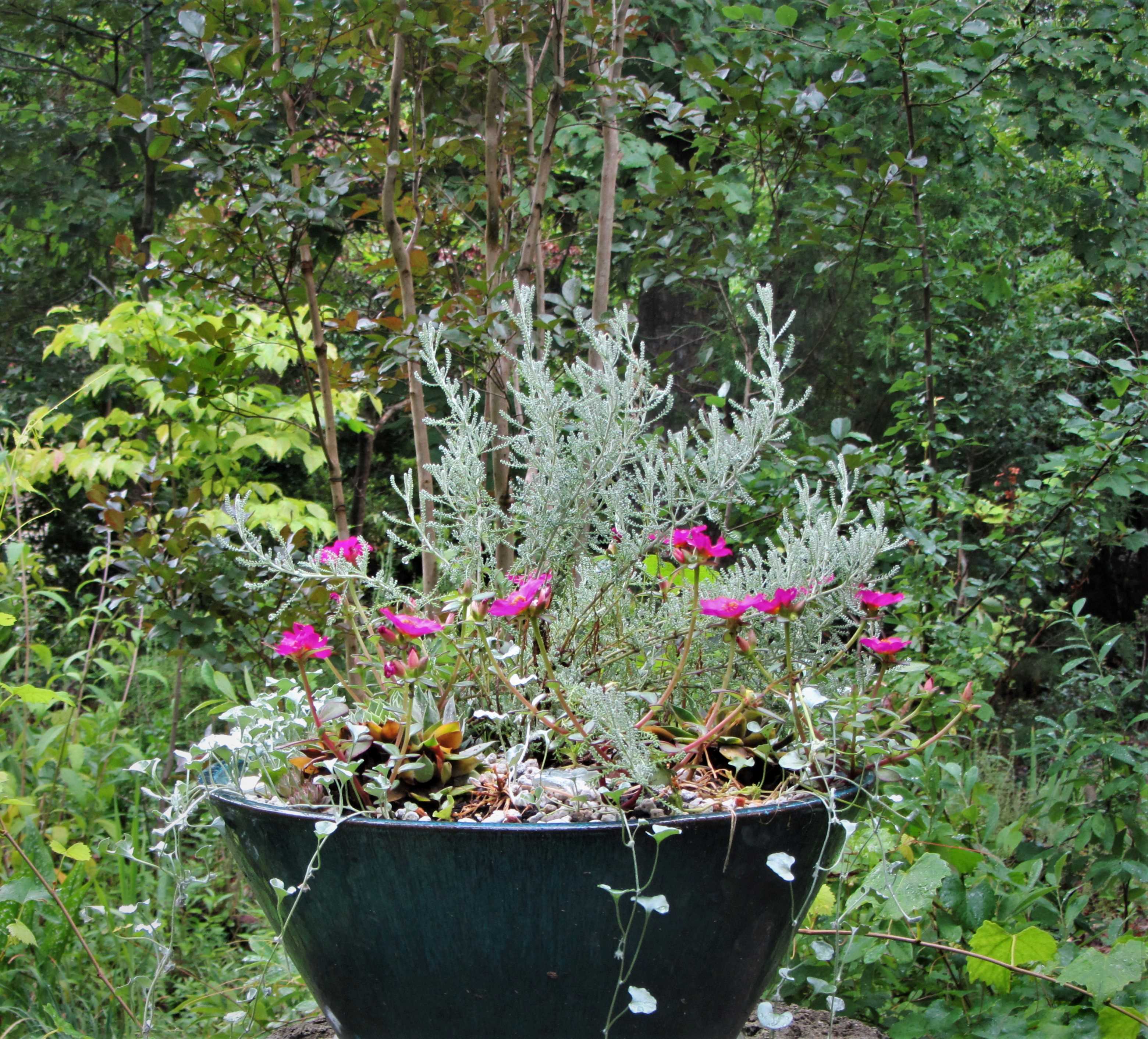
The photos show two views of the raised bed, including another of those new Salvia plants, followed by a larger view of the oak stump with grapevines finally claiming it as it deteriorates. The last photo shows the container planting of drought-tolerant plants, which are doing extremely well. There is Santolina, Portulaca, Echeveria and Dichondra argentea in the planting. The Portulaca has taken off from cuttings pushed into the pot several weeks ago.
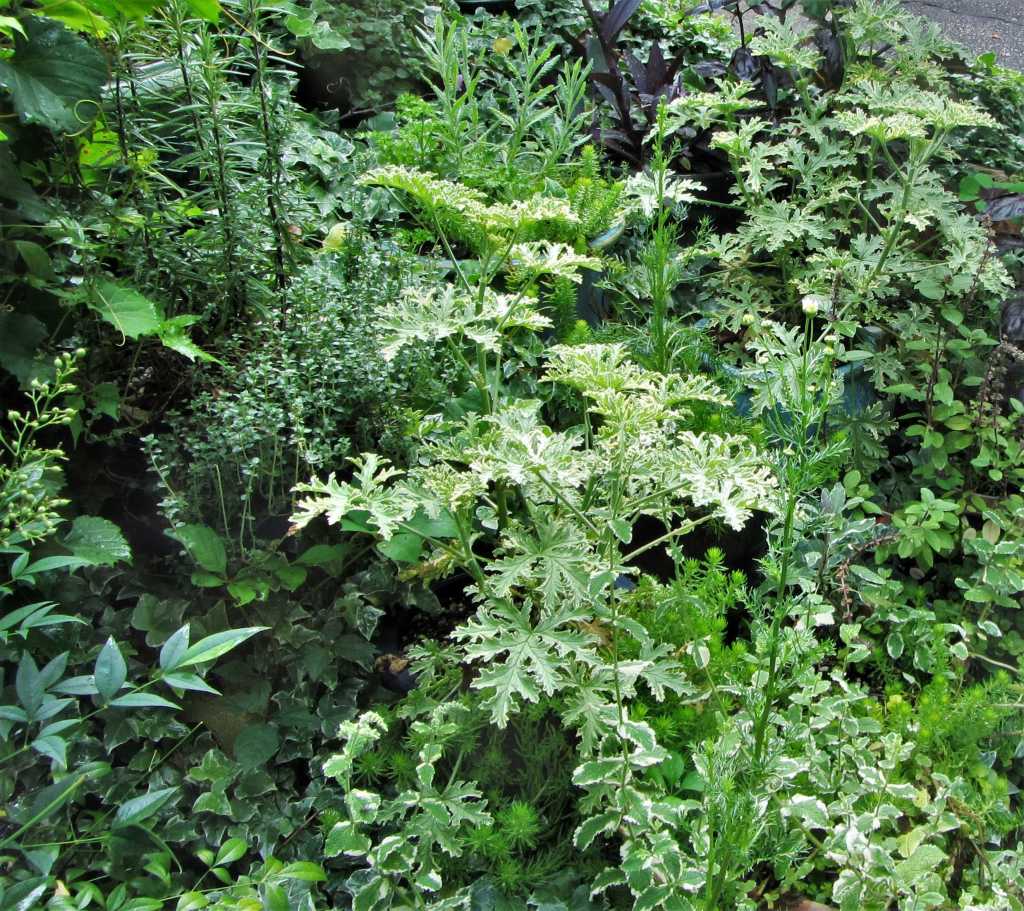
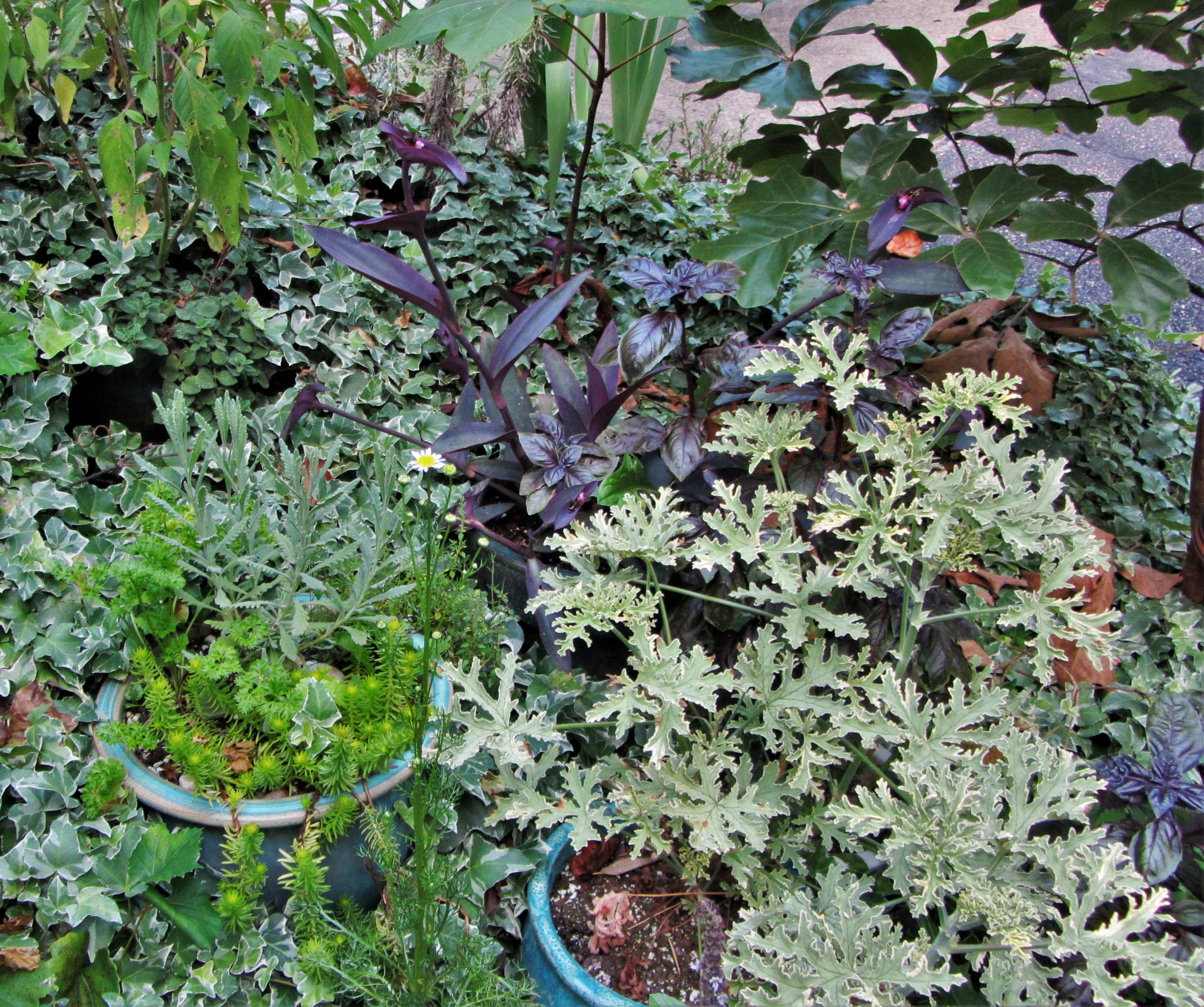
Finally, I’ll close with two views of a planting that is performing very well. This is a sunny area where I’m growing various herbs and perennials in containers. Our neighbor gave us two Chamomile seedlings in the spring, and they bloomed this week. I disturb this area almost daily by watering, weeding, and perhaps harvesting a bit of basil for lunch.
Haven’t we all learned to live with a great deal of disturbance and disruption in recent years? Perhaps we, like the land itself, will respond with new growth, more biodiversity, and greater resilience. At the least, we have the opportunity to create something beautiful in the spaces where we have experienced loss. It just takes courage, creativity, and a vision of what we can accomplish to keep moving forwards towards what comes next.
With appreciation to Jim Stephens of Garden Ruminations, who hosts Six on Saturday each week.
You might enjoy my new series of posts, Plants I Love That Deer Ignore.
Visit Illuminations for a daily photo and quotation
 Our Forest Garden
I have just finished Guy’s Rainforest book. I tried to tentatively discuss it with my farming brother-in-law! Probably not the best first choice. Anyway, I enjoyed the lessons from the book. Hopefully your Salvia will root for you.
LikeLiked by 1 person
Please let me know how that goes- the conversation. I appreciate how Guy presents both sides of the issue throughout his book. Even if farmers would turn some of their least productive land back to forest it would have a huge impact. But it may be that the royal estates changing their priorities from hunting and grazing to land restoration could make the biggest impact. Thank you for all good wishes on the Salvia. I’m watching them daily for a hint of a root. I just planted out a pineapple sage plant grown from a similar ‘mistake’ earlier this spring. Fingers crossed… ❤ ❤ ❤
LikeLike
I really like the last 2 photos, actually with your plantings . You can’t even see the pots anymore, it’s so dense and well arranged.
LikeLiked by 1 person
Thanks very much, Fred. That area is always fun. It started when we had mostly shade elsewhere in the yard, and I wanted to grow a lot of basil. Every pot on the steps held basil, the first year or two. Then, like everything else, it shifted and evolved. Last year it was mostly scented geraniums. The unusually cold winter gave me the ‘opportunity’ to replant most all of the pots this spring. ❤
LikeLiked by 1 person
Disturbance is not how we want to think of gardening. Some are offended by the concept. I suppose that I sort of get offended by those who insist that it brings nature into their environment. I certainly enjoy gardening and unnaturally manipulative horticulture, but I do not try to portray it as natural. I can not doubt that houseplants from South America are appealing within local home or office interiors that would otherwise be devoid of vegetation. Nor can I doubt that trees from Australia make the urban landscape of Los Angeles more comfortable. I do get offended though, by so-called ‘environmentalists’ who want to protect aggressively invasive species, such as silver wattle, pampas grass and broom, that have become naturalized here, and are detrimental to the natural ecosystem.
LikeLiked by 1 person
All good points, Tony. I never really considered it that way, either. It is an interesting idea presented in these British books that implies that by gardening, we keep the landscape at a certain, desirable, point in the process of succession. For example, if we did nothing here in coastal VA, much of the land would return to a thick forest. The forest would then shade out many desirable native and non-native species and limit the types of birds, insects and other animals that could survive in that environment. By interrupting that process, we can provide habitats for a much richer bio-diversity of plant and animal species. I manipulate our space to provide for birds and insects by planting species I know will attract them, and I definitely disturb things here that I consider weeds. I don’t know any East Coast environmentalists in favor of protecting aggressively invasive species. Rather, our issue is people buying things that they don’t know are invasive because they are for sale at the local home center or garden center- like pampas grass. I had a similar conversation with a neighbor about an invasive, but beautiful, shrub on the property they just purchased (Euonymous alatus) And, there is a difference between restoring 100s of acres of public or private land to a more natural state, and what we do to landscape small areas around homes and businesses. It is a different process entirely. Thanks as always, Tony, for leaving thoughtful comments. (What Australian trees are grown in LA? I’ve always wished I could grow tree fern here, but our climate won’t support it.)
LikeLiked by 1 person
Eucalypti were formerly popular in the Los Angeles region, and should still be popular. (Blue gum and red gum were the huge and very problematic trees that gave all Eucalypti a bad reputation.) Eucalypti are native to chaparral climates, so are right at home in much of California.
LikeLiked by 1 person
Gabe Brown, writing about regenerative agriculture, was for keeping livestock in the mix because plants were stimulated to make more growth by light grazing. He pointed out that the herbivores would have been kept on the move by apex predators, so preventing localised over-grazing. Those ecosystems would have developed over many thousands if not millions of years and reached a fairly stable equilibrium which would have been disturbed by climatic events like ice ages and the occasional new animal or plant arrival, but nothing remotely like the level of disturbance wrought by humans in just a few hundred years. It gets tricky when we try to cast ourselves in the role of apex predator, gardens (or farms) are a profoundly unnatural ecosystem to begin with. I think it’s interesting that the complex ecosystems of the prairies evolved to maximise plant growth, just the right amount of grazing to stimulate more growth, not so much that there is less. That way the plants get to maximise the amount of energy they get from the sun and that in turn supports the maximum number of herbivores, then carnivores, that depend on the plants. The whole system gains. Maximising plant growth has become something of a guiding principle with me, so I am not prepared to let slugs or rabbits or caterpillars take very much. What is missing is their natural predators and I’m happy to take that role. The key word you use is symbiosis, which in all its myriad forms, involves a far greater amount of co-operation than some neo-darwinists want to admit to. I just read Frank Ryan’s “Darwin’s Blind Spot”, and both Lynn Margulis and James Lovelock in the past, and symbiosis is an immensely big, and largely untold, part of the story of life.
LikeLiked by 1 person
The more we come to understand plant, animal, fungal and microbial interactions the more we find evidence of the deep levels of symbiosis undergirding the entire ecosystem. It isn’t just that we plant a seedling and water it. Rather, the seedling begins to develop connections with everything in the environment around it that supports its growth. As with everything else in this living system of ours, there is continual ‘give and take,’ inhalation and exhalation, growth and decay. We humans are a part of that system, and I believe that our creative thought and attention impact it. The reverse is true, also. Understanding and working with these various relationships is key to our positive stewardship of the resources in our care. ‘Back in the day,’ before the explosion of human population, there was more space available for those vast grasslands, forests, and wetlands to support the grazing of various herds. There was the potential for balance, and restoring balance after major disruptions. We have taken so much land out of normal use and paved it, built upon it, sheared it and poisoned it that those natural systems are struggling in many parts of the planet. I admire and support the efforts at restoring the ecosystems and finding new balance. In fact, I’ve come to understand that the key to restoring balance to our climate and to the various biomes on our Earth is through cleansing the air of certain gasses by using plants to filter the air and sequester carbon and other elements. We can never go backwards to what things were in the past. We can only move forward and find a new balance that supports the needs of as many species as possible. I work mostly with the plant kingdom. Tree and Burrell’s book has opened my understanding to the importance of the interactions of animals- even seemingly ‘destructive’ ones- to finding balance in an ecosystem. In the past, I’ve just been grateful to find birds, insects, small mammals and reptiles living in our yard. I get the importance of pollinators. Now I am trying to understand how even those who graze my beloved plants- even the deer that we work so hard to keep out of our space- have their role to play. I’m working with these ideas on a residential scale on our acre. And I allow the birds and reptiles to help handle the snails, slugs, and certain insects. The ideas are applied a bit differently on the larger scale of estates and national parks.
LikeLike