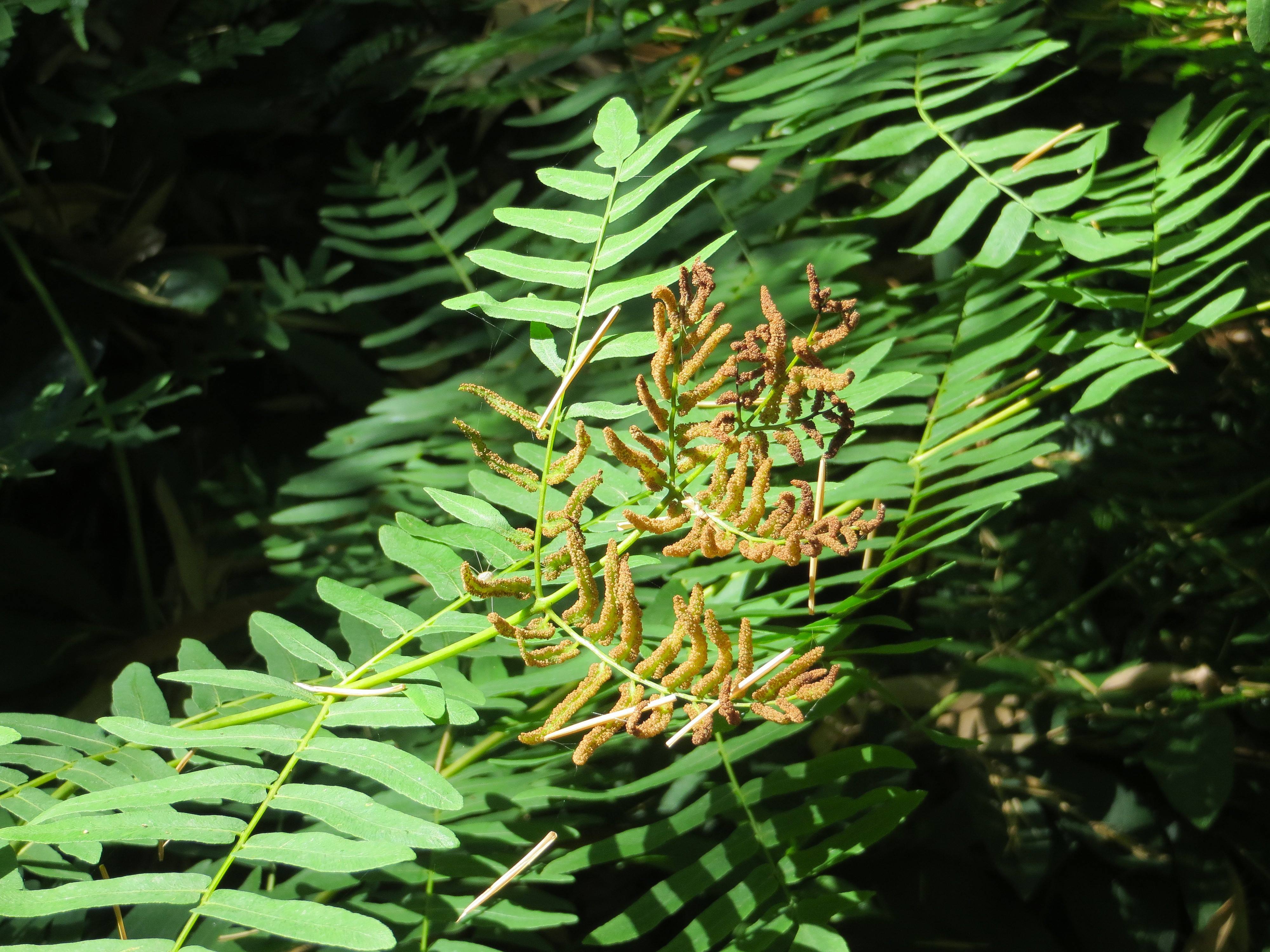
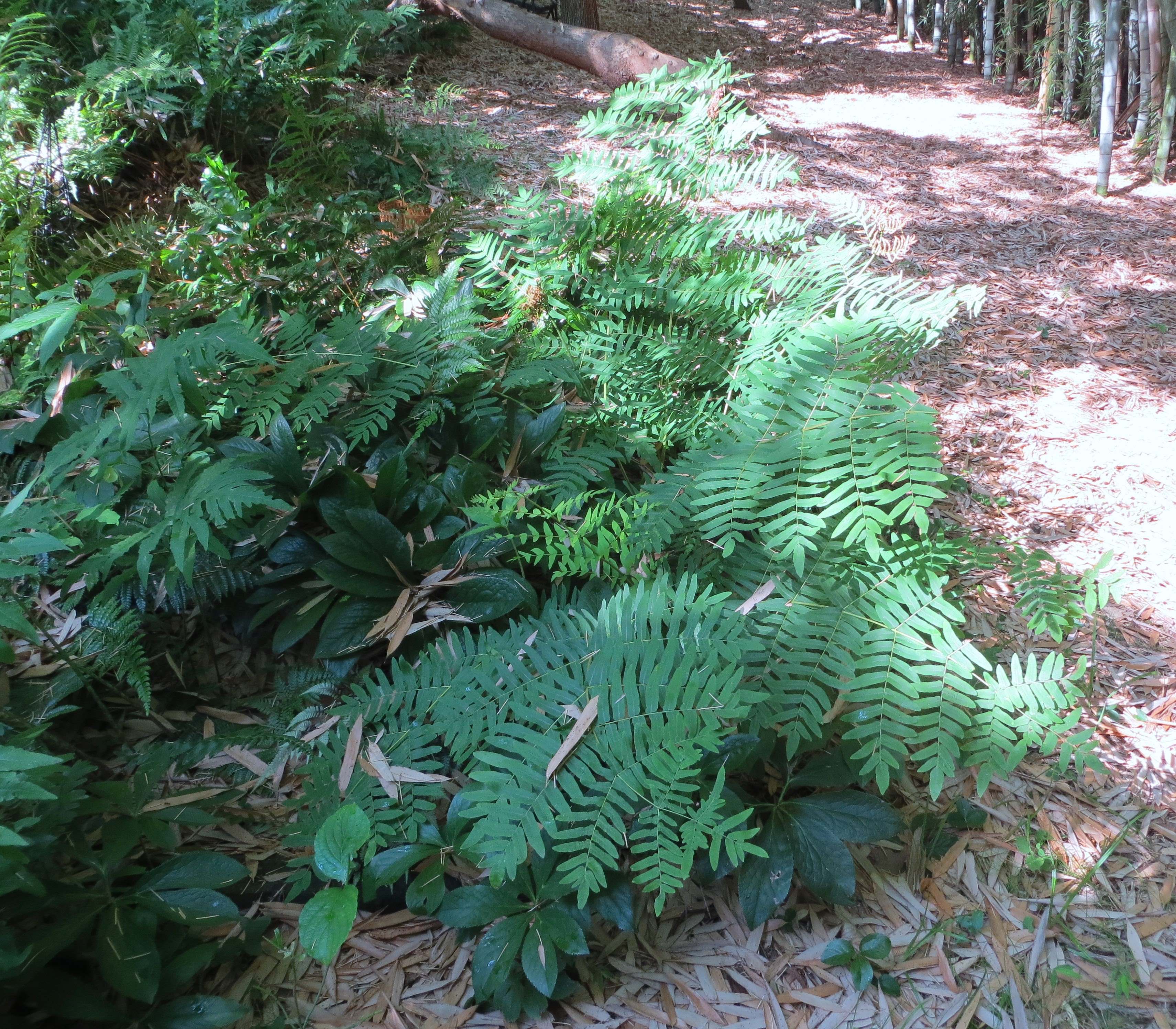
Let’s begin with an ancient fern, Osmunda spectabilis or O. regalis var. spectabilis, depending on how current you may be on your botanical nomenclature. I learned it as the latter. Royal fern, whether you are discussing O. regalis, the European, African, and Asian form, or O. spectabilis, which is the native form in North and South America, is a very large, coarse, deciduous fern whose earliest dated fossils are more than 230 million years old. This makes it one of the earlier plants to develop in wetlands well before the first flowering plants appeared. It likely served as fodder for many a dinosaur or ‘dragon’ back in day.
Royal fern belongs to the family Osmundaceae, which evolved on the ancient supercontinent of Gondwana, during the Jurassic age. Since its appearance has not substantially changed in the last 180 million years, we consider the royal fern to be a living fossil, offering us a glimpse of the flora that flourished long before humans appeared. It prefers consistently moist soil in partial shade, but will tolerate quite a bit of sunlight as long as it has enough moisture.
The name Osmunda may have been derived from the name of the Saxon god Osmunder. Osmunder was also known as Thor in Norse legends. There are various reasons why this fern is called a ‘royal’ fern, but certainly it is one of the largest ferns with the largest, widest fronds in most temperate gardens in Europe and America. It can grow to 5′ tall and wide once established. Its spores are borne on the tops of specialized fertile fronds which emerge some weeks after the infertile fronds.
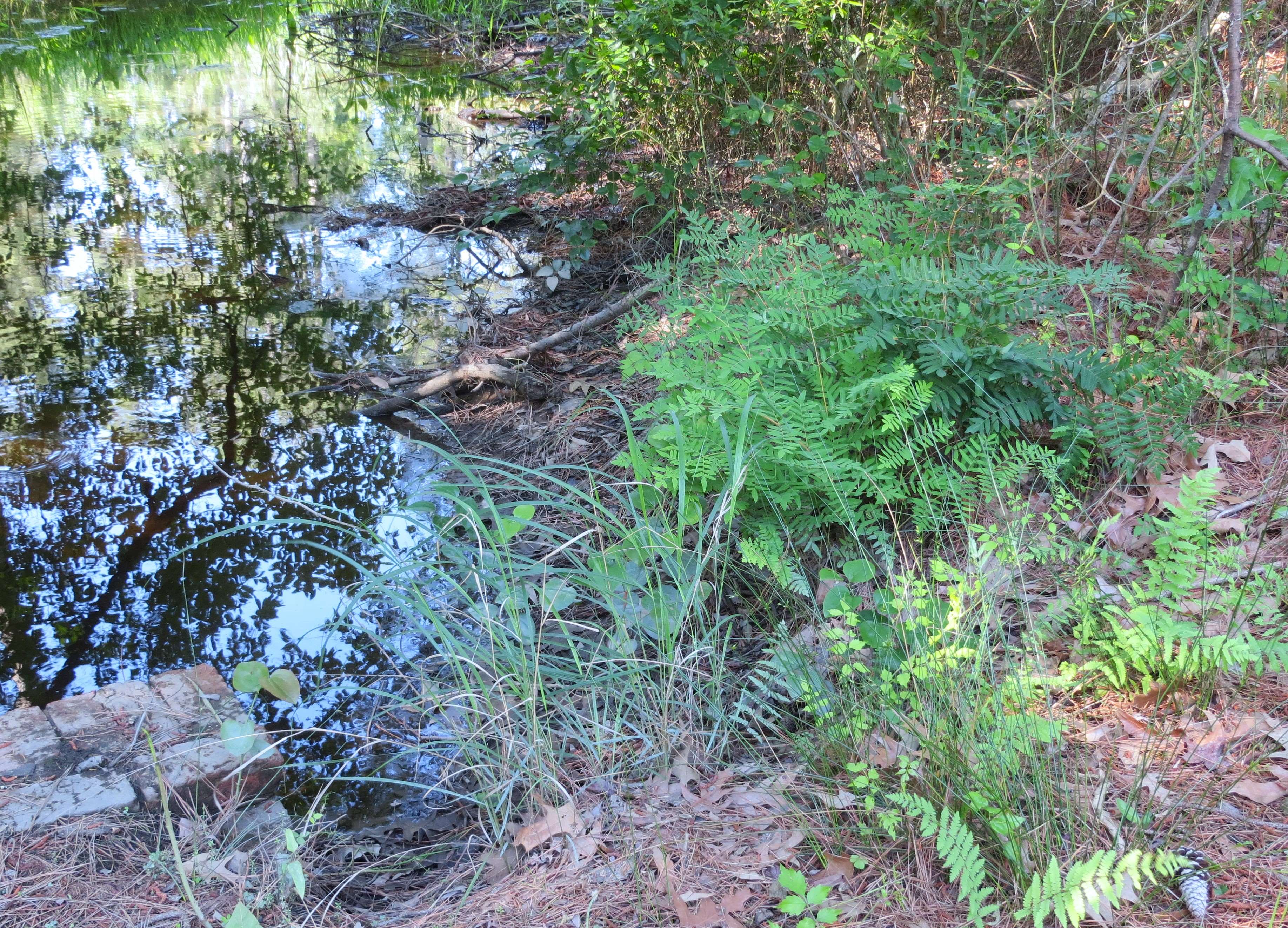
This is an easy fern to grow, and can be found growing wild in nearby wetlands. The third photo shows a royal fern growing on the edge of a drainage creek on Jamestown Island. This fern grows along the lowest edge of our first cultivated fern garden, nearest the ravine, and yet the deer don’t graze it. They will sometimes leave a newborn fawn resting in the shelter of this and nearby ferns, but they don’t damage the fern.
Osmunda turns yellow in fall as the weather cools and its fronds fall away by early winter. Botanists have only recently determined the O. spectabilis is a separate species from O. regalis. The closely related cinnamon fern, Osmundastrum cinnamomeum, grows to similarly royal proportions and also has fertile fronds, which somewhat resemble cinnamon sticks.
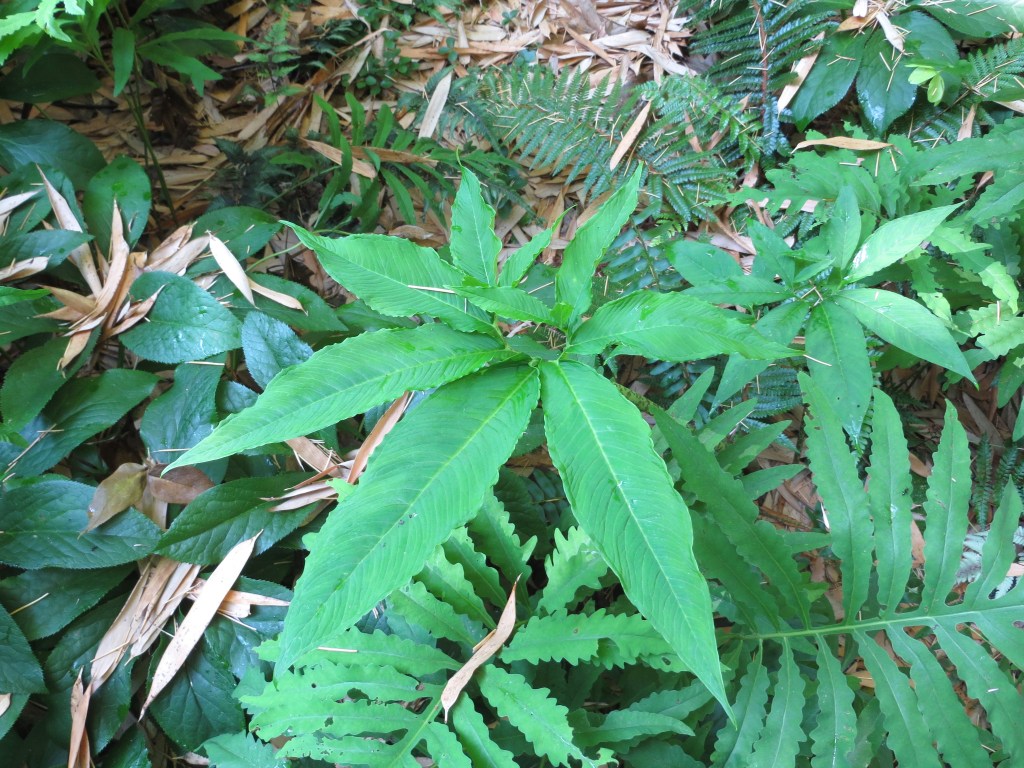
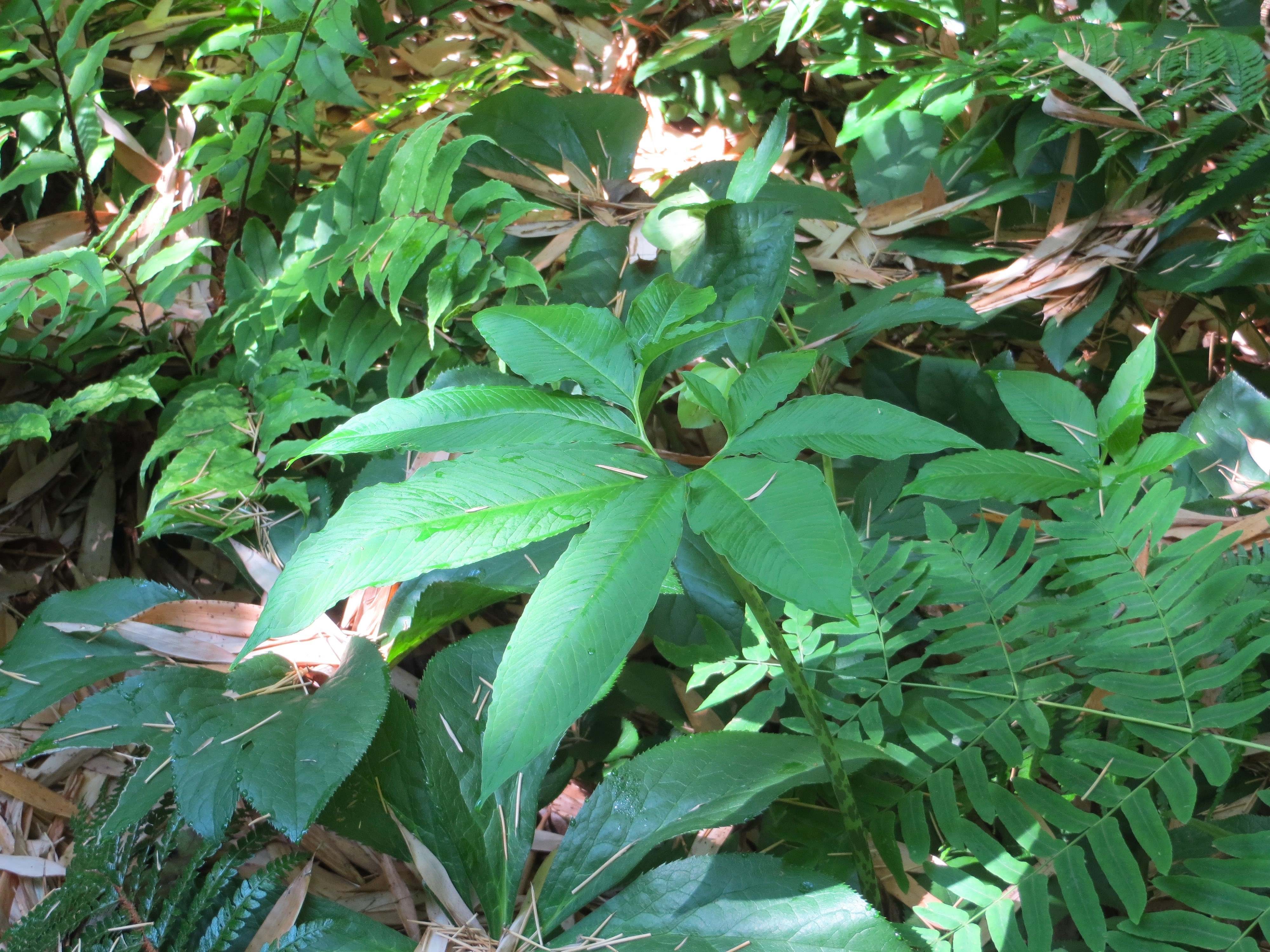
Another ancient plant, the aroid Sauromatum venosum, known as the ‘voodoo lily,’ grows near our royal fern. It also looks like a living fossil from another age. It first blooms with a long, tubular, purplish and green spadix and spathe flower before the first leaves appear. Aroids tend to have an unpleasant odor to attract flies and ants to pollinate them. But I grow them for their marvelous leaves, which are poisonous as their name suggests, and will not be grazed or touched for the duration of the summer. Their leaves disappear as the weather cools and the bulb rests for another year. This entire part of the garden is carpeted in bamboo leaflets.
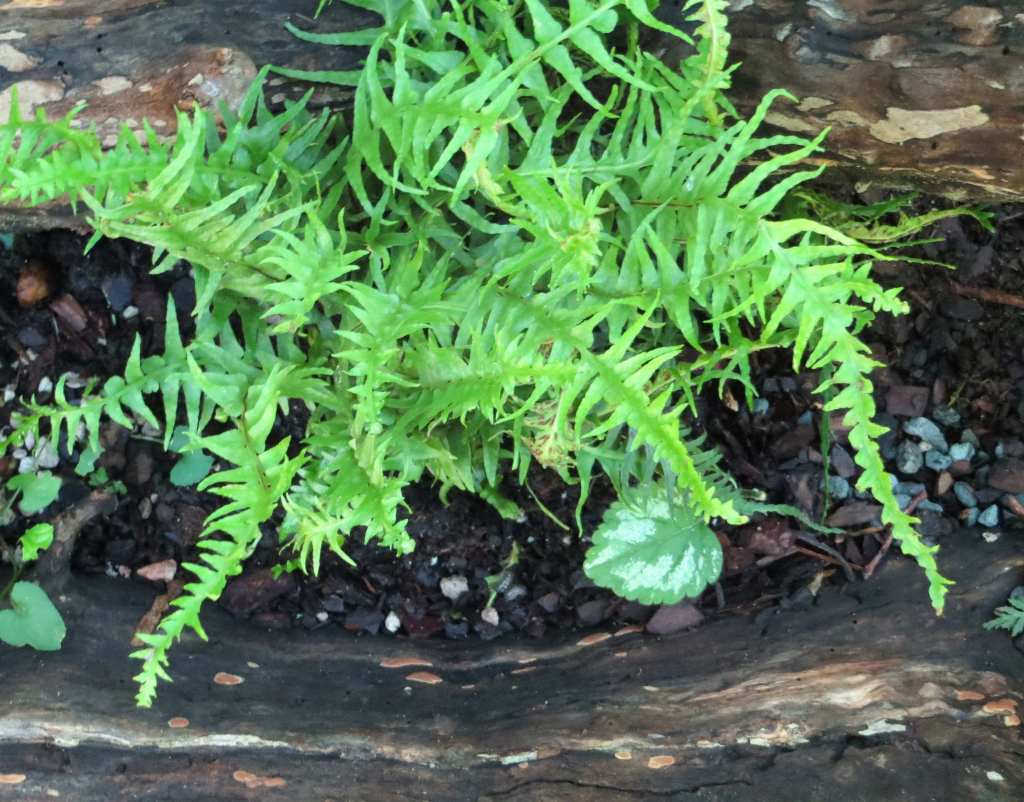
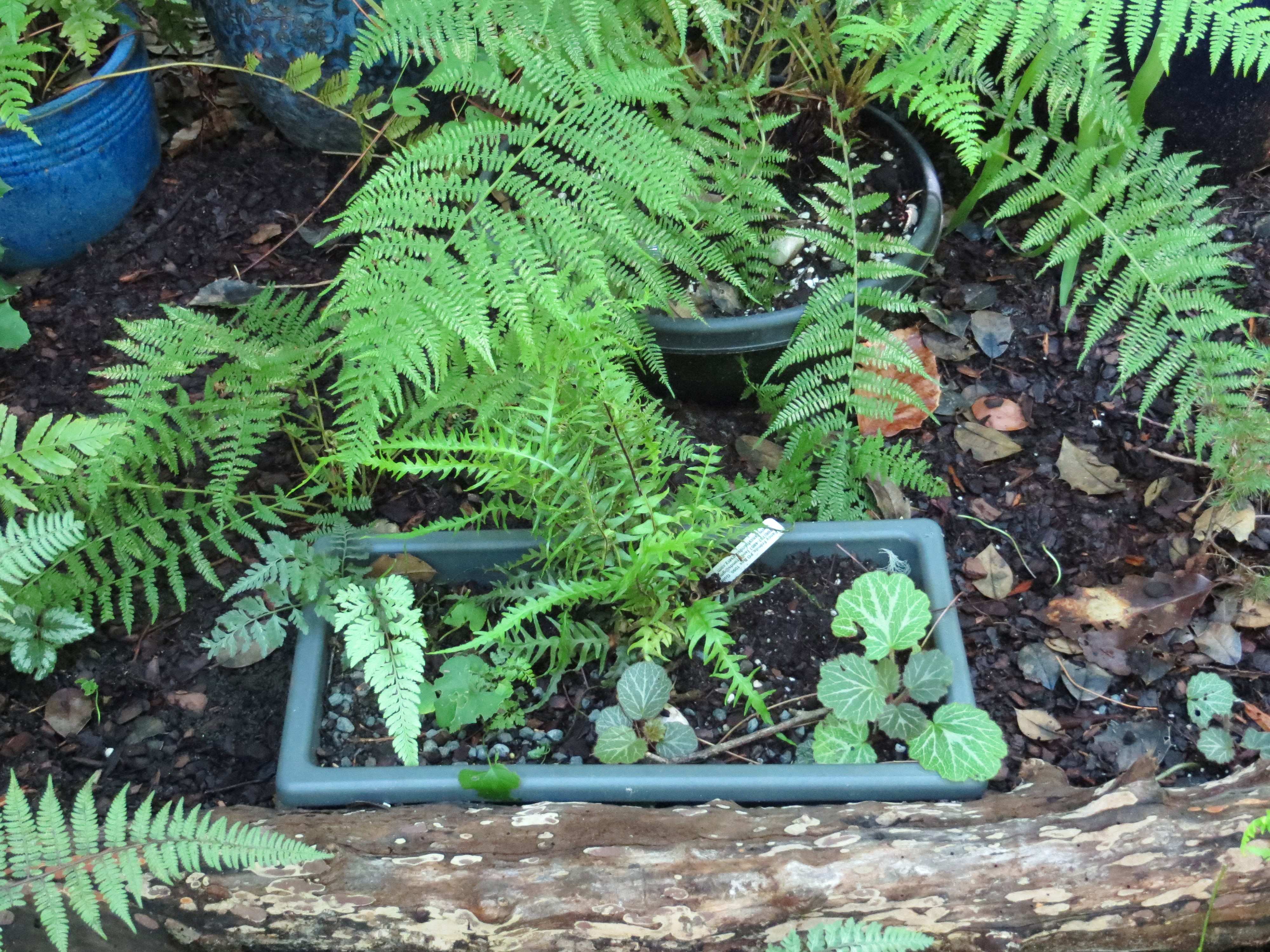
The dragontail fern, Asplenium x ebinoides, is a natural, native hybrid of ebony spleenwort. This fern is a new addition just planted within the last week, grown by Fancy Fronds Nursery in Washington, near Seattle. I like its whimsical appearance, but also its trait of rooting when the tip of a frond remains in contact with the soil, which allows this fern to spread around. It is evergreen and hardy to Zone 5.
I ordered several of these earlier this month to use in the newest fern garden that we constructed this spring. I wanted to replace some maidenhair ferns which didn’t survive the winter and also establish Asplenium in this area. My previous efforts to grow A. platyneuron haven’t succeeded, likely because of our recent dry summers, and so I am going to give this hybrid a try in a newly constructed, enriched bed, among other young ferns and recently transplanted perennials. I have quite a few containers holding this bed at the moment while the plants root in, and I expect to replace them with plants rooted directly into the bed as the area matures.
While I would happily fill the rest of this post with photos updating how favorite ferns are coming along, I will show a modicum of restraint and turn, instead, to my summer mainstay plants, the very poisonous Aroids which mostly survive our weather and our fauna in June through September, at least. Aroids are geophytes, growing from ‘bulbs.’ They can live some part of the year in a dormant state without soil, moisture, or light.
There are over between 100 and 150 different genera within the Araceae family, and most are cultivated for their showy leaves rather than for their mostly insignificant flowers. The bulbs of some members of this family are edible (poi comes from taro, or Colocasia). But there are tiny irritating biochemical ‘crystals’ in the leaves of most aroids that make them extremely irritating to the mouth when a creature tries to eat them. They are also mostly tropical plants, though some are hardy in our Zone 8, and they thrive in our hot, humid summers. Aroids succeed for us where many more traditional ornamental plants fail or become deer lunch.
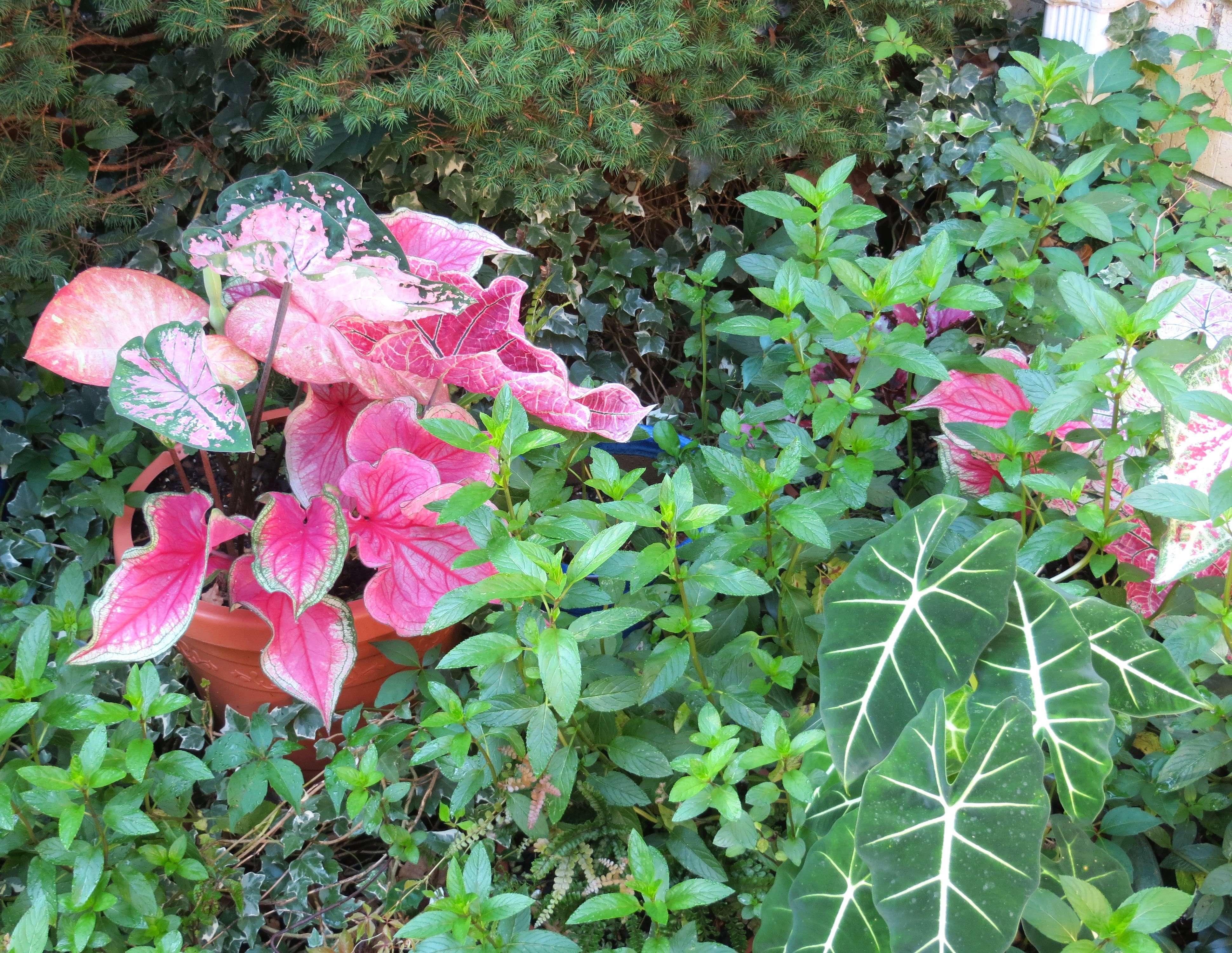
A variety of Caladiums grow near a pot of Alocosias. Mint grows up in this area of the patio, keeping snakes and other critters away. 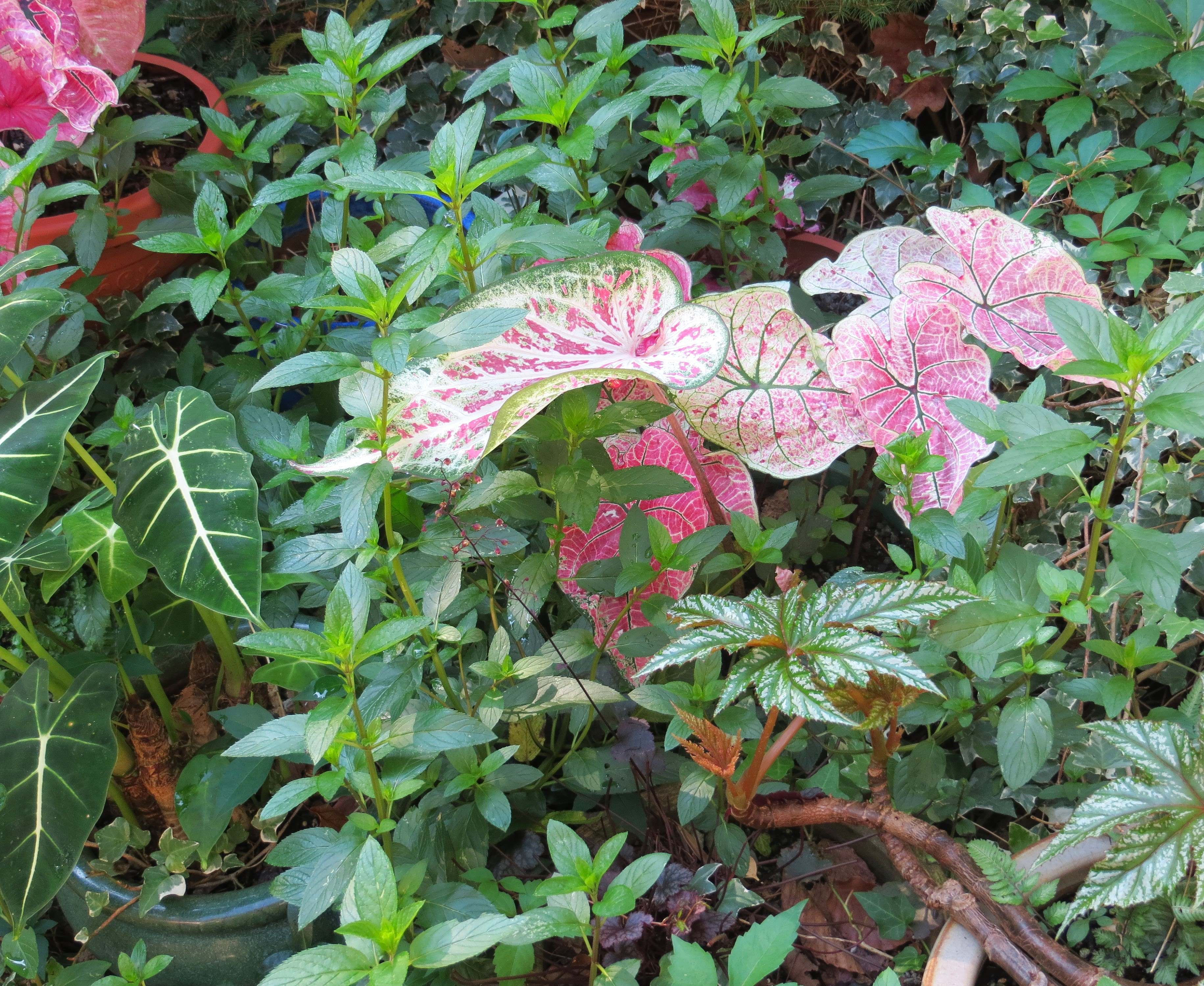
Various Begonias also grow in containers among the Caladiums. This B. ‘Gryphon’ recently fed some of our resident deer. 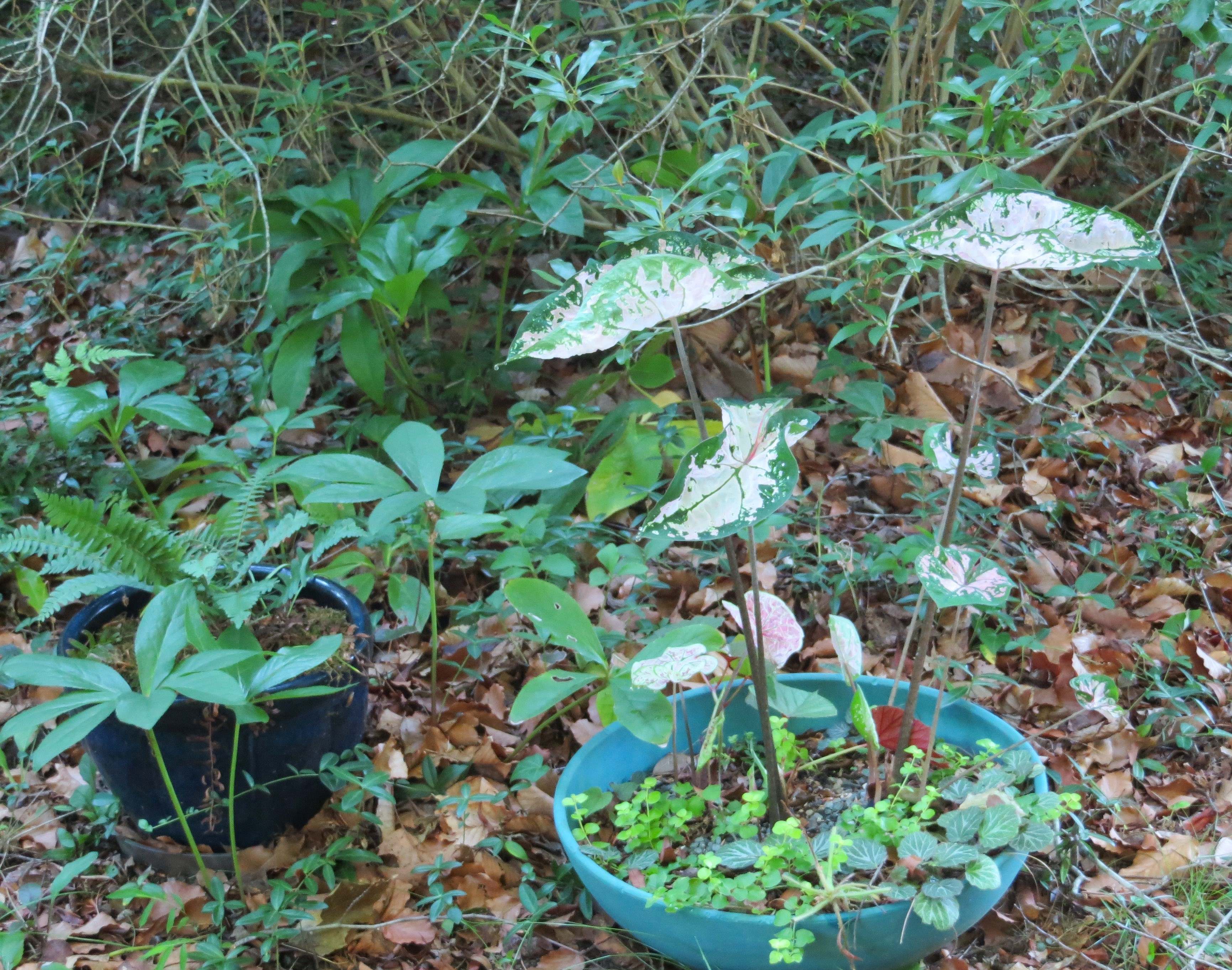
Strawberry Begonia shares this container with Caladiums. 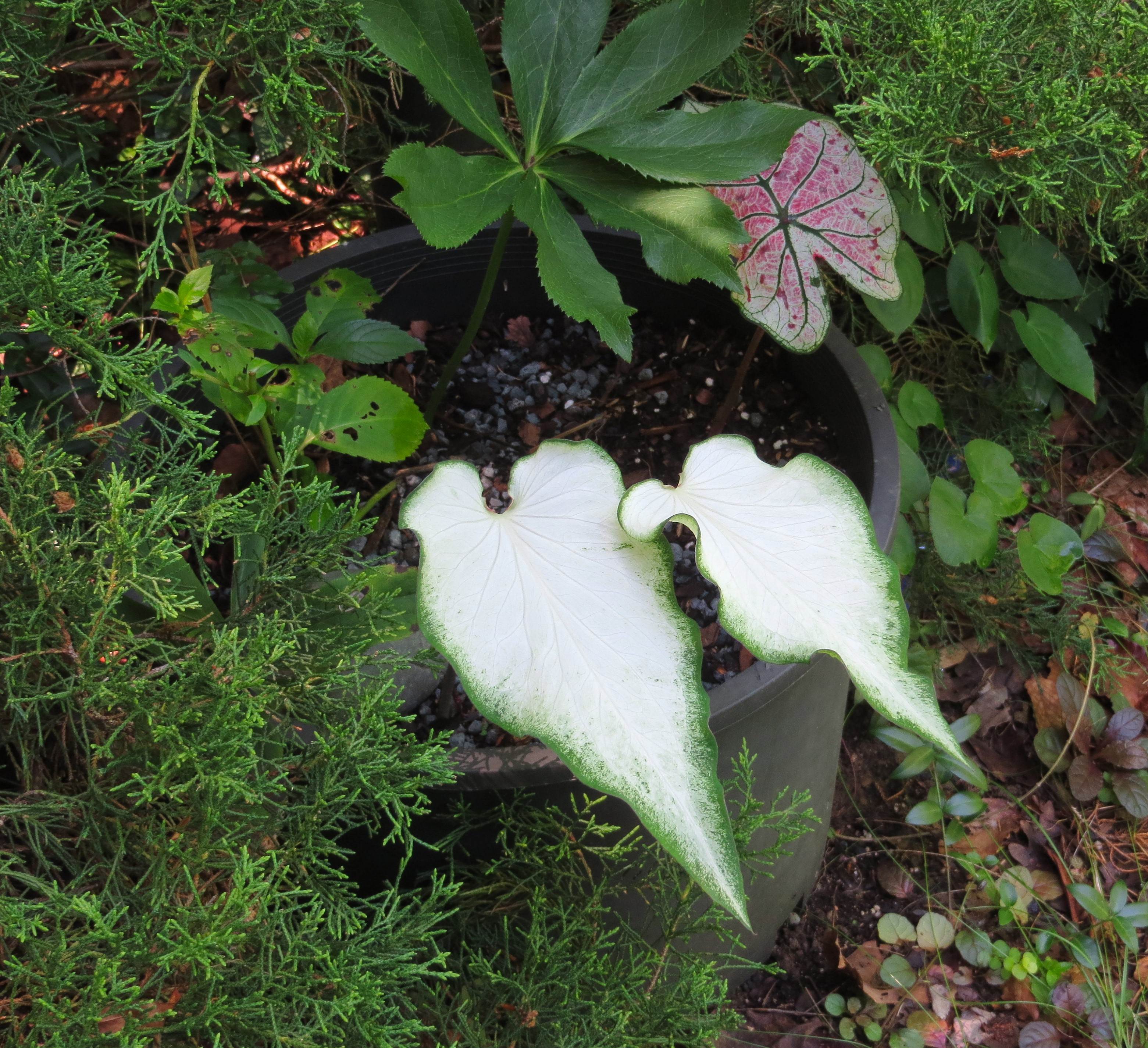
Caladiums want warm soil, over 60F and consistently warm weather to awaken in early summer. I waited to plant saved ‘bulbs’ until it warmed sufficiently outside instead of starting them indoors this year. So our first leaves are emerging this week. I did finally place an order with Classic Caladiums, my favorite grower in Florida, and those bulbs are all planted now but not yet leafing out. I am only planting the saved bulbs as they wake up and show signs of new growth, so I still have a pan of bulbs resting in moist potting mix and am planting out a few at a time. Saving the bulbs without sorting and labeling them means I haven’t a clue which is which at planting time. So the plantings of saved bulbs will be a bit chaotic, but always beautiful.
Caladium bicolor is native to South and Central America. It is extremely easy to growth in shade or part shade. Newer varieties are more sun tolerant than older ones, but dappled shade and morning sun seem to work best in our climate. Feed Caladiums for the best display. Newly purchased ‘jumbo’ bulbs put on a more spectacular show than saved ones, but mainly because larger bulbs produce more leaves to begin with. The leaves are the same size, color, and form whether the bulb is new or has been saved repeatedly over the years. So I make the effort to save the bulbs over the winter and enjoy seeing them emerge anew each year.
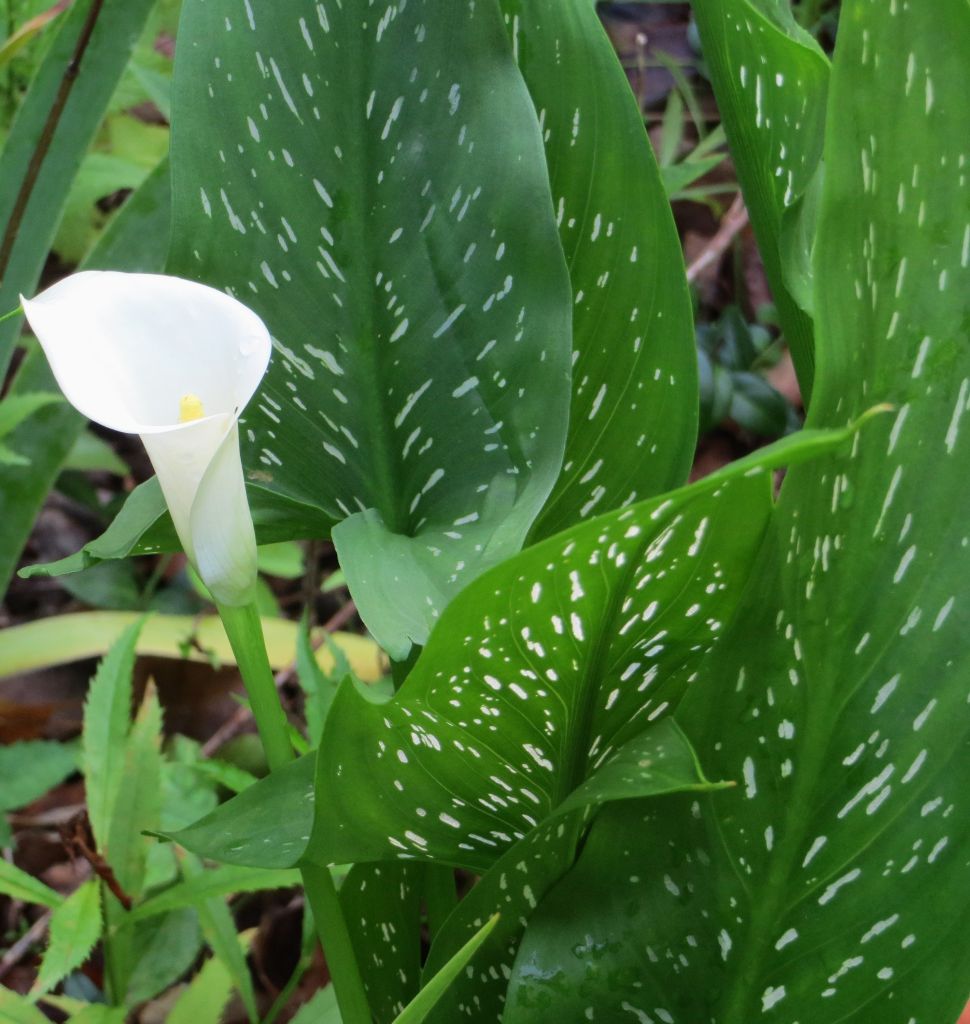
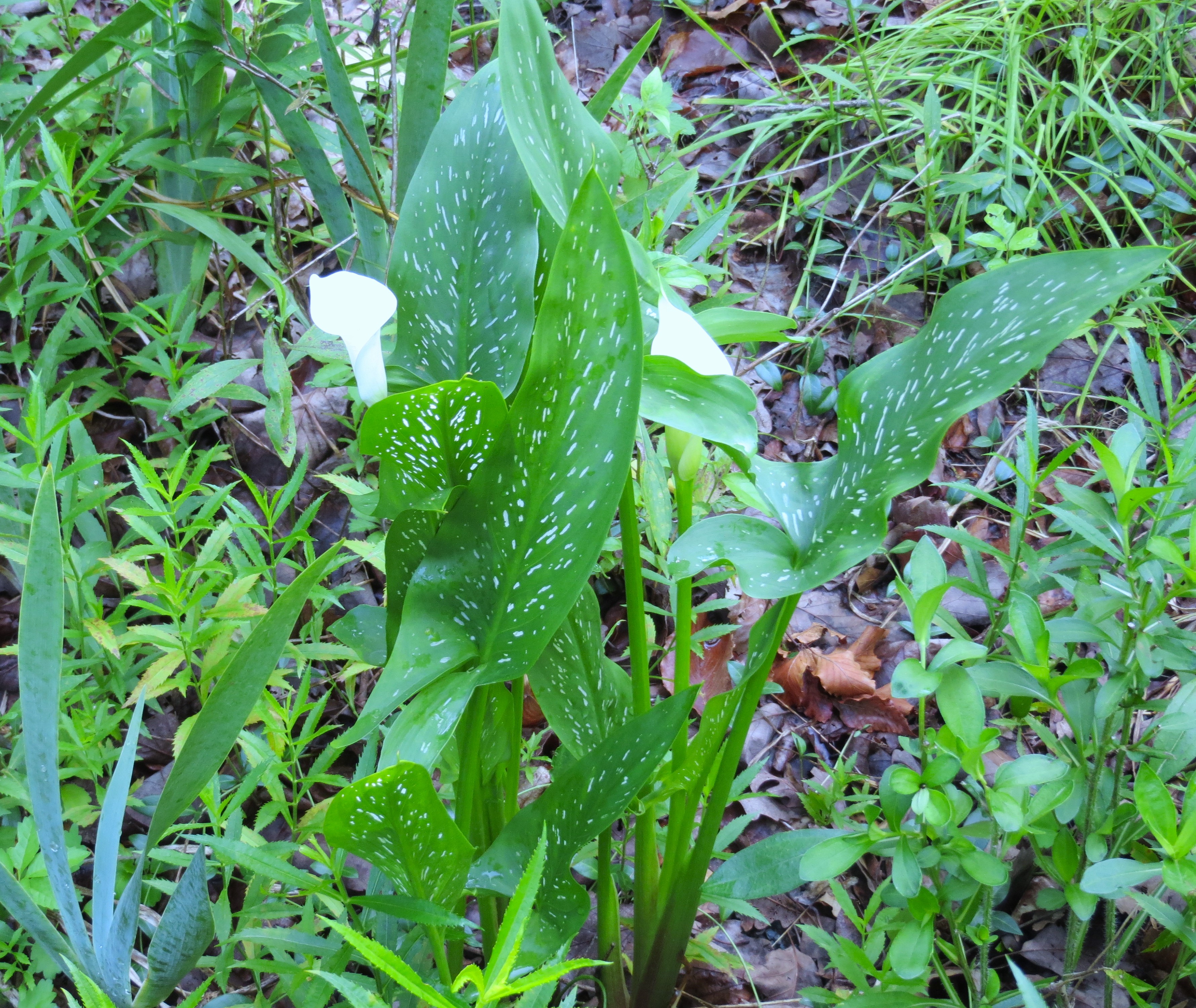
I have planted in a variety of Zantedeschia over the years. Some bloom faithfully and others not so much. These are the most ornamental of the aroid flowers we grow, although the white flowers are notoriously hard to photograph. Only a few white flowering plants have bloomed thus far, but we are enjoying the foliage of them all. We have other colors of Zantedeschia flowers that I hope will be blooming soon.
As is evident in the photo, these plants thrive while others that should be thriving are slow to fill in. The flowers are very elegant, but also very top heavy. They tend to fall over in heavy weather if not staked or supported. The flowers last for several weeks before fading and forming seeds in shiny, green fruits. I have never found any Zantedeschia volunteers growing from the seeds, however. The ‘bulbs’ grow larger each year, allowing the plants to expand as they mature.
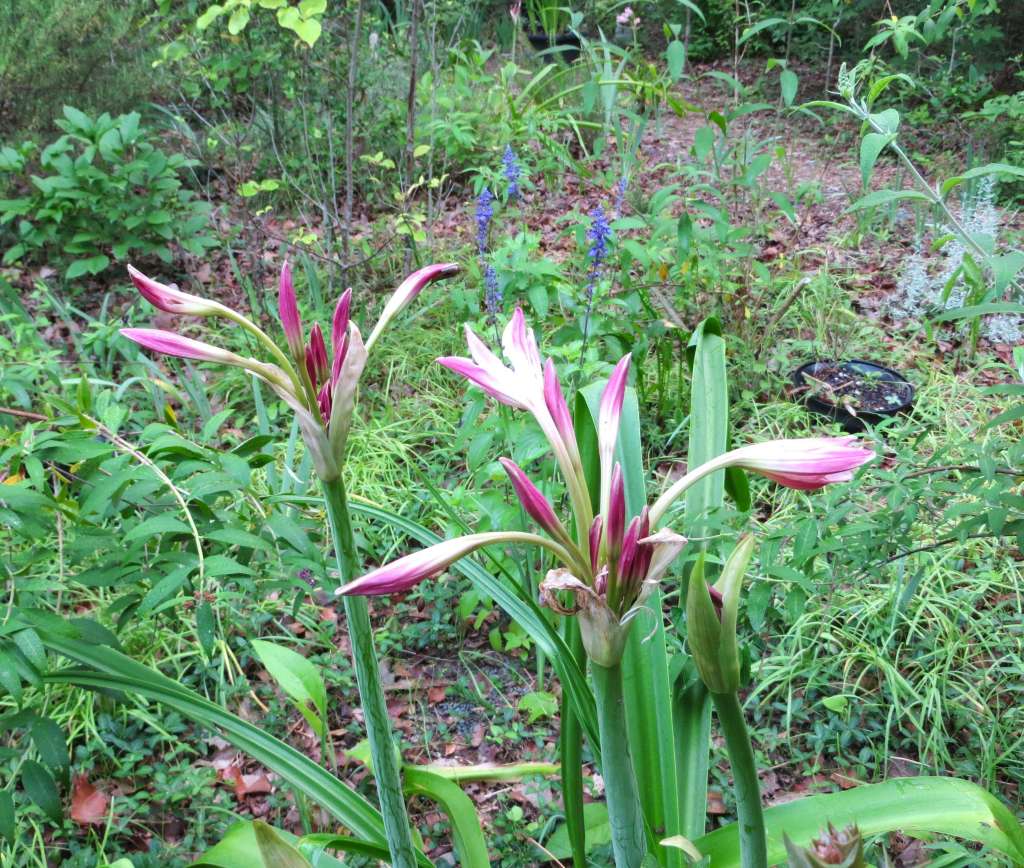
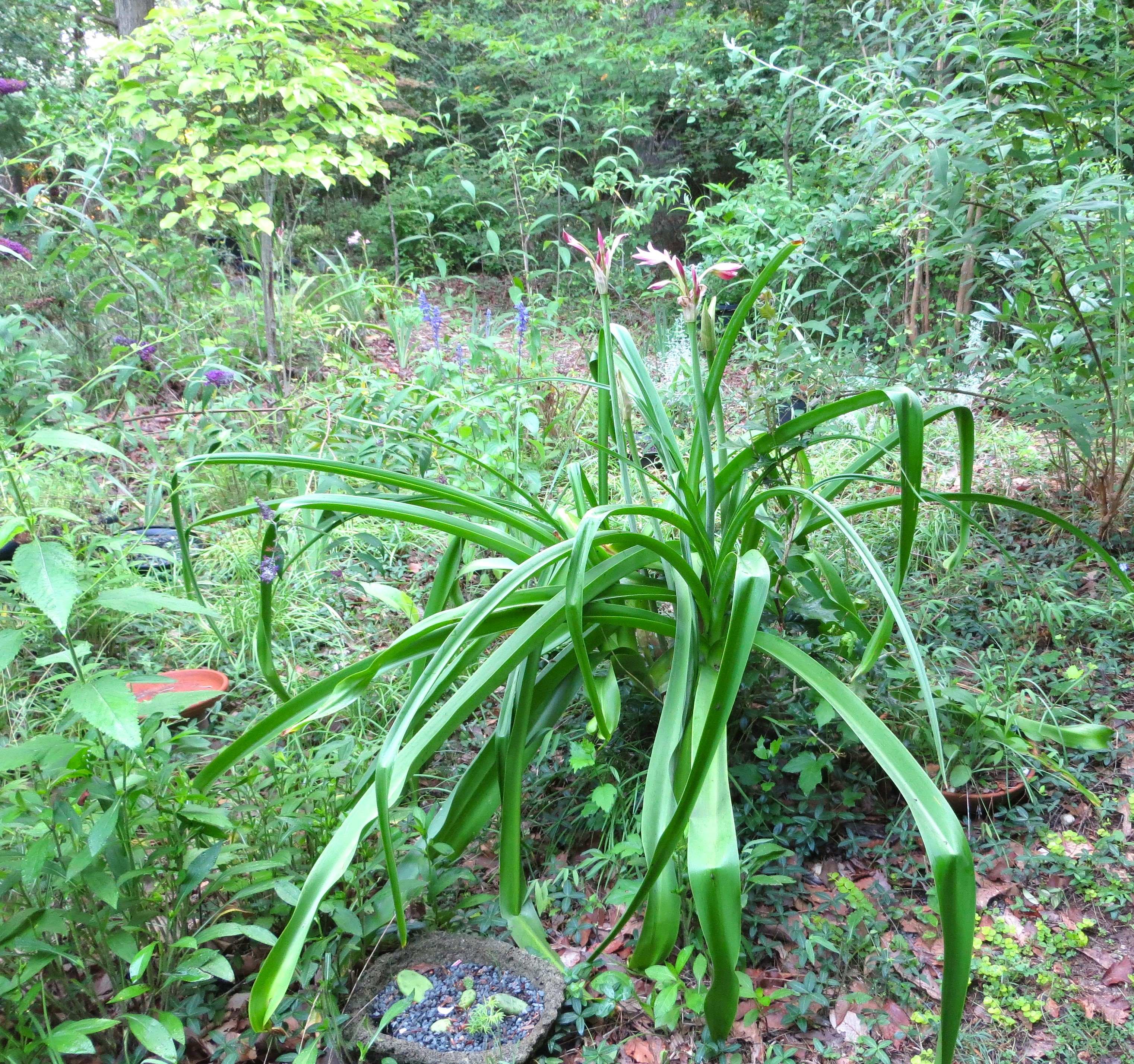
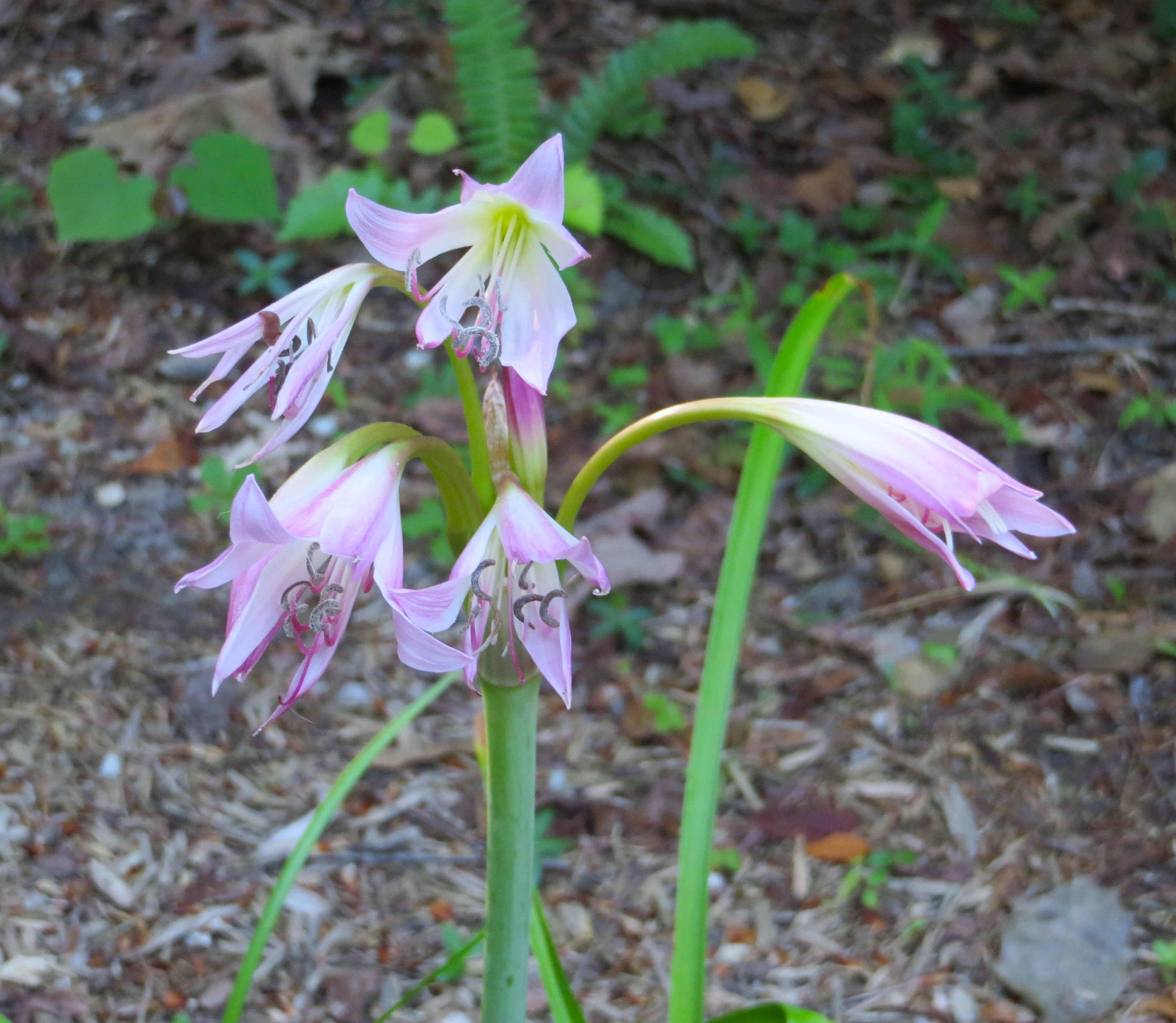
For those who love flowers, we will finish our weekly six today with Crinum x. powellii, which is a hybrid Crinum lily in the Amaryllis family. Another very hardy geophyte, these huge plants have huge bulbs that want to be left alone once planted. They bloom over a long season, producing multiple flowering stalks topped with buds that open a few at a time. Each flower lasts only a day before it fades, but the overall effect of the plant is stunning when it blooms. This is another basically ‘pest proof’ plant and several varieties are available, although most bloom in shades of pink or white. It is one of several Amaryllis family summer blooming lilies that grow well in our area.
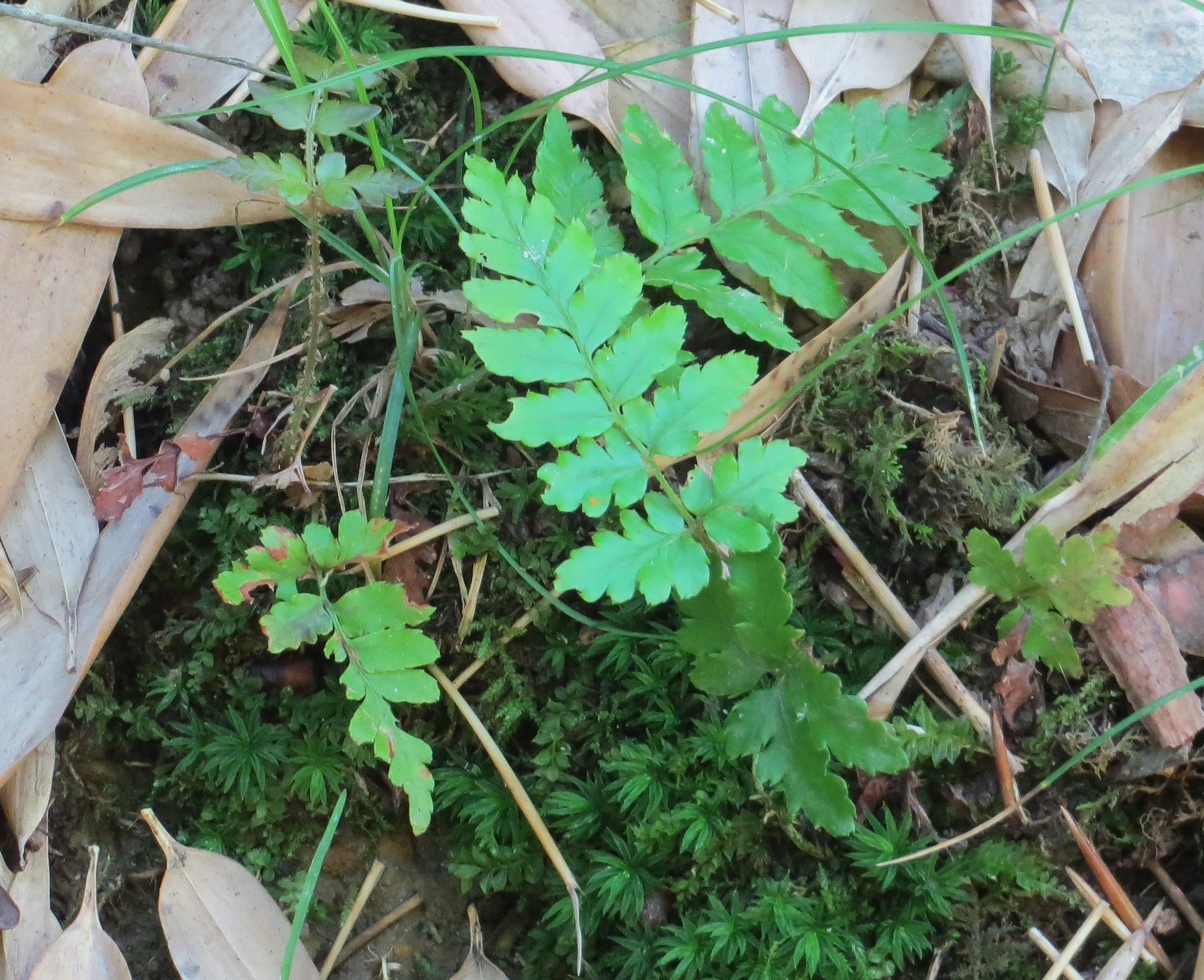
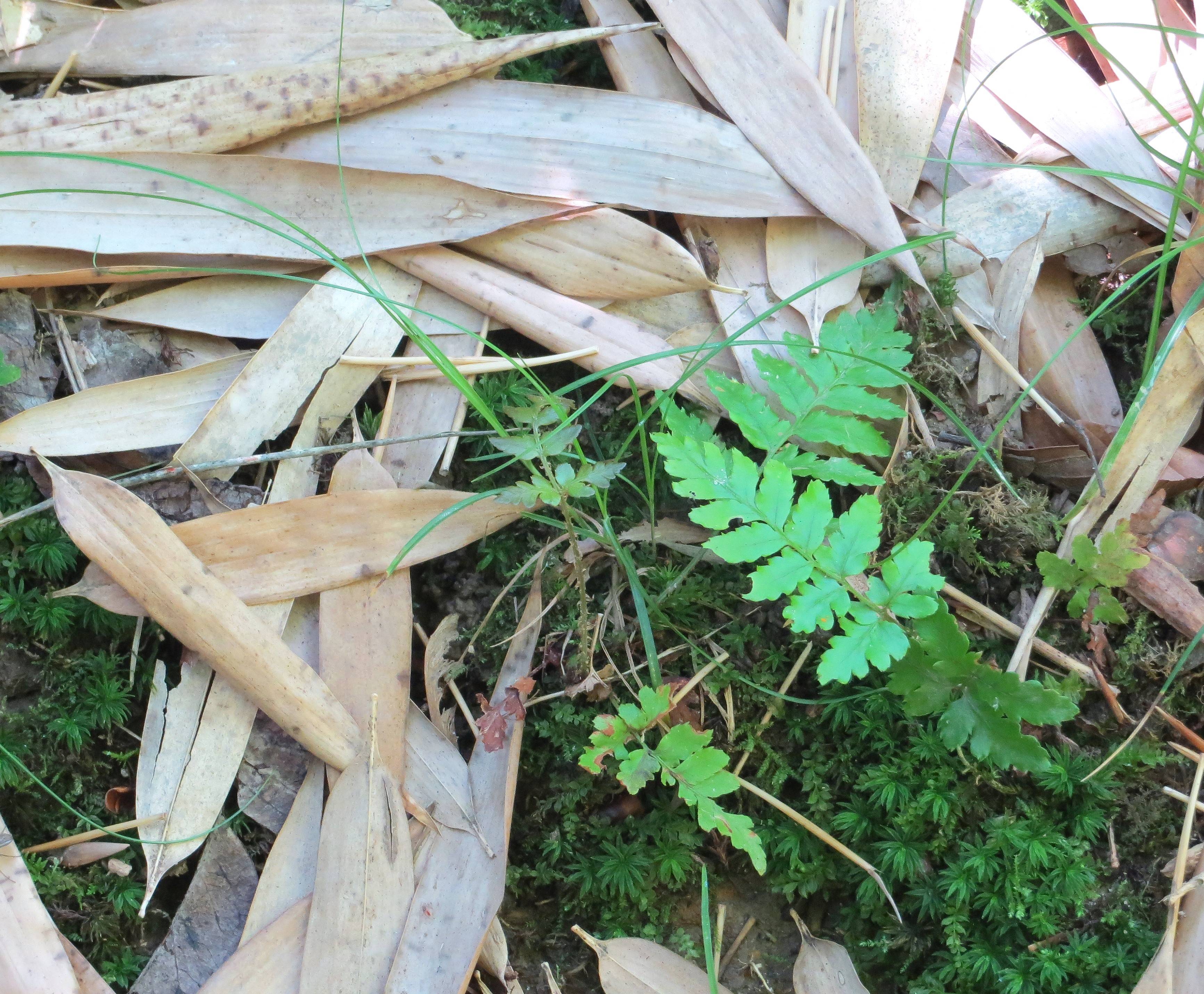
I want to close today with a 7th ‘bonus’ image of two volunteer sporelings that I found growing under our fig tree. They are most likely a Dryopteris species from spores that originated on our Dryopteris erythrosora ‘Brilliance’ which grows nearby, further up the slope. Although this is a native Japanese species of Dryopteris, it thrives in our climate and apparently can naturalize here. Most ferns first developed aeons ago when the continents weren’t divided as they are now. And so ferns of the same genus now growing on different continents were once all growing in the same general area under the same conditions. These are ancient plants and transcend the human borders and boundaries we want to impose today.
I have grown sporelings from collected spores in previous years, but these little surprise volunteers are a product of nature’s ingenuity. Please notice that they are growing out of the moss. In our garden, most of our sporeling volunteers develop within the moist protective embrace of mosses. We grow several different Dryopteris species, so it may be that these sporelings grow into something other than D. erythrosora. Time will tell…
With appreciation to Jim Stephens of Garden Ruminations, who
hosts Six on Saturday each week.

 Our Forest Garden
Crinum X powellii must be tough. Crinum bulbispermum, which is one of its parents, grows wild here, in a chaparral climate. I am not so keen on the color of bloom of ours, but I sort of wonder why something that is so reliable and its relatives are not more popular.
LikeLiked by 1 person
Tony, you would probably adore the white flowering Crinum. Yes, they are very tough and drought tolerant. Some of my older ones are now in more shade than is good and while their leaves are still lovely, they don’t bloom as much. These are sun loving lilies.
LikeLiked by 1 person
I do like the bloom, but not all their floppy foliage. Besides, crinum are the sort of flowers that are not necessarily best in white. They are all pretty, except for the Crinum bulbispermum that grows wild here.
LikeLiked by 1 person
I googled the C. bulbispermum and the photos of it I could find look attractive (to me). Perhaps it isn’t as good in person?
LikeLiked by 1 person
It probably is attractive. However, I am not so keen on it. The flowers are too big, but do not seem to open completely.
LikeLike
The Crinum that I grow allows the flowers to hang on for several days as they fade and turn brown, if I don’t get out there to deadhead. There are no pictures after the main plant actually bloomed because we had some heavy rain that night, and rain takes its toll on the blossoms, too. At least the deer tend to ignore it. I like, “It is probably attractive…” With so many choices of plant materials, why go with less than the best choice for a given situation?
LikeLiked by 1 person
Well, I relocated a few that I found out in the forest where no one could see them to an out of the way but visible situation within my own garden because I know that my neighbors will like them.
LikeLiked by 1 person
I’m growing sauromatum venosum here too : Its amazing and smelly flowering precedes the leaves, really very original. I love it!
Of course, lots of interesting things in your post this week, with an attractive bonus for me: the dragontail fern
LikeLiked by 1 person
Thanks so much, Fred. I often don’t notice the Sauromatum flowers when they bloom, but am going to look through last month’s photos to see whether maybe there is a photo to add to the post. They aren’t very showy or noticeable, but are quite interesting if you stop to appreciate them. Isn’t the little dragontail fern interesting? I am hoping to propagate it by spores or by rooting the frond tip.
LikeLiked by 1 person
Royal ferns are my favorite native fern, though maidenhair is a close second. Of course, I am certainly enamored with Japanese painted ferns in all their cultivars!
LikeLiked by 1 person
It is so hard to choose a favorite, isn’t it? Royal fern isn’t my favorite, but I’m happy to have a patch of them. I prefer the lacier ferns, like the JPF in all their cultivars ❤ ❤ ❤
LikeLiked by 1 person
I just went and looked at my Crinum x powellii to see if it had any flower buds; it hasn’t. I moved it last year so I’m not really surprised, though it looks to have settled in well enough. Such an enormous root system! I’ve moved Camellias as tall as me with less trouble. I moved it because the flower colour was jarring, even for me, with Dahlias for company. I envy your Caladiums, I have tried but I don’t think we have the necessary warmth.
LikeLiked by 1 person
Hi Jim, Planting a Crinum is enough work in our shallow soil. I can’t imagine digging one to transplant it. I can tell you that the bulb vendor I buy from cautions against trying to move them on their site because it does take some time for them to settle into their new space before blooming again. And the light has to be right- I have more clumps- now likely too shaded- that don’t bloom than clumps that do. These ladies are sun lovers! But don’t give up on your Crinum for summer 2025. They can throw up blooming stalks all summer long, and your may just be taking her time. I’m sure you have a little something to pour or sprinkle over her roots to encourage her. We adore the Caladiums and are very grateful that we can grow them here. You might be able to enjoy them for a few months if you have space and time to start them in your greenhouse. Some folks also treat them like houseplants, and we sometimes have a few leaves to enjoy, indoors, into the winter. They are easy so long as they are kept moist and warm. Good luck with your renovations and preparations for your next open days!
LikeLike